How to verify a NAATI translator’s credentials
Step 1: Check the NAATI stamp
The first thing to do is to check the NAATI stamp on your translated document. Every translation by a true NAATI-Accredited translator must contain an official NAATI stamp. If there is no stamp, the translation is not properly certified.
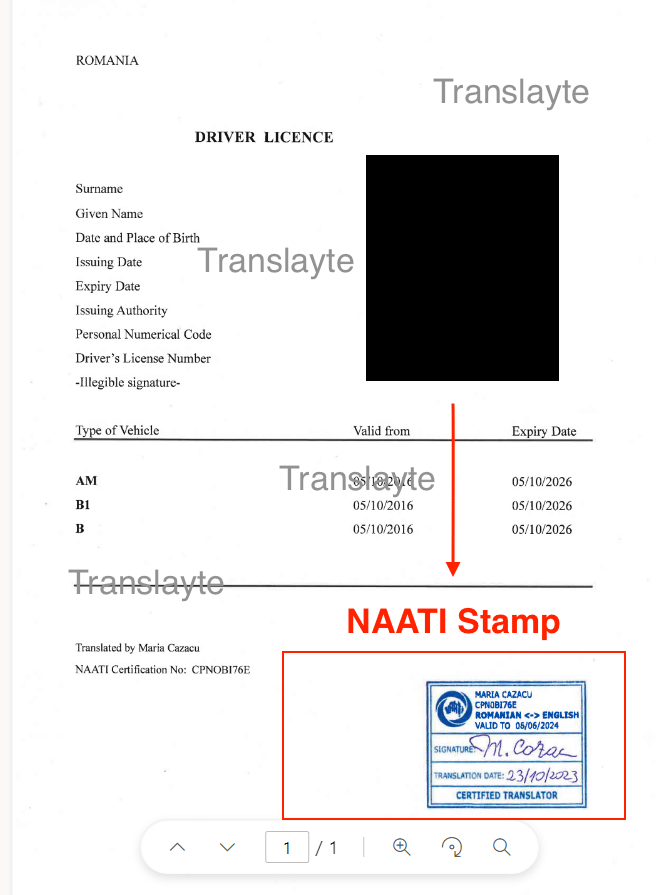
Additionally, the document must include the translator’s full name, their Certified Practitioner Number (CPN), language pair, signature, date, and certification statement confirming the translation is accurate.
Pay close attention to the language pair the translator listed. That is, if your document was translated from German to English, the translator must be certified to provide translations from German to English. If the language pair on the document doesn’t match the details in the NAATI directory, then it’s a red flag.
Step 2: Understand the Practitioner Number (CPN Explained)
All NAATI-Certified translators are issued a Certified Practitioner Number (CPN) and a translator stamp or ID card (physical or digital) to verify their credentials and work. The CPN is unique to every translator, and as such, no two people can share the same number.
A valid CPN is 9 characters long and always begins with “CPN” followed by a number, 2 letters, 2 numbers, and a letter, for example, CPN5LM67F.
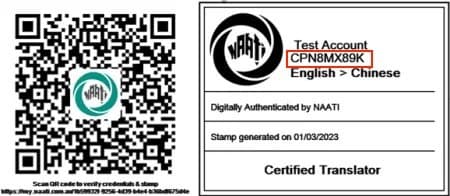
But some CPNs are made up entirely of numbers. These types belong to holders of an older accreditation system that is no longer in use. They are still valid, but most of the holders are not practising.
When reviewing a translation, check for the CPN on the translated document. You can also use it to verify the translator's identity in the official NAATI directory.
Step 3: Use the official NAATI verification tool
You can verify a translator’s credentials by using NAATI’s official online directory. Visit NAATI’s search tool and enter the translator’s Certified Practitioner Number (CPN). This will show all the credentials held by that person, including their working languages, certification status, and expiry date.
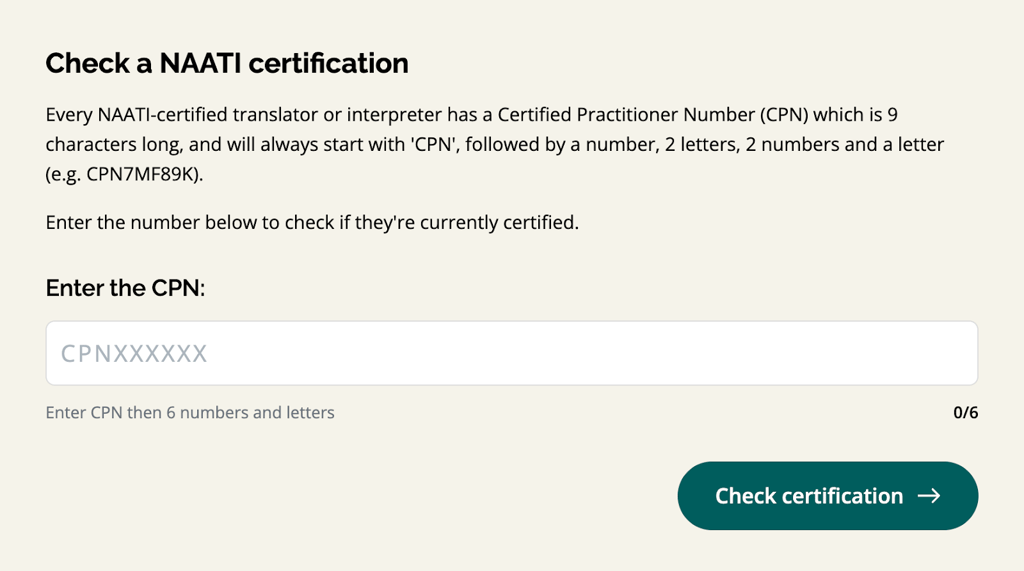
If the status shows “Current,” it means that the translator’s credential is active and valid. If it shows “Expired,” the translator has not renewed their certification, making their translation invalid.
Always confirm the credential is current at the time your translation is issued to avoid delays or rejection.
Understanding expiry dates and translation validity
NAATI translations themselves do not expire, and there is no set “validity period” on the translated document. What expires is the translator’s credential.
If a translation was done before the translator’s credentials expired, it remains valid. However, the translator must renew their certification to maintain their status.
But if a translation was done after a credential expired, it may be rejected by Australian authorities. The most important thing, however, is that the translator held a valid certification at the time of completing the translation.
It’s always best to verify a translator’s certification status before engaging them for their services.
Digital NAATI stamps and QR code verification
NAATI offers digital stamps to certified translators alongside physical stamps. These digital stamps contain a unique QR code that, when scanned, shows the translator's credentials and verification information.
This means that when you see the digital stamp on a translated document, you can scan the QR code to check whether the translator’s certification was active at the time the stamp was issued and to verify their details.
These QR codes only work for the day they’re created. So translators should download a new stamp on the day they complete the translation.
On the digital stamp, you’ll see “Stamp generated on XX/XX/XXXX” on the right-hand side. This replaces the “Translation date” that used to appear on the physical stamp.
When you scan the QR code, and it shows “Digital Stamp: Invalid,” it could be a red flag. As such, you should not submit the document. You can ask the translator or the translation agency for clarification or a replacement.
Red flags of a fake NAATI translation
No official NAATI stamp or signature
The stamp or signature looks copied or inserted as an image
The name, certification number, and language pair do not match the records on the official NAATI directory listing.
Has no Certified Practitioner Number (CPN)
Extremely low prices for certified translation services.
Handwritten or informal certification statement
The translator’s credentials had expired at the time of providing the translation
What happens if you submit a non-certified translation?
Simply, your documents may be rejected, and your application may be denied. Australian authorities rely on certified translations from NAATI-certified translators for quality assurance and accuracy. This helps them verify your documents and reach a decision about your application.
When you submit a non-certified translation, you’re taking away the validity of your translation. Authorities can’t verify that the information provided is accurate, and as such, may delay or deny your application.
To avoid this, it’s important to work with a trusted provider from the start. At Translayte, we work exclusively with verified NAATI-certified translators for Australian submissions. Every certified translation includes the correct stamp, practitioner details, and certification statement, so your documents meet official requirements the first time.
Conclusion
Sometimes, the accuracy of your translated documents can be the only thing standing between you and your dream in Australia. So, it’s best to get it right from the beginning.
Translayte is here to ensure your documents are accurately translated and include all the translator's details required for official use. We offer fast, reliable translations in 12-48 hours so you can meet urgent deadlines without worry.
Get started today. Upload your documents for a free quote.