What the subclass 462 visa pause actually means
A pause is a lodgement block, not a programme closure. Home Affairs sets an annual grant cap for each capped partner country, and lodgements open on 2nd July each year. The department says it may pause applications when a cap is nearly filled, to spread lodgements across the programme year, or to support the government’s migration settings.
Home Affairs Minister Tony Burke confirmed on 16th August that Working Holiday Maker visas were being processed more slowly than previously, but did not address the pause directly. Statuses can move between Open, Paused and Closed at any point during the 2026–2027 programme year, which runs to 30 June 2027. Indonesia and Mongolia were flagged as countries that may reopen later in the year.
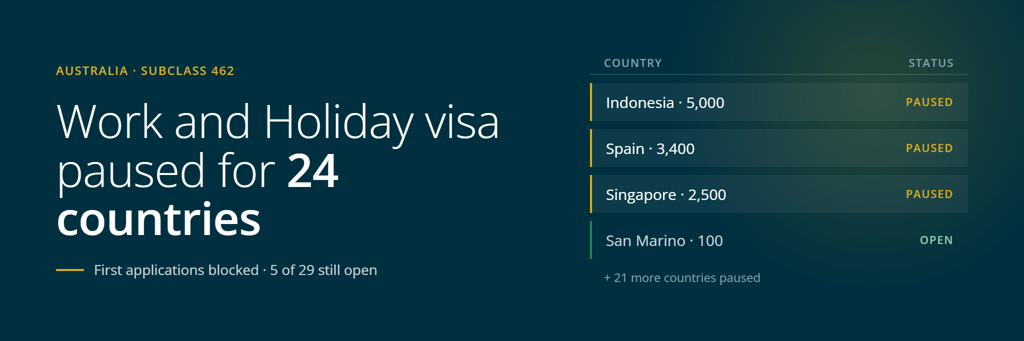
Which 24 countries are affected by the work and holiday visa pause
Country | Annual cap | Country | Annual cap |
|---|
Argentina | 3,400 | Mongolia | 100 |
Austria | 500 | Papua New Guinea | 100 |
Brazil | 500 | Peru | 1,500 |
Chile | 3,400 | Poland | 1,500 |
Czech Republic | 500 | Portugal | 500 |
Ecuador | 100 | Singapore | 2,500 |
Greece | 500 | Slovak Republic | 1,000 |
Hungary | 500 | Slovenia | 200 |
Indonesia | 5,000 | Spain | 3,400 |
Israel | 2,500 | Switzerland | 200 |
Luxembourg | 100 | Thailand | 2,000 |
Malaysia | 1,100 | Uruguay | 1,500 |
Why Australia paused work and holiday visa applications
Officially, the pause is demand management tied to annual country caps. Unofficially, most commentary connects it to net overseas migration. A former deputy secretary of the Department of Immigration has argued that slowing processing is a poor instrument for reducing NOM: it does not reduce the number of valid applications; it simply builds a backlog that must still be worked through.
The move drew immediate political criticism, with the Opposition arguing that backpackers are not the cohort straining urban housing, and that regional pubs, farms and tourism operators depend on them. There were 206,187 working holiday-makers in Australia as at 30 June 2025, contributing an estimated $3.2 billion annually, roughly $726 million of it spent regionally.
Who is not affected: subclass 417, ballot countries and second visas
Subclass 417 Working Holiday visa holders. The separate uncapped 417 stream covering 19 partner countries, including the UK, Canada, France, Japan and South Korea, remains open, though processing has slowed since 1 July.
San Marino and Türkiye. Both remain open with 100 places each on a first-in, first-served basis.
China, India and Vietnam. These operate through a pre-application ballot rather than open lodgement, so the pause mechanic does not apply in the same way.
Second and third 462 applicants. Country caps apply only to first visas, so eligible applicants may still lodge a second or third Subclass 462 application.
Working holiday-makers already onshore. Existing visa holders are unaffected.
The reopening problem no one is talking about
Coverage so far has concentrated on the pause itself. What has been largely overlooked is what happens when a country flips back to Open, and that is where applicants actually lose places.
Capped countries operate first-in, first-served. A pause does not suppress demand; it accumulates it.
When Indonesia’s 5,000 places or Spain’s 3,400 reopen, they reopen against a queue built over weeks, into a cap already partly consumed. Lodgement speed becomes decisive, and the only part an applicant controls is whether their document set is complete, translated, and ready to upload the moment the status changes.
A second, quieter risk is that documents expire. Home Affairs accepts police certificates issued in the 12 months before you apply, and health examinations also have limited validity. An applicant who assembled evidence for an early-July lodgement and is still waiting in October may find they must re-obtain and re-translate parts of it before they can lodge them at all.
Certified translation requirements for Australian visa applications
Any document that is not in English must be accompanied by an English translation. The standard Home Affairs applies depends on where the translator is based, and this distinction matters for 462 applicants because most of them are applying from outside Australia.
Translators inside Australia
Translations produced in Australia must be completed by a NAATI-certified translator, and the translation must include that translator’s NAATI practitioner number. This applies to onshore applicants and to anyone already in Australia lodging a second or third visa or a different visa class.
Translators outside Australia
Offshore translations do not require NAATI accreditation, but must carry the translator’s full name, address, telephone number, and details of their qualifications and experience in the relevant language. Omitting those details is a common and entirely avoidable cause of a “request for further information”, which is costly in a first-in, first-served queue in a way that has nothing to do with money.
Which documents typically need translating
Birth certificate and national identity documents
Police clearance certificates from every country of residence
Bank statements and evidence of sufficient funds
Educational transcripts and qualifications, where the applicant relies on study to meet eligibility
For second and third visas: payslips, employment letters, tax statements and other specified-work evidence
Translation out of Australia matters too
The corridor runs both ways, and it is routinely underestimated. Working holiday-makers already onshore who pivot into a student visa, a skilled or partner pathway, or simply back home generally need Australian-issued documents, police checks, academic transcripts, employment references, marriage certificates and driver licences translated from English.
Translayte’s data reflects both directions. NAATI-certified translation makes up a substantial, consistent share of our overall certified volume, with Australia the dominant ordering market. Within that segment, the paused countries are well represented, with Spain, Indonesia, Austria, Switzerland and Chile leading, and the source languages map onto that list precisely: European and Latin American Spanish, Indonesian, German and Austrian German, Malay and Brazilian Portuguese. Outbound, Australian-origin orders flow consistently into Italian, French, Spanish, German and Croatian. One caution for anyone weighing alternatives, pivoting to a student, skilled or partner visa increases the translation burden rather than reducing it.
What applicants should do during the pause
Check the official Home Affairs country-cap status regularly. It is the only authoritative source, and it changes without announcement.
Do not book non-refundable travel assuming your country will reopen. No reopening date has been published.
Assemble and translate your document set now, not after the status changes. This is the most valuable use of the pause period.
Check validity windows on police certificates and health examinations, and time any re-issuance so documents are current at reopening.
Confirm you are actually affected. Second- and third-visa applicants, 417-eligible nationals, and ballot-country applicants sit outside the pause.
If considering an alternative visa class, budget for a heavier documentation and translation load.
.png)