Can a foreigner get a Switzerland driving license?
You can get a Swiss driving license for foreigners if you are 18 years or older. Switzerland allows foreigners to drive using their foreign license for up to 12 months. After that, you must exchange it for a Swiss one. Foreigners with a license from EU/ EEA countries (Iceland, Norway, and Liechtenstein) can complete the exchange without taking a Swiss driving test. But if your license is from a non-EU/EEA country, you may be required to apply, and pass the theory and practical driving test.
If you don’t have a driver's license in your home country, you can get one by following Swiss requirements. Unlike exchanging your local license, this process has more steps and requirements. It includes taking a first-aid course, an eye control test with a specialist, and passing a driving theory and practical test.
Note: During the 12-month grace period, if your license is not issued in German, French, Italian, or English, you must carry either:
A valid International Driving Permit (IDP) alongside your original license,
A certified translation of your license completed by an official translator (notary, issuing authority, or approved professional translator).
When you apply to EXCHANGE your license, the IDP alone is not sufficient - you must provide a certified translation of your original license as part of your application documents. This translation must be done by an official service (e.g. the local authority responsible for issuing the national driving license, a notary, or an approved professional translator).
Who needs to exchange their license in Switzerland?
In Switzerland, you need a Swiss license if you reside there for more than 12 months. These rules apply to the following categories:
New residents: If you have just taken up residence in Switzerland for over 12 months, you must exchange your driver's permit to continue driving there. This requirement is mandatory for drivers with EU, EEA, and other foreign countries' driving licenses. However, for non-EU/EEA countries, you must confirm if your country has a reciprocity agreement with Switzerland. If they don’t, you must apply for a standard Swiss driving license.
Government employees without legitimation (diplomatic) status: Foreign license holders with the B, C, D, E, or P-type "carte de légitimation” are exempt from exchanging driving permits. Others must comply within the 12-month validity period.
Professional drivers: If you drive professionally, you must exchange your driver's license in Switzerland. However, unlike others, you must complete the exchange process before driving professionally.
Holders of F, N, or S residence permits (temporary protection, asylum seekers, and provisionally admitted persons): The Road Traffic Office sends your driving license to the State Secretariat for Migration (SEM) for processing, rather than issuing a Swiss license directly. Contact your canton’s Road Traffic Office for specific guidance.
Note: The 12-month clock applies to residents only. If you are visiting Switzerland for less than 12 months and are not officially registered as a resident, you may drive on your foreign license for the full duration of your stay. The grace period starts from your official registration date at your Swiss municipality.
Recommended Reading
How to Translate Your Driver's License for the DMV
Who is exempt from converting their driver’s license in Switzerland
If you are visiting Switzerland briefly, you can drive with a valid foreign license without exchanging. However, your stay time must be less than 12 months.
Additionally, foreigners working as members of permanent missions (PM) and international organisations (IO) are exempt from the obligation to exchange driving permits. They include:
Heads of mission (PM): Members of the senior management (IO) (holders of a "B" legitimation card)
Diplomatic agents (PM): High-ranking officials (IO) (holders of a "C" legitimation card)
Administrative and technical staff members (PM): Officials in a professional category (IO) (holders of a "D" legitimation card)
Service staff members (PM) - Officials in general services (IO) (holders of an "E" legitimation card)
Civil servants on short-term contracts (holders of a "G" legitimation card)
Non-Swiss members of the personnel of the ICRC (holders of an "I" legitimation card)
Non-Swiss members of personnel of the IFRC (holders of an "L" legitimation card)
Members of the scientific personnel of CERN (holders of a "P" legitimation card)
Family members of the categories mentioned above (holders of a legitimation card or a Ci permit)
Note: This exemption is limited to licenses for motor vehicle categories A (motorbikes) and B (motor cars and motor tricycles whose total weight does not exceed 3500 kg and whose seating capacity, in addition to the driver's seat, does not exceed eight persons). It does NOT cover professional or heavy vehicle categories (C, D, etc.).
Countries with reciprocal agreements with Switzerland
Switzerland has recognition agreements with European countries and other states that exclude you from getting a driving test. Some countries include:
EU / EEA (Direct Exchange — No Test) | Germany, Austria, France, Italy, Spain, Belgium, Netherlands, Poland, Czech Republic, and all other EU/EEA states (Iceland, Norway, Liechtenstein) | No theory test, no practical test. Direct exchange. |
Recognition Agreement — Kontrollfahrt Only | Australia, Canada, USA, Japan, New Zealand, Israel, South Korea, Singapore, Taiwan, Morocco, Tunisia, Monaco, Andorra, Saint-Martin | Practical control drive (Kontrollfahrt) only. No theory test. One attempt only - failure means full process. |
All Other Countries | Any country not listed above (e.g., India, China, Brazil, Pakistan, Indonesia, Philippines, most African and Middle Eastern countries) | Full theory test + practical driving test. Plus mandatory first-aid course and eye test. |
Recommended Reading
Driving license Translation by NAATI-Approved Translators
Documents needed to convert your international driving license in Switzerland
The documents required for exchanging foreign driver's licenses in Switzerland include;
Application form
Valid foreign driving license
Valid Passport/ID
Swiss residence permit
Eye test certificate
Coloured passport photo with dimensions 35 X 45 mm
A certified translation of the original license if it’s not in one of Switzerland's official languages or English.
Medical certificate for people who drive professionally or are over 75 years old
If you are driving professionally, you might need a criminal records statement, depending on the canton.
Confirmation of examination date from your home country driving license authority. This is required if it's not included in your original license.
Kontrollfahrt appointment confirmation (if your country requires a practical control drive)
Proof of driving experience if applying after 5 years of Swiss residency (e.g. rental receipts, travel records showing you have been driving).
Note: Different cantons in Switzerland might have unique requirements besides those listed above. Confirm from the cantonal Road Traffic Office (Strassenverkehrsamt) near you before proceeding.
How can Transalyte help you drive in Switzerland?
Switzerland requires that any driving license not issued in German, French, Italian, or English must be accompanied by an official certified translation. The translation must be completed by:
The local authority responsible for issuing the national driving license in your home country, or
A notary, or
An approved professional translator
Translayte provides certified translations of foreign driving licenses accepted by Swiss cantonal Road Traffic Offices. Translations are delivered within 12–48 hours and meet Swiss authentication standards. We offer;
Certified translation services accepted by Swiss authorities
Access to authorised translators fluent in the required languages
Transparent and competitive translation rates from $25 per page
Online ordering process with multilingual support
Additional services like notarised translation, apostille stamps, plus delivery by post
Fast delivery timeline from 12 to 24 hours, depending on the volume.
Request a free quote to get accurate pricing.
Recommended Reading
How To Get An Apostille On Documents Issued In Switzerland
Step-by-step process: How to get a Swiss driving license for foreigners
The application steps for exchanging a license from a foreign country in Switzerland are straightforward if you meet the requirements. Here are the steps
Before submitting your application, confirm:
Your foreign license is still valid, expired licenses cannot be exchanged.
You are within 12 months of your official Swiss registration date (not your date of physical arrival).
If your license is not in German, French, Italian, or English, you have obtained a certified translation.
You have booked your eye test with a certified optician (results must be on a standard Swiss form).
For countries requiring a Kontrollfahrt: You have booked your control drive through the cantonal Road Traffic Office before submitting.
Step one: Complete the application form
You can get and fill out the application form from the cantonal Road Traffic Office near you. The form is mostly available online for download and contains relevant information.
Step two: Submit the application
When you complete the form, you should submit your application and the required documents. These often include a valid foreign license, a translated version if it's not in the official Swiss national language or English, and other information. You can submit the application in person or by post, depending on your canton. For example, if you reside in Solothurn, you can submit by post. However, you must submit the application form in person if you are in Bern.
Step three: Take a driving test or a control ride
If your license was issued in a country outside the EU/ EEE or doesn’t have a recognition agreement with Switzerland, you will need a driving test. This depends on the canton and its requirements. The driving test may include a theory test and/or a control ride, which might be practical. Ensure you prepare by studying Swiss driving rules and getting a qualified driving instructor, as failing the test means you start all over.
Step four: Pay the required fees
The Switzerland driving license cost often ranges from CHF 80–150 for standard licenses; heavier categories may cost CHF 150–200. However, it varies between cantons. Other certificates, such as eye tests, certified translations, medical exams, and Kontrollfahrt, may incur extra charges.
Step five: Receive your Swiss driving license
Once your paperwork (and any tests) are approved, your Switzerland driver's license is processed. Processing times vary by canton. Typical timeframes:
Standard exchange (EU/EEA): 1–3 weeks after submission
Kontrollfahrt countries: 3–6 weeks (including test scheduling time)
Full test countries: 2–4 months (including theory + practical test scheduling)
You will receive your submission receipt as temporary proof while the license is processed. Keep it, you may need to show it to the police. When your Swiss driver’s license is issued, the foreign one is destroyed or returned to your local driver's licensing authority.
Switzerland driving license cost
Cost Item | Estimated Cost (2025–2026) |
Exchange application fee | CHF 80–200+ (varies significantly by canton; e.g. Basel-Landschaft CHF 80, Solothurn CHF 200–500) |
Eye test (certified optician) | CHF 15–30 |
Certified translation of license (if required) | CHF 60–150 depending on provider and page count |
Kontrollfahrt (practical control drive) | CHF 100–200 depending on canton |
Theory test (if required) | ~CHF 40 |
Practical driving test (if required) | CHF 100–150 |
Driving lessons (if needed) | CHF 80–110 per hour (no minimum hours required by law) |
Passport photo | CHF 5–15 |
Do you need a driving test in Switzerland?
Whether you have to take a driving test depends on where your license was issued. Here’s what you should know
EU/EFTA licenses: No test required
Agreement countries (e.g., USA, Canada, Japan, Australia) require a control drive (“Kontrollfahrt”), which may be needed, but there is no theory test.
Exception countries may require a theory test only if holding professional categories (C/D/B for passenger transport)
All other countries must take both the theory and practical tests.
Practical tests for Category A and B licenses must now include at least 45 minutes of driving on open roads. You typically have one attempt at the control drive; failure means retaking full tests.
Recommended Reading
15 Driving Test Tips to Help You Pass the First Time
What happens to your foreign license after exchange
Once your Swiss license is issued, your foreign license is NOT returned to you. Here is what happens:
EU/EEA licenses: Your original license is sent back to the issuing authority in your home country and marked as ‘exchanged’.
Third-country licenses (non-EU/EEA, non-agreement): Your foreign license is marked ‘not valid in Switzerland’ and returned to you. You keep the document, but it is no longer usable for driving in Switzerland.
Practical implication: If you plan to drive in your home country during visits back, confirm whether your home country requires you to hold a local license or whether your Swiss license is recognised. If not, you may need to re-obtain a license from your home country upon return.
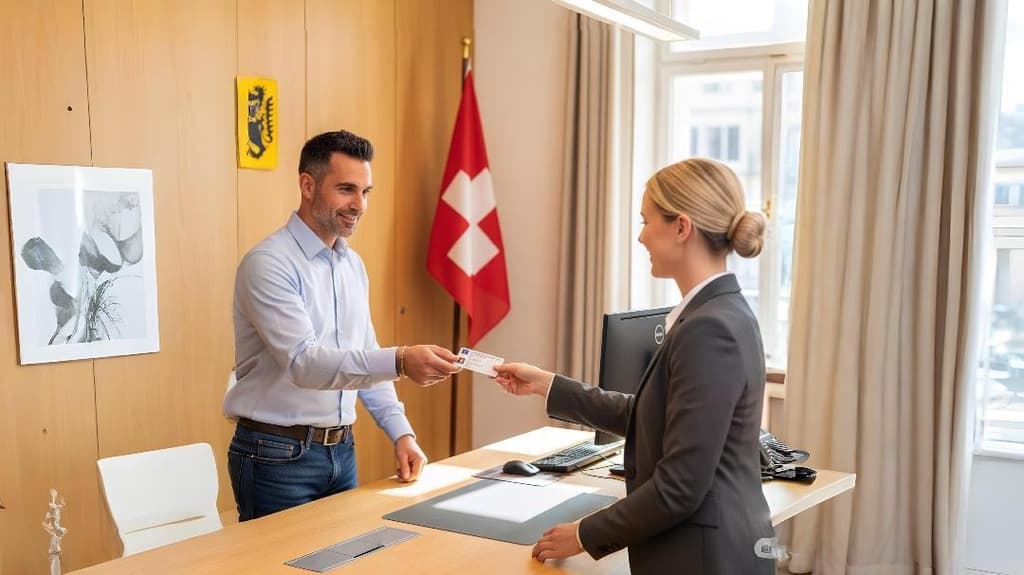
Deadlines & validity for converting a license in Switzerland
Switzerland has some deadlines and validity requirements for foreign driver’s licenses. Here’s what you should know;
12-month driving period: After obtaining residence in Switzerland, you may drive with your foreign license for up to 12 months. However, you must exchange it within this time if you drive often, or risk fines and other issues. Penalties include:
Fine of up to 360 daily rates (maximum CHF 3,000 per day rate, depending on income)
Six-month driving ban
Your foreign license is revoked in Switzerland
You cannot apply for a Swiss license during the ban period
In cases of repeat offence, imprisonment of up to three years is possible
Insurance may refuse to cover you in an accident.
It is still possible to exchange your license after the 12-month period (within the 5-year window), but you must stop driving immediately and cannot drive again until the Swiss license is issued.
Exchange application requirements: You can apply for a license exchange after the one-year grace period. However, this only applies if the foreign license is still valid in your home country. If the license is invalid, you must go through the standard process of applying for a Swiss driving license.
5 years eligibility period: After moving to Switzerland, you can still apply to exchange your license for a Swiss one within a 5-year window. However, you aren’t allowed to drive within that period. Beyond the 5-year window, you must prove ongoing driving experience (e.g., rental receipts, travel) or pass a Kontrollfahrt (control driving test).
3-year validity: After submitting your foreign driving license exchange application, you might receive a Swiss license on a 3-year trial basis or without an expiry date.
Note: Paper (blue) Swiss driving licenses became invalid on 1 November 2024. If you exchanged your foreign license before this date and received a paper Swiss license, you must exchange it again for a credit-card format license. Failure to do so risks a fine of CHF 20 at a police check. Contact your cantonal Road Traffic Office to arrange the free exchange.
Where to apply for a Swiss driving license exchange
You can exchange a foreign driving license for a Swiss one at the local traffic office in the canton where you reside. Each canton might have unique requirements for submitting applications or documents you need. You can usually book an appointment through their online portal or in person if they don’t have an online booking portal.
Canton-specific requirements comparison
Canton | Exchange Fee (CHF) | Submission Method | Processing Time | Notes |
Zurich | ~CHF 100–120 | In person or post | 2–3 weeks | Book online via ZH traffic office portal |
Geneva | ~CHF 150–200 | In person required | 2–4 weeks | Appointment required; French-language forms |
Bern | ~CHF 120–140 | In person required | 2–3 weeks | Must attend in person (no post option) |
Solothurn | CHF 200–500 | Post | 1–3 weeks | Highest fee canton in Switzerland |
Basel-Landschaft | CHF 80 | Post | 1–2 weeks | Lowest fee canton; post submissions accepted |
Note: Verify current fees at your canton’s Strassenverkehrsamt (Road Traffic Office) before applying
Recommended Reading
Foreign Driving license Exchange in France
Tips to avoid mistakes when converting a foreign driving license in Switzerland
Start your application early, ideally within the first few weeks of arriving in Switzerland.
Get the eye test from a certified optician early; the results must be recorded on your application.
If your license isn’t in German, French, Italian, or English, you’ll need an official translation (e.g., via a public notary or qualified translator/ translation company). Some cantons may accept English; however, check with the local Road Traffic Office.
Confirm test language options in your canton for theory and practical tests. The language formats can vary, so it’s best to be prepared.
Check canton-specific documentation and fees before you apply to avoid missing specific medical certificate requirements.
Pro Tip: If anything is unclear, such as fee amounts, form translations, the need for tests, or processing timelines, contact your Canton’s Strassenverkehrsamt. You'll get more detailed information for your situation.
Get certified translation services for your foreign driver’s license and other supporting documents. Request for a free quote.