Do you need a visa for Germany?
This depends on a few factors, explained below;
EU, EEA, and Swiss citizens: You do not need a visa for any length of stay or purpose.
Nationals of 62 visa-exempt countries: You do not need a visa for short stays of up to 90 days. However, for stays longer than 90 days, such as work or study, you will need a national visa (Type D).
All other nationals: You’ll need a visa for any stay in Germany. The specific visa type depends on the purpose and duration of the stay.
Note: A long-stay visa does not cover the full duration of a long-term stay. After arriving in Germany on a national visa, you must apply for a residence permit at the local Foreigners’ Office (Ausländerbehörde). The visa is your entry document; the residence permit is what authorises your continued stay. Additionally, Germany is expected to introduce ETIAS from 2027. Once launched, visa-free travellers will need online travel authorisation before entering Germany or other Schengen countries.
Types of German visas
German visas fall into two main categories: short-stay Schengen visas (Type C) and long-stay national visas (Type D). Within each category, specific subtypes depend on the purpose of travel. Let’s look at both types in detail.
Short-stay Schengen Visa (Type C)
A Schengen visa (Type C) permits stays of up to 90 days within any 180 days across all Schengen member states, not just Germany. It suits tourism, business visits, medical treatment, and similar short-term purposes.
Important: None of the Type C subtypes below permit paid employment in Germany.
Visa Type | Purpose & Who It’s For | Key Conditions |
Tourist & Visitor Visa | For leisure travel, visiting friends or family, or exploring Germany as a tourist. | No paid work permitted. Must show return ticket and proof of accommodation. |
Business Visa | For attending meetings, negotiations, conferences, or trade activities. | Does not authorise employment or salaried work. Proof of business purpose required. |
Airport Transit Visa (Type A) | For non-exempt nationals who must pass through a German airport international zone en route to another destination. | Does not permit entry into German territory; it is only for the airport transit zone. |
Medical Treatment Visa | For individuals travelling to Germany to receive medical care unavailable in their home country. | Requires confirmation from a German medical facility and proof of funds for treatment. |
Cultural / Sports / Film Crew Visa | For artists, athletes, filmmakers, and crew participating in specific cultural or sports events. | Tied to the specific event or production; cannot be used for general employment. |
Trade Fair & Exhibition Visa | For professionals attending or exhibiting at trade fairs and exhibitions in Germany. | Proof of registration or participation in the relevant event is required. |
Training & Internship Visa | For individuals from non-EU countries undertaking short-term vocational training or internships. | Must be a recognised, structured programme. Duration is limited. |
Guest Scientist / Research Visa (Short Stay) | For researchers and scientists invited by a German institution for short-term collaboration or study. | Requires a host agreement letter from the inviting German institution. |
Long-Stay National Visa (Type D)
A national visa (Type D) is required for any stay exceeding 90 days or for any purpose that requires a German residence permit, such as employment or full-time study. It is valid for 90 days and serves as the entry document until German authorities issue a residence permit after arrival.
Visa type | Purpose & Who it’s for | Key conditions |
Work Visa | For non-EU nationals who have secured a job offer in Germany (e.g., nursing, engineering, etc.) and want to take up employment. | Requires a confirmed employment contract and, in most cases, recognition of foreign qualifications. |
EU Blue Card | For highly qualified professionals outside the EU with a university degree and a job offer meeting the minimum salary threshold (As of 2026, €50,700/year general; €45,934.20/year for shortage occupations). | Offers a faster path to permanent residency and freedom of movement within the EU. |
Job Seeker Visa | Allows qualified non-EU nationals to enter Germany for up to six months to look for suitable employment. | Requires a recognised university degree and proof of sufficient funds (€1,500+ per month). |
Chancenkarte (Opportunity Card) | Germany’s points-based visa, introduced in 2024, for skilled workers without a job offer. Points are awarded for qualifications, work experience, language skills, and age. | Allows work of up to 20 hours per week in trial employment. Requires a minimum of 6 points on the scoring system. |
Skilled Worker Visa | For non-EU nationals with a recognised vocational qualification (not just a university degree) and a confirmed job offer in a shortage occupation. | Broadened in 2023 to include qualified professionals without a university degree. |
IT Specialist Visa | For IT professionals who can demonstrate relevant work experience and professional skills, even without a formal degree. | Germany does not require a degree for IT specialists if you can prove professional competence. |
Recognition of Foreign Qualifications Visa | For individuals who need to have their foreign professional qualification formally recognised in Germany before starting work. | Allows a stay of up to 18 months to complete the recognition process. |
Recognition Partnership Visa | Allows individuals to begin working in their profession while their qualification is being assessed in parallel. | Requires an employer willing to support the recognition process. |
Student Visa | For non-EU nationals who have been accepted to a full-time academic programme at a recognised German university or higher education institution. | Requires proof of university admission and a blocked account (Sperrkonto) holding at least €11,904 per year (€992/month). |
Language Course Visa | For those attending a full-time German language course in Germany, usually as preparation for university admission. | Limited to the duration of the language course. Does not permit study at a degree level. |
Student Applicant Visa | For individuals who want to apply to German universities from within Germany. Allows a stay while university applications are being processed. | Valid for up to six months. Does not guarantee admission or a subsequent student visa. |
Family Reunion Visa | For spouses, minor children, and, in some cases, parents of German residents to join their family member in Germany. | The German resident (sponsor) must meet minimum income and accommodation requirements. |
Au Pair Visa | For young adults (typically 18–26) who wish to live with a German host family and help with childcare in exchange for board, lodging, and pocket money. | Must be arranged through a recognised au pair programme and is limited to 12 months. |
Vocational Training Visa | For individuals undertaking an official German vocational training (Ausbildung) programme at a company or educational institution. | Requires a training contract with a German employer. Duration matches the training programme. |
Research / Guest Scientist Visa (Long Stay) | For researchers, scientists, and academics invited by a German research institution or university for a stay exceeding 90 days. | Requires a formal host agreement (Aufnahmevereinbarung) from the German host institution. |
Germany visa document requirements
Requirements vary by visa type and consulate. However, virtually all German visa applications require the following documents. Always verify the exact list with the German embassy or consulate responsible for your country of residence.
Completed visa application form
Complete and sign before submission.
The VIDEX online form is accepted at most German consulates. You must print and sign it before your appointment. Ensure you provide correct and current information that matches the data in your other documents.
Valid travel passport:
Biometric passport photos
Travel / Health insurance:
Short-stay visas: Minimum coverage of €30,000 for medical emergencies and repatriation, valid across all Schengen states for the entire duration of the stay.
Long-stay visas: German public or private statutory health insurance is typically required instead of travel insurance.
Proof of accommodation
Travel itinerary
Proof of financial means
Recent bank statements covering the last three to six months, showing sufficient funds for the duration of the trip (a common benchmark is approximately €45 per day).
For student visas: a blocked account certificate (Sperrkonto) showing at least €11,904 held for the academic year (€992 per month, 2026 rate). A blocked account is a special German bank account from which only a fixed monthly amount can be withdrawn, demonstrating that the applicant has sufficient funds without the risk of overspending.
A formal sponsorship declaration (Verpflichtungserklärung) with the sponsor’s proof of identity and income, if applicable.
Purpose-specific documents
Work visa: Confirmed employment contract and employer confirmation letter.
Student visa: University admission letter and blocked account certificate.
Family reunion visa: Marriage certificate or birth certificate proving the relationship.
Au pair visa: Signed host family agreement through a recognised programme.
Research visa: Official host agreement letter from the German institution.
Visitor visa: A formal invitation letter from the person you are visiting in Germany.
Germany visa application process
Applications must be submitted to the German embassy or consulate with jurisdiction over your place of legal residence, not any German consulate of your choice. Here is the step-by-step process:
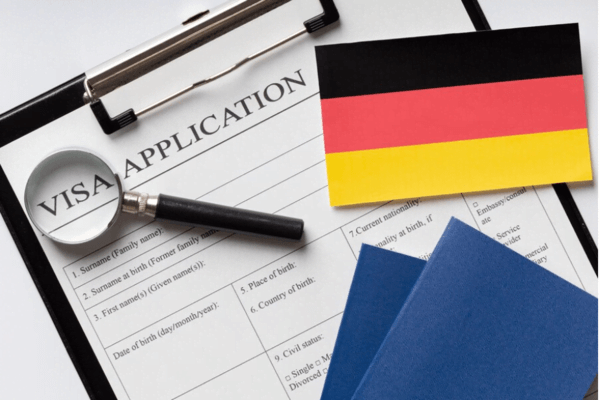
To apply for a German visa, follow these steps:
Determine the correct visa type based on your nationality, purpose, and planned duration of stay.
Gather the required documents, including the completed application form, passport, proof of funds, and other required documents.
Complete the visa application form online or download the PDF version.
Book an appointment at the relevant German consulate or authorised Visa Application Centre (e.g., VFS Global), responsible for processing visas in your country. Germany’s new Consular Services Portal (launched in 2025) now allows online appointment booking and, for certain categories, online document submission. But it varies by country.
Attend the visa interview, answer the questions about your trip and intentions in Germany, and provide your biometric data as required.
Pay the visa application fee for your visa type at the consulate or VAC(some embassies require you to pay before the interview).
Wait for your application to be processed.
If approved, receive your German visa and prepare for your trip. If rejected, follow the instructions in the rejection letter for further steps.
Note for Schengen visa applicants: If Germany is not the main destination of your trip (i.e. you will spend more days in another Schengen country), you must apply at the consulate of that primary destination country rather than Germany.
Where to apply for a German visa
Apply for a German visa through the German representative body responsible for visa applications in your country. This could be:
If there is no German representative body in your country, you might need to apply at:
Germany visa processing times and fees
Schengen (Type C) visas are typically processed within 15 calendar days. National (Type D) visas can take several weeks to several months, depending on the consulate, visa category, and application volume. Work and skilled worker visas involving credential recognition tend to take longer.
Visa fees, however, are non-refundable, even if your application is refused or you withdraw it. Fee waivers or reductions apply in certain cases. Verify current exemptions on the official German Foreign Office website. Always apply well ahead of your planned travel date to avoid unexpected delays.
Visa category | Standard fee | Common exemptions |
Schengen (Type C) Visa | €90 | Children under 6, researchers, certain EU family members, students |
National (Type D) Visa | €75 | Scholarship recipients, diplomats, certain bilateral agreement nationals |
Figures below reflect August 2026 rates and are reviewed annually. Always confirm current amounts on the official German Foreign Office site before applying.
Germany visa extension
If you need to stay in Germany longer than your visa permits, you may apply for an extension under specific circumstances. These include medical emergencies, humanitarian reasons, or late entry.
How do I extend a German visa?
To extend your visa:
Submit a visa extension application at the Local Foreigners' Office (Ausländerbehörde).
Provide a valid reason for the extension.
Submit the required documents.
Pay the extension fee.
Do all of this before your current visa expires.
Germany tourist visa checklist
If you are applying for a Schengen tourist visa for Germany, use this checklist to ensure you have everything ready before your appointment.
Requirements may vary slightly by consulate; always confirm the full list on your country's official German embassy website.
Completed and signed VIDEX application form
Valid passport: issued within the last 10 years, valid at least 3 months beyond your stay, minimum two blank pages, with copies of all data pages
Two biometric passport photographs (35×45mm, ICAO-compliant)
Travel health insurance certificate: minimum €30,000 coverage across all Schengen states, valid for the full duration of the trip
Confirmed return flight reservation with travel dates clearly stated
Proof of accommodation for every night of the stay (hotel bookings, rental agreement, or invitation letter)
Bank statements from the last 3–6 months showing sufficient financial means
Cover letter summarising the purpose, planned itinerary, and duration of the visit (recommended at most consulates even where not formally mandatory)
Always verify this list against the official German Foreign Office visa page (auswaertiges-amt.de) for your specific country and consulate, as requirements can differ.
When do you need certified translations for a German visa?
If your documents are not in German, you'll need to translate important documents like birth certificates, marriage certificates, medical records, and educational qualifications. These translations must be certified, meaning a professional translator or an approved translation service recognised by German authorities must do them.
Accurate translations are crucial to avoid delays or rejections. Services like Translayte specialise in providing certified translations that meet German visa requirements. Our experienced sworn translators ensure your documents meet the necessary standards, giving you one less thing to worry about as you prepare for your journey.
Here’s how to get started:
Visit the Translayte website.
Click on “ORDER YOUR TRANSLATION”.
Choose "Certified Translation," then select the target and source languages and your preferred turnaround time.
Upload the document you want to translate, ensuring the file is named correctly.
Select Standard, Specialist, or Professional translation services based on your needs and budget.
Specify any other preferences for your document.
Place your order and wait for your translation, which will be delivered by email or post by the stipulated time.