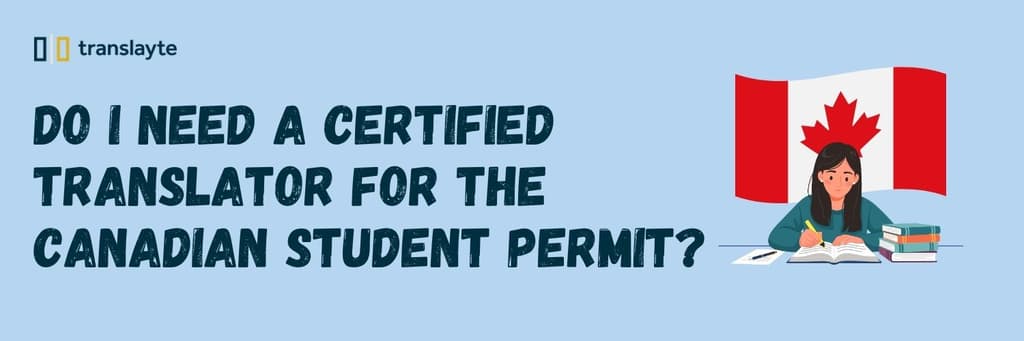
Which study permit documents need certified translation?
Any supporting document for your study permit that isn’t in English or French must be translated.
Here are the most common documents that may need translation;
Academic transcripts and diplomas (high school, undergraduate, graduate)
Letter of Acceptance (LOA) from a Designated Learning Institution (these are usually issued in English/French, but if it’s from a non-English DLI pathway or foreign prep program, it may need translation)
Proof of financial support (bank statements, scholarship letters, sponsor letters, GIC confirmation letters (if issued in another language)
Police clearance certificates (required for some countries)
Birth certificate (if required as a supporting identity document)
Passport bio-data page (only if it’s in non-Latin script and specifically requested)
Medical exam results (typically issued in English, but supporting documents from home country may need translation)
Parental consent letter (if applicant is under 18)
Custody documents (if applicable for minor applicants)
Not every student will need all of these, but any document not in English or French must be translated. Conversely, the Provincial Attestation Letter (PAL/TAL), Confirmation of Acceptance for Studies (CAS), and GIC letters are mostly issued in English or French, so there’s no need to translate those ones.
What IRCC requires for study permit translations
The Immigration, Refugees and Citizenship Canada (IRCC) has clearly outlined its rules for translating documents for your study permit application in the IRCC Guide 526. This applies to all applicants and must be followed carefully to avoid application delays or rejections.
According to IRCC translation requirements, there are two accepted ways to submit a certified translation:
Route 1: Certified translator
This is the most straightforward option. A certified translator is officially recognised in Canada (or by a professional body) and can provide a translation that meets IRCC standards.
Route 2: Non-certified translator + affidavit
If your translator is not certified, you must include an affidavit.
This affidavit must:
Be sworn before a person authorised to administer oaths in the country where the translator lives (typically a notary public)
Confirm the translator’s language ability
Confirm that the translation is accurate and complete
The person administering the oath (such as a commissioner or notary) must also be proficient in English or French.
Additional IRCC rules to follow
These rules apply no matter which route you choose:
Word-for-word translation only: You must translate the original document word for word. Summaries or partial translations are not accepted.
All elements must be translated: This includes stamps, seals, signatures, and handwritten notes.
No self-translation: You, your family members, or your immigration representative cannot translate your documents.
Include a certified copy of the original: The translated document must be submitted together with a certified true copy of the original document.
Common translation mistakes that delay study permit applications
Here are some of the common mistakes that may delay your study permit application;
1. Not translating all your documents
You might think that since it’s a study visa, you only need to translate your academic-related documents, but that is not the case. Translate everyyythiiinggg. Your bank statements, scholarship documents, birth certificates, etc. If it’s not in English or French, and it’s required, translate it.
2. Using a family member or friend to translate
IRCC does not accept translations done by you, your relatives, or your representatives, even if they are fluent. This may appear as being cost-effective at first, but the costs soon add up when it leads to your application being rejected, and you have to start the process again.
3. Submitting bank statement translations without proper formatting
Financial documents have a different formatting from other documents. Which is why you must translate it exactly as they appear, including tables, balances, stamps, and notes. Poor formatting or missing details can raise red flags during review.
4. Inconsistent name spelling across documents
If your name is spelled differently across your passport, transcripts, and translated documents, it can cause confusion or delays. Always check that it is spelled correctly across all documents.
5. Waiting until the last minute
Translation takes time, especially if you require affidavits. Leaving it too late can delay your submission or force you to choose rushed, lower-quality services. It’s better to plan ahead and get a fair certified translation cost to avoid paying rush fees.
How Translayte helps study permit applicants
With Translayte, you get certified translation in Canada that is accepted the first time. Here’s how we support your application;
We only work with CTTIC-accredited translators, including ATIO and OTTIAQ professionals, so you don’t need an affidavit for your translation.
We translate your documents accordingly, such that it mirrors the original and maintains the same formatting.
Our standard delivery is from as little as 12 hours, without compromising quality, so you never miss your deadlines.
We offer translations in over 150+ languages, including Hindi, Mandarin, Punjabi, Urdu, Arabic, Tagalog, Farsi, Korean, Portuguese, Spanish, French, and Vietnamese
Our certified translations have 100% guaranteed acceptance by IRCC
We deliver your translations digitally via email. Upon request, we also offer physical delivery to your location anywhere in the world.
Ready to get started? Check prices and place your order for our certified translations in Canada service today.
Preparing your study permit application?
Upload your documents today and receive IRCC-compliant certified translations from 12 hours.
Disclaimer: Translayte provides certified translations that comply with IRCC's stated requirements for document submission. Translation acceptance does not constitute advice on immigration or study permit outcomes. Consult a Regulated Canadian Immigration Consultant (RCIC) or licensed immigration lawyer for advice specific to your application.

.jpg)