What are the different routes to GMC registration?
The GMC offers different routes for international doctors to register in the UK. Options include PLAB, postgraduate qualification, sponsorship, and the Portfolio Pathway.
Registration route | Who it is suitable for | Main evidence or requirements | Indicative timeline |
PLAB route | Doctors who graduated from a medical school outside the UK, European Economic Area (EEA) or Switzerland without an acceptable postgraduate qualification or another qualifying route | Acceptable primary medical qualification, PLAB 1 and 2 passes, internship or qualifying clinical experience, English language evidence | Depends on exam availability, preparation and document verification |
Postgraduate qualification route | Doctors who hold a postgraduate qualification accepted by the GMC | Acceptable primary medical qualification, recognised postgraduate qualification and supporting registration documents | Depends on qualification verification and application assessment |
Sponsorship route | Doctors selected for approved UK postgraduate training or sponsored by an approved organisation | Acceptable primary medical qualification, Sponsorship Registration Certificate, and qualifying recent medical practice | Depends on sponsor selection, evidence and application assessment |
Portfolio Pathway | Experienced doctors seeking specialist or GP registration without completing a UK-approved training programme | Evidence showing you have the knowledge, skills and experience required to practise as a specialist or GP in the UK | Evidence preparation can take considerable time; assessment can take several months |
Use the application finder to find an option that fits your qualifications.
PLAB route
PLAB assesses whether overseas-trained doctors have the knowledge and clinical skills expected of a doctor entering the second year of the UK's Foundation Programme (F2).
The examination has two parts:
PLAB 1
PLAB 1 is a written, applied-knowledge examination consisting of 180 multiple-choice questions. Candidates have three hours to complete the test.
The questions assess how well doctors can apply their medical knowledge to clinical situations, including common conditions, emergencies, and managing long-term illnesses. The examination focuses on current UK clinical practice rather than simply testing recall of medical facts.
PLAB 2
PLAB 2 is a practical Objective Structured Clinical Examination (OSCE). It assesses clinical and communication skills through 16 scenarios, each lasting eight minutes. Candidates may be asked to demonstrate skills such as taking a patient history, conducting an examination, and explaining a diagnosis.
PLAB 2 takes place at the GMC's clinical assessment centre in Manchester.
How many times can you take PLAB?
You can attempt each part of PLAB up to four times. If you fail either PLAB 1 or PLAB 2 four times, you cannot immediately book a fifth attempt. You must first complete at least 12 months of additional learning and development after your fourth failed attempt. You can then apply to the GMC for permission to take one final attempt.
The GMC may accept evidence of 12 months of clinical practice or a relevant postgraduate qualification, provided it meets its criteria. The additional attempt is not automatic; the GMC must assess and approve your application.
You must also pass PLAB 2 within two years of passing PLAB 1. After passing both examinations, you must obtain approval for your registration application within two years of your PLAB 2 pass date.
Postgraduate qualification route
This route suits doctors who have completed additional medical training or professional examinations recognised by the GMC.
Examples of accepted UK postgraduate qualifications include:
Membership of the Royal College of Physicians (MRCP)
Membership of the Royal College of Surgeons (MRCS)
Membership of the Royal College of Obstetricians and Gynaecologists (MRCOG)
Membership of the Royal College of Paediatrics and Child Health (MRCPCH)
Membership of the Royal College of Psychiatrists (MRCPsych)
Fellowship of the Royal College of Radiologists (FRCR)
The GMC also accepts certain overseas postgraduate qualifications that meet its requirements.
Some qualifications also require additional evidence from the awarding institution or relevant Royal College.
Generally, the GMC expects an accepted postgraduate qualification to have been awarded within three years of the date it approves your application. If it was awarded earlier, you may need to provide additional evidence of recent medical experience.
You must also meet the other registration requirements. This includes providing evidence of your primary medical qualification, English language proficiency, professional standing, and identity.
Sponsorship route
The sponsorship route allows eligible overseas doctors to obtain full GMC registration through an approved sponsor rather than following another route. It applies to doctors who have secured a place on an eligible postgraduate training programme or have been selected by a UK medical Royal College, faculty, or other approved institution.
To qualify, you must:
Hold an acceptable primary medical qualification from a medical school outside the UK or Switzerland.
Be selected for postgraduate training by a UK medical Royal College or faculty, a qualifying postgraduate institution, or an organisation on the GMC's approved sponsor list.
Have practised medicine for at least three of the last five years, including at least 10 of the most recent 12 months.
Your sponsor will provide a Sponsorship Registration Certificate (SRC), which forms part of your registration application.
You will still need to provide evidence of your English language proficiency, identity, good standing and professional history.
The sponsorship route does not mean your employer or training institution automatically registers you. You must still complete the GMC application and satisfy its registration requirements.
Portfolio Pathway (formerly CESR)
The Portfolio Pathway is for experienced doctors who want to join the GMC Specialist Register or GP Register without completing a UK-approved training programme.
It replaced the Certificate of Eligibility for Specialist Registration (CESR) and Certificate of Eligibility for GP Registration (CEGPR) application routes in 2023.
This pathway is relevant to overseas-trained specialists with postgraduate degrees and substantial clinical experience from their home countries or other healthcare systems.
If you are eligible, you must submit a structured portfolio of evidence showing that your knowledge, skills, and experience meet the required standards. The evidence must be relevant to the specialty or general practice area in which you are applying.
Depending on the specialty, supporting evidence may include:
Medical school and postgraduate training certificates
Specialist qualifications and examination results
Detailed records of clinical experience and employment
Evidence of clinical procedures and practical competencies
Workplace-based assessments and appraisals
Continuing professional development (CPD) records
Audit, research and quality improvement projects
Evidence of teaching, supervision and leadership
References from appropriate senior clinicians
How long does the Portfolio Pathway take?
Gathering evidence often takes several years, especially if you’ve worked in more than one country. Once an application is opened, applicants have 24 months to submit it. After submission, the GMC says the initial processing stage can take 6 to 12 months before it sends the application for evaluation. The evaluation process and any additional evidence requests can extend the overall timeline.
Documents required for GMC registration
The documents required for GMC registration depend on your route. But the core GMC registration requirements for overseas doctors are the same: evidence of your medical qualifications, clinical experience, identity, English language ability, and professional history.
Some documents must be verified directly by the issuing institution or relevant regulatory authority. Others must be translated into English if they were originally issued in another language.
Overall, the documents required for GMC registration include;
Evidence of your primary medical qualification: medical degree
Primary source verification through EPIC, carried out by the Educational Commission for Foreign Medical Graduates (ECFMG)
Evidence of internship or clinical experience in the form of a certificate or official letter from the hospital or training institution
English language evidence, usually an IELTS Academic or OET Medicine certificate. For IELTS, you need an overall score of at least 7.5 and at least 7.0 in each of listening, reading, writing and speaking. For OET, you need at least a grade B in all four sub-tests. Results are normally valid for two years. If you’re thinking of combining results from more than one test, check the GMC’s English language guidance first
Passport and identity evidence: a copy of the photo identification and signature pages of your valid passport
Certificate of Good Standing from every medical regulatory authority with which you have been registered or licensed during the last five years
Five-year history and employer references
Declaration of fitness to practise
Which documents need translating for GMC registration?
Only documents not originally issued in English need a translation. If you qualified in a country where medical schools issue certificates and transcripts in English, you can usually submit those documents as-is. The exception is often the Certificate of Good Standing, which some regulators issue in the local language even where the degree is in English.
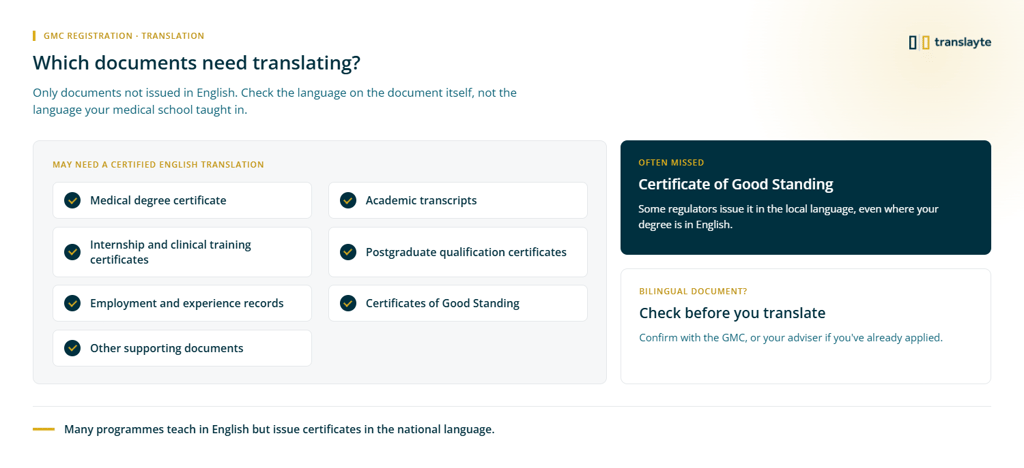
Documents that may need translation include:
Medical degree certificates
Academic transcripts
Internship and clinical training certificates
Postgraduate qualification certificates
Employment and professional experience records
Certificates of Good Standing
Other supporting documents required for your application
If you are unsure whether a particular document qualifies, check the language on the document itself rather than the language of instruction at your medical school. Many programmes teach in English but issue certificates in the national language. If your document is bilingual, check with the GMC (or your adviser, if you’ve already applied).
How to translate documents that aren't in English for the GMC
If any of your supporting documents are in a language other than English, you must provide an English translation alongside a copy of the original document.
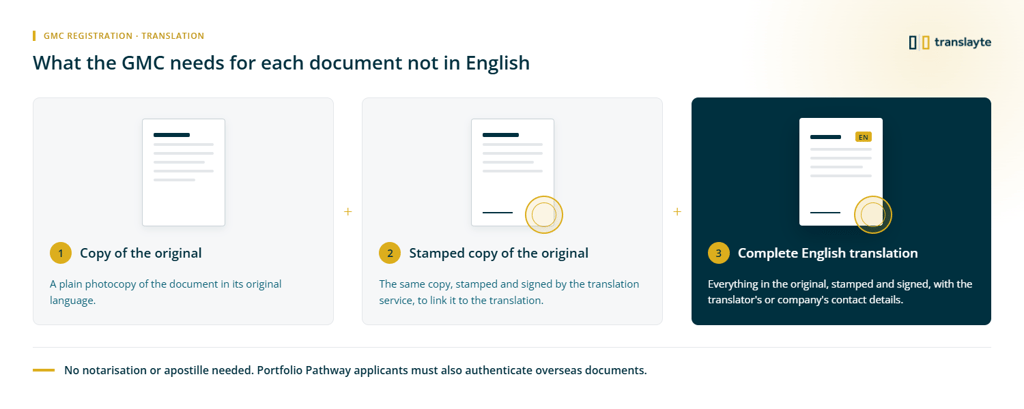
For each document that isn’t in English, the GMC asks for three items:
A photocopy of the original document. This is a plain copy of the document in its original language.
A photocopy of the original document, stamped and signed by the translation service. This confirms which document the translation belongs to.
A complete and accurate English translation, also stamped and signed by the translation service. The translation must include everything in the original document, and the contact details of the translation service or translator.
Steps to translate documents for GMC registration
Prepare the original: Gather all required documents for your route and make a clear photocopy or high-resolution scan. If you’re applying through the Portfolio Pathway, get overseas qualifications authenticated first.
Choose a qualified translator: Use a court-appointed translator, or a translation company or translator with recognised accreditation, such as ITI, CIOL or ATC membership. You can check membership in each organisation’s online directory before you order.
Check the translation: Make sure the translation is complete and accurate, and that both the translation and the copy of your original are stamped and signed by the translation service. The translation must include a certification statement attached with the translator’s or translation company’s contact details.
Upload your documents: Upload everything through your GMC Online account. Only post hard copies if the GMC asks you to, for example, authenticated evidence for a Portfolio Pathway application.
Who can translate documents for GMC registration?
The GMC strongly advises applicants to use:
A court-appointed or council-appointed translator
Reputable commercial translation services with recognised professional accreditation or membership of an appropriate professional or trade association.
If you use a UK translation service, check that it, or its translators, belong to one of the following:
Institute of Translation and Interpreting (ITI)
Chartered Institute of Linguists (CIOL)
Association of Translation Companies (ATC)
Review the GMC's official translation requirements before submitting your documents.
Do you need notarisation, an apostille or authentication for GMC registration?
The GMC requires a complete English translation stamped and signed, with the contact details of the translator or translation company. It doesn’t require notarisation or an apostille. If you’re applying through the Portfolio Pathway, qualifications and registration documents from outside the UK must also be authenticated (certified as true copies) by a solicitor or the awarding body. Authentication confirms your copy is genuine. It’s separate from the translation, which still only needs standard certification.
93% of the certified translations we’ve produced for use in the UK needed only standard certification. If you are translating documents for the GMC and nothing else, a standard certified translation is what you need.
How Translayte can help
Translayte provides certified translation services for individuals who need to submit foreign-language documents to UK organisations and authorities. If you are applying for GMC registration, we can help translate supporting documents.
We are an accredited member of the Association of Translation Companies and work with translators who are members of ITI and CIOL. Every translation includes a certification statement, and we can provide a stamped paper copy when it’s required.
Need your medical documents translated for GMC registration? Request a free quote for your certified translations.
How to submit your GMC registration application
Once you have confirmed your eligibility and gathered the required evidence, you can submit your application through GMC Online.
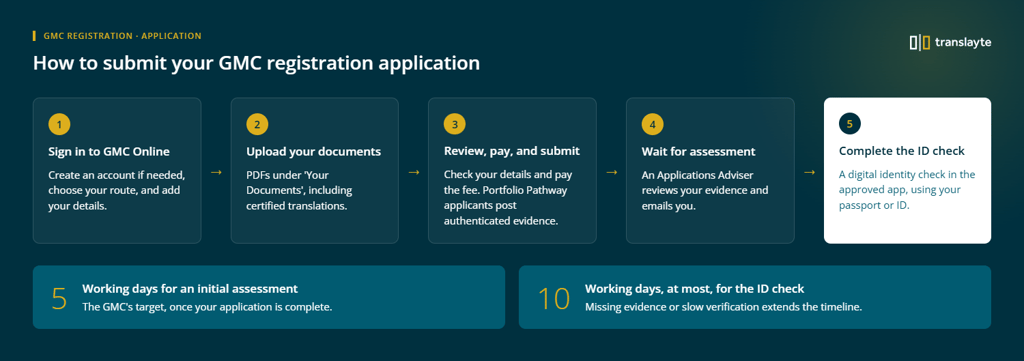
The application process generally involves the following steps:
Create or access your GMC Online account
Visit the GMC website and sign in to your GMC Online account. If you do not already have an account, you will need to create one. Select the appropriate registration application route and provide the requested personal, educational, and professional information.
Upload your supporting documents
Attach PDF copies of your supporting evidence to the relevant sections of the application under 'Your Documents'. Use the individual evidence sections as a checklist to make sure you upload each document in the correct place.
If a document will be sent directly to the GMC by a third party, select the appropriate evidence status and explain why you have not uploaded it.
Read the GMC's guidance on attaching documents to your application.
Review and submit your application
Before submitting, check that your personal details are correct, that you have uploaded all required documents, and that you have paid the application fee. If you’re applying through the Portfolio Pathway, you’ll also need to post your authenticated evidence once you’ve submitted. The GMC will contact you by email if it needs additional information.
Wait for assessment
An Applications Adviser will assess your documents, confirm you meet the requirements, and email you with the outcome.
Complete a digital identity check
The GMC will ask you to complete a digital identity check using the approved app. You’ll need identity documents such as a valid passport, EEA identity card or full UK driving licence for this step.
How long does GMC registration take?
The time required to obtain GMC registration depends on a few factors. These include:
For full registration applications, including the PLAB route, the GMC aims to complete an initial assessment within five working days of receiving a complete application. This first check confirms whether you’ve sent everything it needs.
After that, the GMC verifies your evidence, checks with overseas medical regulators, and asks you to complete a digital identity check. The GMC can take up to ten working days to process the identity check alone. If you need to send more evidence, or verification takes longer, the whole process will take longer too. Your registration is confirmed only once all of these checks are complete.
If you are applying through the Portfolio Pathway, the GMC estimates three to six months to process applications combining full registration with specialist or GP registration. Applications for specialist or GP registration alone can take 6 to 12 months before evaluation.
How much does GMC registration cost in 2026?
The total cost of GMC registration depends on your chosen route and the additional assessments, examinations and document preparation you need. Here’s a breakdown of the fees:
Expense | Cost in 2026 |
PLAB 1 | £283 |
PLAB 2 | £1,036 |
Full GMC registration with a licence to practise | £481 |
Annual retention fee with a licence to practise | £481 |
Annual retention fee with eligible 50% income discount | £240.50 |
EPIC MyIntealth account establishment | US$110 |
EPIC portfolio establishment | US$35 |
EPIC verification per credential | US$110 |
IELTS Academic | Varies by country and test provider |
OET Medicine | Varies by country and booking arrangements |
Certified document translation | Depends on the language, number of pages and service required. Translayte translation cost starts from £25 per page. |
Note: The fees in the table above are accurate as of November 2026. Check the GMC's official registration fees page for updates.
If you’re following the PLAB route, budget around £2,500 to £3,000. This estimate covers PLAB exam fees, registration, EPIC verification, English language testing, and document translation.
It doesn’t include the cost of travelling to the UK for PLAB 2, which you must sit in person in Manchester. Flights, a visitor visa, and accommodation can add £1,000 or more, depending on where you’re travelling from. You’ll also need to budget for any exam resits.
Looking at our certified translations into English between May 2025 and May 2026, 52% of orders were single-page, 75% were two pages or fewer, and 83% were three pages or fewer. The average order came to 2.5 pages. A medical degree certificate is usually one page. An internship certificate or a Certificate of Good Standing is typically one page each. Academic transcripts are the main exception and can run to several pages, particularly for six-year medical programmes.
At £25 per page, if you need your degree certificate, internship certificate, and Certificate of Good Standing translated, that’s typically three pages, or from £75. You can expect to pay more if you are submitting a long transcript or a Portfolio Pathway application, where the volume of evidence is far higher.
Will there be restrictions on where I can work after registration?
Yes. Most doctors who receive full GMC registration with a licence to practise for the first time must work within an approved practice setting (APS) until their first revalidation.
An approved practice setting is an organisation with appropriate clinical governance, supervision, appraisal and professional development arrangements. These requirements help ensure that newly registered doctors receive the support needed to practise safely.
While the restriction applies, you can only practise in the UK if you have a connection to a designated body, such as an NHS trust. All designated bodies count as approved practice settings. You must keep your designated body details up to date in your GMC Online account.
The restriction is lifted after your first revalidation. It doesn’t apply at all if you join the GP or Specialist Register at the same time as you get full registration.
Common GMC application mistakes to avoid
Applying for GMC registration involves several stages, and even small documentation errors can delay the process. Here are some common mistakes overseas doctors should avoid.
Submitting incomplete applications
Leaving out important documents or leaving sections incomplete can result in additional evidence requests. Before submitting, use the GMC's application guidance to check that you have uploaded all the evidence required for your route.
Providing incorrect or inconsistent documentation
Check that your name, qualification details, dates and other personal information are consistent across all documents. If there are differences, such as a change of name or spelling variation, provide the relevant supporting evidence.
Using an unacceptable primary medical qualification
Not every overseas medical qualification is automatically accepted by the GMC.
Check your medical school's status and the GMC's qualification criteria before booking examinations or starting the registration process.
Delaying primary source verification
Waiting until the final stage of your application to begin EPIC verification can create unnecessary delays. Your awarding institution may take time to respond to verification requests, so start the process early.
Submitting incomplete or uncertified translations
A translation that does not include the complete original information, the translator's contact details, a stamp, and a signature may not meet the GMC's requirements.
Make sure you include all three items: a copy of the original, a copy stamped and signed by the translation service, and the stamped and signed translation.
Allowing certificates to expire
Certificates of Good Standing and employer references are valid for only three months from their date of issue. Requesting them too early may mean you need to obtain new certificates before your application is approved.
Conclusion
GMC registration is an important step for overseas doctors who want to practise medicine in the UK. However, the process involves more than passing the PLAB examinations. You must choose an appropriate registration route, demonstrate that your medical qualifications and clinical experience meet the GMC's standards, and provide qualification and identity evidence.
Preparing your documents early can make the process easier and help prevent unnecessary delays. Pay particular attention to primary source verification, internship evidence, and Certificates of Good Standing. If any document isn’t in English, ensure you get a translation that meets the GMC requirements.
Translayte can help you prepare accurate, certified translations for your GMC registration application. Request a free quote for your certified translations.