Eligibility criteria for the Canadian tourist visa
The Canadian tourist visa, or Temporary Resident Visa (TRV), allows foreign nationals to enter and stay in Canada for a limited period. Here are the eligibility criteria:
Proof of purpose: You must be able to demonstrate the purpose/intent of your visit, whether it's for tourism, visiting family or friends, or other recreational activities.
Financial stability: You should be able to prove that you have the money to cover your stay in Canada through bank statements, payslips, or even a letter from someone financially sponsoring the trip.
Ties to home country: You must prove that you have strong ties to your home country. The Canadian government wants to know you have a reason to return home after your visit. You can demonstrate this with evidence of stable employment, property ownership, or family commitments.
Passport validity: Your passport must be valid for the whole of your stay, because your visa cannot be valid beyond your passport's expiry date. IRCC does not set a fixed "six months beyond your stay" rule, but a passport with plenty of validity left is the safest choice.
No criminal record: A criminal conviction might lead to a visa denial. So, be truthful and provide all necessary documents, possibly including a police clearance certificate.
Health: Depending on where you live or have recently visited, you might need to undergo a medical examination.
Intent to Leave: Similar to the ‘Ties to home country criteria’, you must have a clear intent to leave Canada once your visa expires. You can prove this with a return flight ticket or an onward travel itinerary.
Invitation: If you are visiting someone in Canada, you should have an invitation letter from your host that details your relationship, the purpose of your visit, where you will stay, and your host's financial status.
Types of Canadian tourist visas
The next stage after determining your eligibility is to decide the type of tourist visa you want to apply for based on your need.
There are 3 types of Canadian tourist visas, so you can apply for the one that best matches your travel intentions. Below, we explain the different types, including their purpose and length of stay.
Single Entry Visa
Purpose: The single-entry visa type is tailored for travellers who want to visit Canada once at a time. It is ideal for making one-off trips, like attending an event or visiting family.
Duration of Stay: The border services officer at the Canadian port of entry decides the duration, typically granting up to six months. However, once you exit Canada (except for travel to the United States or Saint-Pierre and Miquelon), you'll need a new visa to return.
Multiple Entry Visa
Purpose: The multiple entry visa is for travellers who want to visit Canada multiple times over a longer period without reapplying each time. It's useful for frequent visitors or those with family or business ties in Canada.
Duration of Stay: The visa is valid for up to 10 years or until your passport or your biometrics expire (whichever comes first), allowing multiple entries. However, for each visit, you can generally stay for up to six months, as decided by the officer at the port of entry.
Transit Visa
Purpose: Specifically designed for travellers who need to pass through Canada en route to another destination. This visa is common for those with layovers in Canada but not intending to stay.
Duration of Stay: The Transit Visa is for short layovers and allows you to remain in Canada for up to 48 hours. After this period, you must either continue your journey to the next destination or apply for a different type of visa to stay longer.
Documents required to apply for a Canadian tourist visa
Once you've decided which visa type fits your situation, you need to gather the required documents. The good news is, you don't have to do it alone; we are here to help. Here are the documents you need to provide for your Canadian tourist visa application:
Passport: Your passport is your primary identification document. Ensure it has blank pages for any necessary stamps. IRCC requires at least one blank page, not counting the last page.
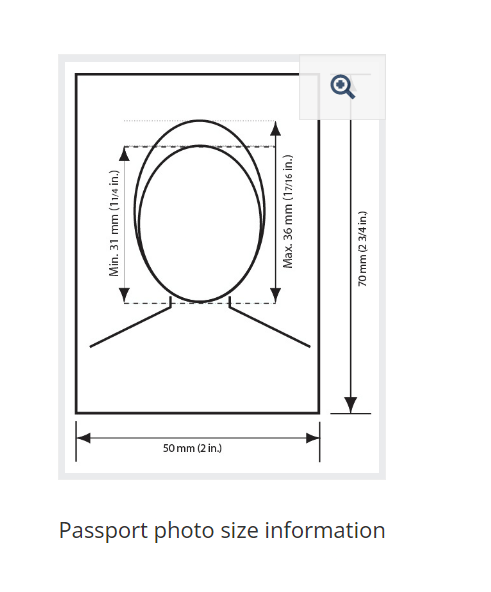
Two recent passport-sized photos: There are specific requirements for visa application photographs. Both photos should be identical, and the frame must be at least 35 mm wide by 45 mm high (1⅜ inches by 1¾ inches), and the height of your face must measure between 31 mm (1¼ inches) and 36 mm (1⁷⁄₁₆ inches) from your chin to the crown of your head (natural top of head), and they must be clear. A professional photographer can help you achieve this.
Proof of sufficient funds
Travel itinerary: This should include flight bookings, hotel reservations, and a list of places you intend to visit. While it's not mandatory to have every detail nailed down, a clear plan can instill confidence in your genuine intent to tour.
Ties to your home country: Evidence can include property deeds, a letter from your employer, family commitments, or other documents that show your obligation to return.
Invitation letter from a sponsor (if applicable).
A completed IMM 5645 form (optional): Family members who apply on behalf of the applicant, or third parties, must complete this form.
A completed (IMM 5475) form: Use this form to allow Immigration, Refugees and Citizenship Canada (IRCC) to release your personal information to someone you choose.
Employer information (optional): A letter printed on your employer’s letterhead will suffice. The letter should be no older than 3 months when you apply and should include all your employment details.
Medical examination: Some countries or regions are flagged for specific health risks, and Canada may require visitors from these places who plan to stay for more than six months to have an immigration medical exam to protect public health within its borders. Most short visits don't require one.
Travel history (optional): expired/valid visa, previous work or study permits, or previous passports within the last 10 years.
Certified translations: If you're providing documents (like bank statements, criminal record checks, letters of employment, etc.) that aren't in English or French, you'll need certified translation services in Canada. This is crucial since the Canadian government requires a precise translation of all supporting documents. It's recommended to use a certified translator in Canada to ensure the translations are accepted by Immigration, Refugees, and Citizenship Canada (IRCC). IRCC accepts translations by a Canadian-certified translator, or by another translator as long as they include the translator's sworn affidavit.
Criminal record check
Visa payment receipt
Filled visa application form
Processing time for a Canada tourist visa
The processing time for a Canada tourist visa is not the same for all applicants; it varies based on several factors, and understanding these factors will help you set your expectations and plan your trip more effectively. Below are some factors that influence the visa processing duration:
Mode of application
Online application: Applying for a Canada tourist visa online is generally faster. The online system, facilitated by the Immigration, Refugees, and Citizenship Canada (IRCC) website, is efficient as it directly feeds your information into the IRCC system. This direct digital input minimises manual intervention, and any required documents can be uploaded instantly. Moreover, if IRCC needs additional documentation or clarification, communication through the online portal is swift.
Paper-based application: Traditional paper-based applications, submitted at VACs (Visa Application Centers), usually take longer. Manual document handling, postal delays, and the time it takes for physical files to move between departments can add to processing time. Furthermore, if there are discrepancies or missing information, the back-and-forth communication can extend your wait. Note that IRCC only accepts a paper application if you cannot apply online (for example, because of a disability), so most applicants must apply online.
Country of application
The country you're applying from can significantly affect the duration. Some visa offices may have a high volume of applications, which can lead to longer processing times. Offices with more significant visa demand, or applications that need more stringent security checks, can take longer than others. Use IRCC's processing times tool to see the current estimate for your country. (Australian citizens normally do not need a visitor visa and only need an eTA when flying to Canada.)
Complexity of the application
A straightforward application, with all documents in order and clear intent, will be processed more speedily. In contrast, applications with missing documents, unclear travel purposes, or other complexities might require additional review or verification.
Other factors
Peak travel seasons: During holiday seasons or peak travel times, visa applications usually surge. This increased demand can lead to longer processing times.
Security concerns: If there are security concerns related to the country of origin or the individual, additional checks may be required, which can extend processing times.
Technical issues: At times, technical glitches, either in the online system or at the visa processing centres, can lead to delays.
Translation of documents: The completeness and correctness of your submitted documents, including any necessary certified translations obtained through online translation services or local certified translators, can affect the processing time. Inaccurate or incomplete translations, or translations without the required certification or affidavit, may result in requests for additional information, thereby prolonging the processing time.
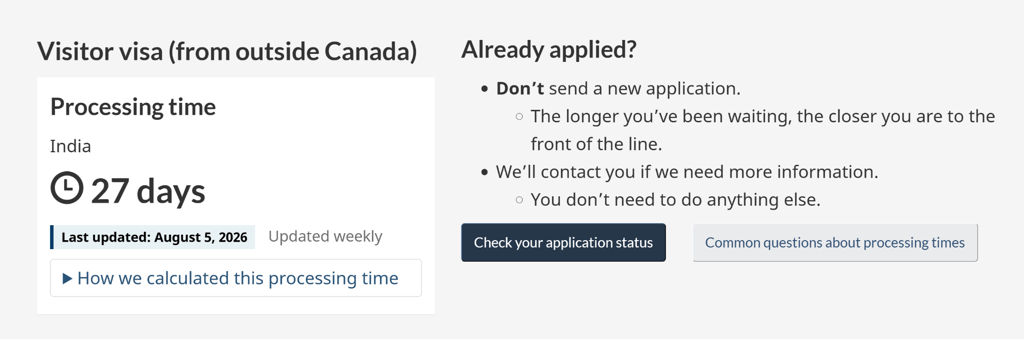
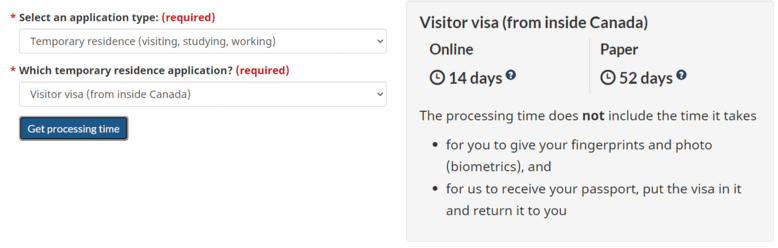
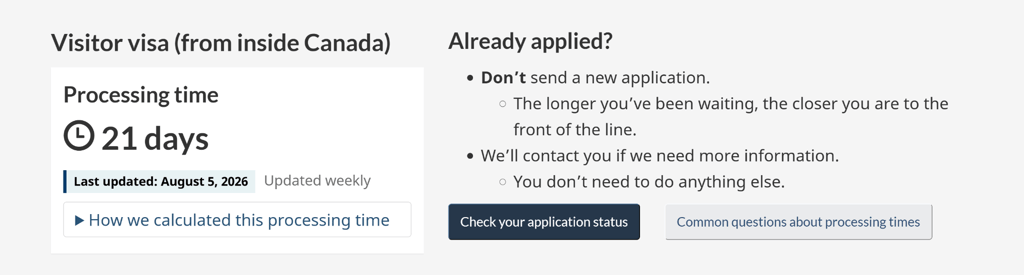
The images below show the estimated processing time according to the IRCC website for an Indian applicant applying for a Canadian visitor visa from outside Canada, and the processing time for an applicant applying for the same visa within Canada for an online and a paper application.
Other Canadian tourist visa requirements
Travel insurance
Importance: Travel insurance isn't mandatory for a Canadian tourist visa, but it's strongly recommended. Canadian healthcare can be expensive for non-residents, and having insurance ensures you're covered in case of any unforeseen medical emergencies.
Coverage: It's advisable to obtain comprehensive travel insurance that covers hospitalisation, emergency care, repatriation, and more. Some policies might also cover travel disruptions and cancellations.
Duration: Ensure your insurance policy covers your entire stay in Canada.
Language proficiency
Overview: Canada has two official languages: English and French. While a tourist visa doesn't always require proof of language proficiency, it can be beneficial in some circumstances or for extended stays.
Evidence: If you're from a non-English/French-speaking country and your itinerary involves activities that require communication, like attending short courses, it may help to show some level of language proficiency.
Biometrics
Biometrics is a modern identification method that involves taking your fingerprints and photographs. To do this, you need to book an appointment at a Visa Application Centre (VAC) or an Application Support Center (ASC) closest to you in your country of residence.
Fee: The biometric fee is non-refundable and costs $85 per adult, in addition to your visa application fee.
Validity: Biometric data for visiting visa applications is valid for ten years. Immigration will use it for all future TRV applications.
Cost of the Canada tourist visa
The cost of a temporary Canadian tourist visa application is CAD $100 and a biometric fee of $85 per adult applicant. Here's a breakdown of the government fees involved in a Canadian tourist visa (Temporary Resident Visa) application:
Fee | Amount (CAD) |
Visitor visa (TRV) application fee | $100 per person |
Biometrics fee | $85 per person |
Total per adult applicant | ~$185 |
Family maximum (5 or more people applying together) — visa fee | $500 |
Family maximum — biometrics fee | $170 |
Electronic Travel Authorisation (eTA), if you qualify for one instead of a TRV | $7 |
A few things worth knowing about these fees:
Not everyone needs a TRV: If you're a citizen of a visa-exempt country (most EU nations, Australia, Japan, South Korea, and others) travelling by air, you'll likely only need the much cheaper eTA instead of a full visitor visa. Check your specific nationality's requirement before applying.
These are government fees only: If you use an immigration consultant, lawyer, or visa agency to help with your application, their service fee is separate and additional.
Biometrics are valid for 10 years and will be reused for future TRV applications, so you generally only pay this fee once per decade, not per application.
All fees are non-refundable, even if your application is denied.
Certified translations for your Canada tourist visa
If any of your supporting documents aren't in English or French, IRCC requires an English or French translation before it will accept them as part of your application. The translation must be done by a Canadian-certified translator or include a sworn affidavit from the translator.
The documents most often requiring certified translation for a tourist visa application include:
Bank statements and proof-of-funds documents
Police clearance / criminal record certificates
Employment letters
Marriage, birth, or family relationship certificates (if applying with or visiting family)
Any invitation letter from a host, if it wasn't originally written in English or French
What counts as a "certified" translation?
IRCC doesn't accept a translation you do yourself, or a rough machine translation. There are two accepted routes.
Route 1: a translator who is certified in Canada, in which case no affidavit is needed.
Route 2: any other translator, in which case the translation must include the translator's sworn affidavit confirming its accuracy.
In both cases, the translation should be accompanied by:
The translator's certification/affidavit confirming accuracy
A copy of the original document alongside the translation
In some cases, the translator's credentials or membership number with a recognised translation body
Why it matters for your processing time
An uncertified, incomplete, or inaccurate translation is treated the same as a missing document (This includes a translation by a non-certified translator that has no affidavit.) It can trigger a request for additional information from IRCC, adding weeks to your processing time. Getting certified translations done correctly and early, alongside the rest of your document checklist, helps keep your application moving without avoidable delays.
Need certified translations for your Canada visa application?
Translayte provides certified translations for Canadian visa and immigration applications, completed by qualified translators and prepared to meet IRCC requirements. Get a free quote for your documents in minutes.