How to find a Canadian certified translator
The best way to find a Canadian certified translator is through Translayte. Translayte has professional, certified translators who can handle translations in different languages for various purposes such as immigration, legal, academic, or business. Our translators ensure accuracy and compliance with government and institutional requirements.
Alternatively, you can find certified translators through provincial translator associations. Across Canada, most provinces have an established association for certified translators. These organisations regulate and certify professional translators in Canada.
List of certified translator associations in Canada (Recognised by IRCC)
Below is a list of provincial translator associations in Canada.
For provinces and territories without a local association, such as Prince Edward Island, Newfoundland and Labrador, Nunavut, and Northwest Territories, you can consult the national directory of Canadian Translators, Terminologists and Interpreters Council (CTIC).
These organisations maintain a list of certified translators in Canada, making it easy to find a professional who meets your needs.
What is a certified translator in Canada?
A certified translator in Canada is a professional translator who has successfully passed a certification process and is officially registered with a provincial translation association.
For IRCC submissions, the translator must be a Canadian citizen or permanent resident and must certify that the translation is accurate, including their name, contact information, and credentials on the document.
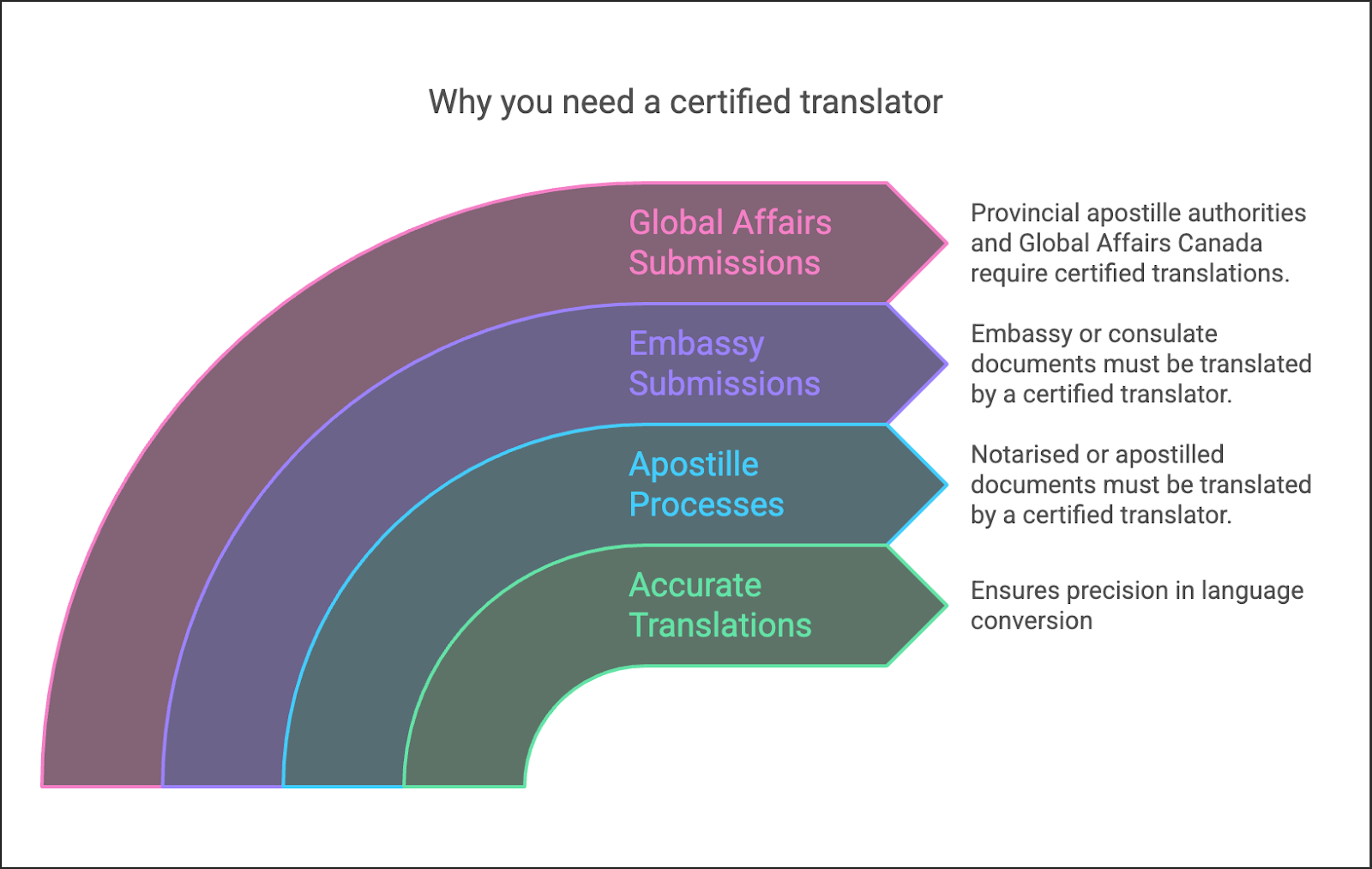
Why you need a certified translator
When dealing with important documents, accuracy, and legal recognition are essential. A certified translator in Canada ensures that your translations meet the official standards for IRCC so your application is not delayed or rejected. Here are the major reasons you need a certified translator;
Accurate and legally valid translations
Certified translators in Canada are trained to provide error-free and official translations that are recognised by government agencies and institutions. Since these translators are registered with provincial translation associations, their work has a legal significance that manual or machine translations do not.
IRCC and immigration requirements
IRCC explicitly requires that any document not in English or French must be accompanied by a certified translation. Submitting an uncertified translation is one of the most common reasons immigration applications face delays or rejection.
Recommended Reading
How Much Does a Certified Translator Cost in Canada?
What is the apostille process?
If your documents need to be used internationally, they may also require an apostille. An apostille is a certification that verifies authenticity for use in countries that are part of the 1961 Hague Apostille Convention. In Canada, an apostille confirms that a document issued by a public authority is genuine so it can be accepted abroad.
How the apostille process works
Authentication: The document is first authenticated by the appropriate government office. In Canada, this is usually Global Affairs Canada or a provincial apostille authority.
Apostille certification: If the destination country is part of the Hague Apostille Convention, the document is issued an apostille, confirming its authenticity for international use.
Translation (If required): Many countries require documents to be in their official language. If translation is necessary, the document must be translated by a certified translation company or translator before the apostille process is completed.
Learn more about the apostille process in Canada.
Why choose Translayte for certified translations in Canada?
If you need a certified translation quickly, services like Translayte work with translators certified by ATIO, STIBC, OTTIAQ, and other provincial associations. Their translations are accepted by IRCC and other official institutions.
Get a free quote from Translayte today.
Conclusion
If you need to translate documents for official purposes in Canada, using a certified translator ensures your translated documents are accepted by the receiving authority. This is very important, as incorrect or uncertified translations can lead to delays or outright rejections.
To get started, you can consult any of the provincial translator associations directories to find an accredited translator or use a professional translation service that already works with certified translators so your documents are accepted the first time.