Are you planning to move, study, work, or join family in the United Kingdom? Various types of visas are available in the UK to suit your specific needs. However, choosing the right UK visa can be challenging, especially if English isn't your first language. In this guide, we'll break down the main types of UK visas, outline the eligibility requirements, and explain why a certified translation of your documents may be essential for a successful application.
Types of Visa in UK: A Complete Guide for Foreign Nationals
What is a UK Visa?
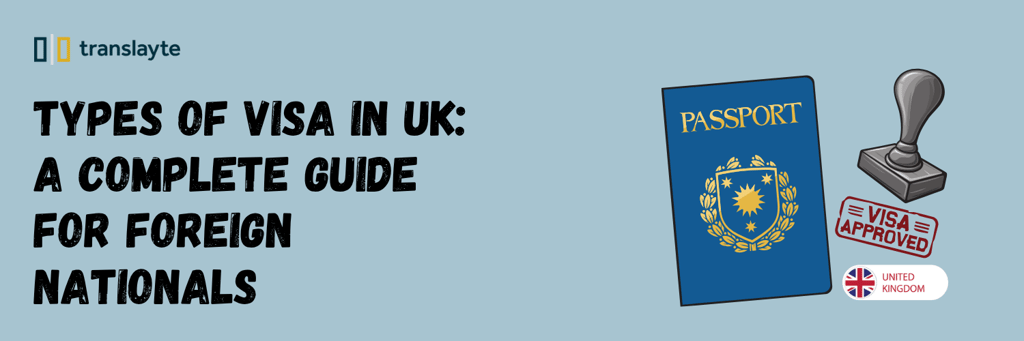
A UK Visa is a stamp in your passport or a document issued by the UK Consulate/Embassy in your country that allows you to visit the UK for a set period under specific conditions. Most new UK visas are now issued as eVisas, a digital record of your immigration status that you access through a UKVI account.
People around the world apply for UK visas to visit the UK and enjoy its benefits. Some reasons people apply for UK visas are:
Tourism/Vacation
Work
Schooling
Medical treatment
Family visits
Relocation/Resettlement
Travelling through the UK
Asylum/Refugee
When applying for a UK visa, you should know there are ways to increase your chances of approval, depending on the visa type. One way is the points-based immigration system. PBS is an immigration system that was created by the UK government that allows foreigners, (with the exception of Irish citizens) who are coming to the UK for work to meet specific requirements, for which points are awarded to them. Visas are then awarded to applicants who rack up enough points.
Who needs a UK visa?
Anyone who wishes to apply for a UK visa can do so, except for certain individuals who are exempt from the application process. Those people are: citizens of the EEA, the USA, Switzerland, & some Commonwealth countries. These visa exemptions or requirements apply only to citizens of specific countries, and eligibility for certain visa schemes is limited to applicants from specific countries. However, if you fall into any of these categories and need to stay in the UK for more than six months, you must obtain a visa to support your stay. The no-visa rule is valid for only 6 months. Most of these visa-free visitors now need an Electronic Travel Authorisation (ETA) instead.
Electronic Travel Authorisation (ETA)
An ETA is a new requirement for individuals who do not need a visa to visit the UK, including some mentioned in the previous section. An ETA is a travel authorisation electronically linked to your passport that allows you to travel to the UK. Similar to a visa, you would say. Well, not quite. It costs £20 (from 8 April 2026) and is valid for multiple trips over two years, or until your passport expires, whichever comes first. Here are some of the reasons you might need to get an ETA.
If you want to visit the UK for up to 3 months on a Creative Worker visa concession.
If you are travelling through the UK, regardless of whether you will meet the UK Border Patrol.
If you want to visit the UK for up to 6 months for business, work, study or family visits.
Note that not everyone is eligible for an ETA.
On the other hand, some people do not need an ETA at all. Those people are:
People who have visas.
People who hold British/Irish passports.
People who have permits to live, work or study in the UK.
Legal Ireland residents.
People who are entering the UK from Ireland, The Isle of Man, & Guernsey.
The ETA application process requires a few details from applicants; they are
Your full name
Date of birth
Country of citizenship
Travel details
You can complete your UK ETA application on the app or online.
What is a Point-based System in the UK
The points-based system is a framework the United Kingdom uses to manage immigration from outside the European Economic Area (EEA) and Switzerland. It was first introduced in 2008 and has been adapted and updated over the years, most recently with the end of the Brexit transition period on 31st December 2020. In PBS, points are awarded based on specific criteria, such as English language skills, having a job offer from an approved UK employer, and meeting a salary threshold.
Here's a brief overview of the main UK visa categories you can qualify under within the points-based system:
Skilled Worker route: This visa is for individuals who have been offered a skilled job in the UK from a Home Office-licensed sponsor. Points are awarded based on a job offer at the appropriate skill level, a certain level of English proficiency, and a minimum salary. Since 22 July 2025, the job must usually be at degree level (RQF 6) and pay at least £41,700; from 8 January 2026, new applicants must have English at level B2.
Senior or Specialist Worker visa (Global Business Mobility): This visa replaced the intra-company visa. It is for established employees of multinational companies whose overseas employer is transferring them to a UK branch of the organisation.
Global Talent route: This visa is for individuals working in a qualifying field who have been endorsed as recognised leaders (exceptional talent) or emerging leaders (exceptional promise).
Start-up and Innovator route: The Start-up and Innovator visas are closed to new applicants and have been replaced by the Innovator Founder visa. It is for people setting up an innovative, endorsed business in the UK, and has no fixed minimum investment
Graduate student route: This visa is for international students who want to work or look for work after their studies. This visa allows you to stay for 2 years after your studies & 3 years if you are a PhD student. For applications made from 1 January 2027, bachelor’s and master’s graduates will get 18 months instead of 2 years.
UK Visa requirements
Visa requirements may vary, depending on the type of visa you are applying for. But fundamentally, the requirements are similar.
The document requirements for applying for a UK visa are as follows:
Your valid Passport.
Biometric details - fingerprints & 2 passport photographs taken in the last 6 months (You need to identify a visa application centre in your country to fulfil this process).
Proof of sufficient funds (to show you can support yourself while in the UK).
Proof of accommodation in the UK.
Your detailed travel itinerary (places you plan to visit in the UK).
A tuberculosis test result if you are from any of these countries or have lived there in the last 6 months.
An invitation letter (if you are going to join a relative or spouse in the UK).
Visa fee payment receipt.
Certified translation of any document written in another language besides English or Welsh.
A cover letter (if requested).
For specificity, here are some additional requirements that might apply to specific types of visa in the UK:
Work Visas: You need a job offer from a licensed sponsor in the UK, and the job must pay a minimum salary.
Student Visas: You need to be registered to study a course at a licensed educational institution, along with evidence of your English language skills and enough money to support yourself and pay for your course.
Family Visas: You may need to prove your relationship to a family member in the UK, and they may need to meet specific financial requirements.
Visitor Visas: You may need to show that you intend to leave the UK at the end of your visit. You can prove this with a return flight ticket.
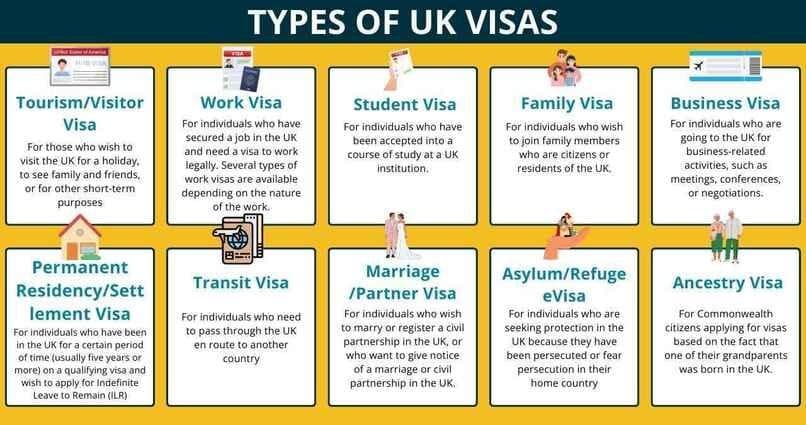
What are the different types of UK visas?
There are two broad UK visa categories: short-term visas & long-term visas.
Visa Type | Eligibility |
For those who wish to visit the UK for a holiday, to see family and friends, or for other short-term purposes. | |
For individuals who have secured a job in the UK and need a visa to work legally. Several types of work visas are available depending on the nature of the work. | |
For individuals who have been accepted into a course of study at a UK institution. | |
For individuals who wish to join family members who are citizens or residents of the UK. | |
For individuals who are going to the UK for business-related activities, such as meetings, conferences, or negotiations. | |
For individuals who have been in the UK for a certain period of time (usually five years or more) on a qualifying visa and wish to apply for Indefinite Leave to Remain (ILR). | |
For individuals who need to pass through the UK en route to another country. | |
For individuals who wish to marry or register a civil partnership in the UK, or who want to give notice of a marriage or civil partnership in the UK. | |
For Commonwealth citizens applying for visas because one of their grandparents was born in the UK. |
Tourism/Visitor Visas
Standard Visitor Visa
This visa is suitable for tourists, people visiting family/friends, and business visitors. It is a short-term visa. The visa fee for standard visitor visas ranges from £135 (up to 6 months) to £1,128 (long-term, up to 10 years), depending on the length of the visa.
Marriage Visitor Visa
The marriage visitor visa is suitable for people who want to get married or register a civil partnership in the UK. It costs £135.
Academic Visitor Visa
The academic visitor visa is for people from overseas academic institutions to take part in formal activities with their UK counterparts and conduct research during a sabbatical. This visa costs £135 for up to 6 months, or £234 for more than 6 and up to 12 months.
Medical Visitor Visa
The medical visitor visa allows its holder to visit the UK for up to 6 months for medical treatment. This visa costs £135, or £234 for longer treatment of more than 6 and up to 11 months.
Work Visas
Skilled Worker Visa
The skilled worker visa is suitable for people who have been offered a skilled job in the UK. This visa costs £819 (up to 3 years) or £1,618 (more than 3 years) if you apply from outside the UK, and £943 or £1,865 from inside the UK. Jobs on the Immigration Salary List cost less (£628 or £1,235).
Senior or Specialist Worker visa (Global Business Mobility)
Formerly known as the intra-company transfer visa, the Senior or Specialist Worker visa is for employees of multinational companies being transferred to a UK branch of their organisation. The standard fee for this visa ranges from £769 to £1,751, depending on your circumstances.
Global Talent Visa
The Global Talent Visa is for leaders or potential leaders in academia, research, arts, and digital technology. This visa costs £766.
Temporary Worker Visas
This visa is for certain types of temporary work. There are about 8 visas in the temporary work visa category, including the charity work visa, creative worker visa, government-authorised exchange visa, religious worker visa, youth mobility scheme visa, seasonal worker visa, & international agreement visa. These visas cost £319 in application fees.
Health and Care Worker Visa
This visa suits medical professionals already working in eligible health occupations. It allows them to come to the UK & work with the NHS, its suppliers or adult social care institutions. The Health and Care Worker visa costs between £324 and £628. Since 22 July 2025, it has been closed to new overseas applicants for care worker and senior care worker roles.
Minister of Religion Visa
This visa is meant for religious Ministers or missionaries who have been offered a job in a religious organisation or order in the UK. This visa costs £769 for the main applicant and any dependents who will be coming with them.
International Sportsperson Visa
The Sportsperson visa is reserved for elite sportspeople or coaches who are internationally established and have proven that taking a job in the UK will advance their sports career to the highest level. This visa costs between £340 (up to 12 months)

Student Visas
Child Student Visa
This visa is for children aged 4 to 17 who want to study at an independent school in the UK. The Child Student Visa costs £558.
Short-term Study Visa
This visa is specifically for people who want to study English in the UK. This visa is for courses longer than 6 months but no more than 11 months. The cost of the short-term study visa is £228.
Family Visas
Parent of a Child Student Visa
This visa goes hand in hand with the child student visa we mentioned previously. This visa is for the parent of a child attending an independent school in the UK. It allows the parent to look after their child while in the UK. To be eligible, your child must be between the ages of 4 and 11. This visa costs £682
Transit Visas
Direct Airside Transit Visa
The Direct Airside Transit Visa is for those changing flights in the UK without passing through UK border control. This visa costs £41.50.
Visitor in Transit Visa
The visitor in transit visa is perfect for those who will go through UK border control but leave the UK within 48 hours. The UK visitor visa application fee is £74.50.
How to Apply for a UK Visa
If you are travelling to the UK for a visit, apply at least 3 months in advance; if you are travelling for work or as a student, apply at least 6 months in advance.
Here are the steps to apply for a UK visa:
Determine the type of visa you need.
Organise your documents for the visa application; an omission could lead to rejection.
Start your visa application online. Some visa types allow paper applications.
Schedule a visa appointment at a UK VAC (Visa Application Centre) in your country.
Pay the required visa fee.
Attend the visa appointment. Be punctual and polite. You will submit your biometric information & other documents during this appointment. If not, you will be scheduled for a visa interview there.
Wait for the Visa Decision. After your appointment, we will process your visa application. Processing time can vary depending on the visa type and your location. You'll be notified when a decision has been made.
Receive Your Visa: If your visa application is approved, you'll receive your visa. This might involve collecting your visa or having it delivered to you. Most successful applicants now get an eVisa rather than a vignette sticker.
If you want to make a change to your application after sending it in, contact UKVI (UK Visas & Immigration) for changes. The same procedure applies if you change your mind about your application and want to cancel it altogether. However, note that a refund of your application fee will only be possible if UKVI has not started processing your application.
What is the Processing Time for UK Visas?
The time it takes to process your visa depends on the visa type you applied for, where you submitted your application (within the UK or outside the UK), and how well you meet the eligibility criteria.
Generally, if there are no peculiarities with your application, your visa should be processed within 3 weeks. However, to avoid losses or frustration, wait to book your flight until you receive a decision on your visa application. Additionally, if you need your visa faster than the standard processing times allow, you can opt for an expedited process by paying an additional fee.
Points to Consider as a UK Visa Applicant
Here are the points to consider as a UK Visa Applicant:
Respect the Conditions of Your Visa: If your visa is granted, make sure you understand and respect the conditions of your visa. Overstaying your visa or working without the right permissions, for example, can result in serious consequences.
Obey rules: You may be required to take an Immigration Control (examination) at any time while crossing the UK border. Your visa may also be cancelled at the border if immigration control officials deem it necessary.
Maintain Your Status: If your circumstances change (for example, if you switch jobs or courses), you may need to apply for a new visa or update your existing one.
Plan for the Interview: For certain visa types, you may need to attend an interview as part of the application process. Be prepared to answer questions about your plans in the UK and how you meet the requirements for the visa you are requesting.
Complete the Application Correctly: Fill out the application form accurately and completely. Mistakes or omissions can lead to delays or even the rejection of your visa application.
Permitted activities on UK visas
Each UK visa type comes with its own set of permitted activities, and it’s important to understand what you can and cannot do under each visa. For example, a Standard Visitor Visa allows you to enjoy tourism, visit family or friends, attend business meetings, or take part in short-term study courses, but it does not permit you to work in the UK.
On the other hand, a Skilled Worker Visa and other work visas are designed for those with a job offer who want to work in the UK in a particular role.
Student Visas enable international students to enrol in full-time courses at UK educational institutions, and may also allow limited part-time work during studies.
Choosing the right visa type and adhering to its conditions is crucial, as activities not permitted by your visa can lead to serious immigration consequences. Always check the specific permissions and restrictions attached to your visa category to stay compliant with UK immigration rules.
Long-term options for UK visa holders
Many UK visas allow you to visit, work, or study in the UK and offer a pathway to long-term settlement and even British citizenship. For instance, if you hold a Skilled Worker Visa or a Family Visa, you may become eligible to apply for Indefinite Leave to Remain (ILR) after meeting certain residency and eligibility requirements. ILR grants you the right to live and work in the UK without time restrictions, and is often the final step before applying for British citizenship. Other visa holders, such as those on a Graduate Visa or a Global Talent Visa, may also be able to transition to permanent residency after fulfilling specific criteria. Many UK visas are designed with progression in mind, so if your goal is to make the UK your permanent home, it’s important to understand the long-term options available and plan your immigration journey accordingly.
Certified translations & UK visa application
The UK requires documents submitted for official purposes, such as visa applications, court proceedings, or service registration, to be certified, notarised, or sworn, depending on the requirements of the body requesting the document. This only applies if you are from a non-English-speaking country, and your documents are not issued in English or Welsh (the official languages spoken in the UK). In this case, certified translation services must be gotten for your visa application documents, such as your birth certificates, academic transcript, medical records, passport and police certificates, amongst others.
For UK visas, a certified translation must include confirmation that it is an accurate translation of the original, the date, and the full name and contact details of the translator or translation company. Membership of a professional body, such as the Chartered Institute of Linguists (CIOL), the Institute of Translation and Interpreting (ITI) or the Association of Translation Companies (ATC), is a good sign of quality but is not a UKVI requirement.
About the author
Marketing Coordinator
Bukola Edgar coordinates marketing at Translayte, a certified translation company handling sworn, notarised and apostilled documents for legal, immigration and official use in more than 60 countries.