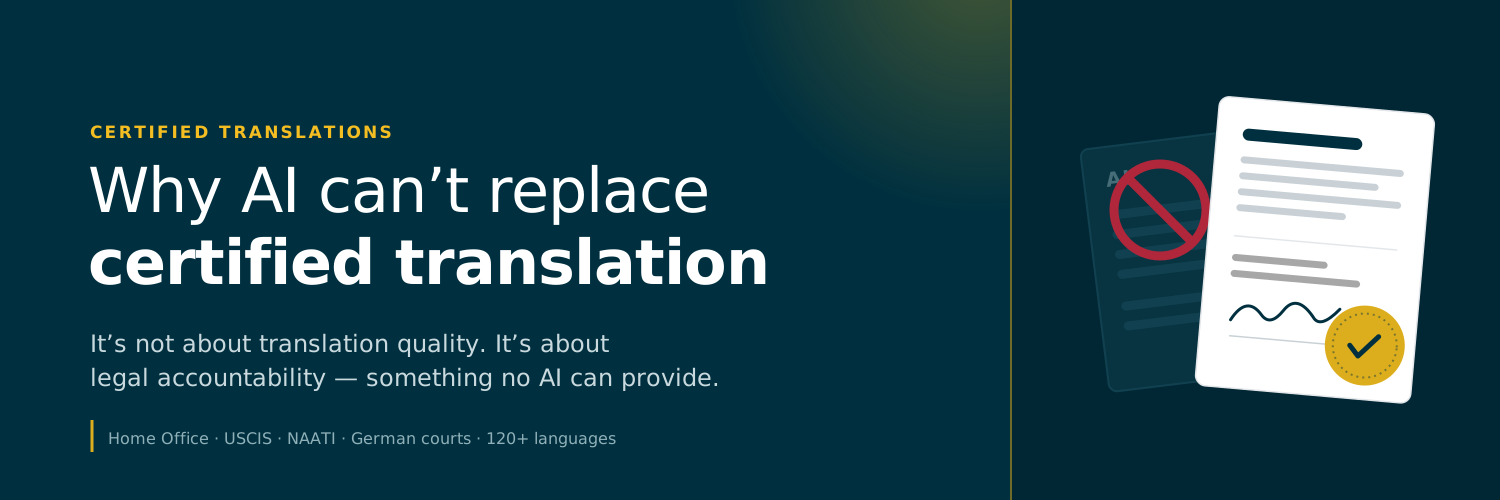
What certified translation actually is, and what most people misunderstand
It is not a quality grade
The word 'certified' sounds like it means 'checked and verified to a high standard', in the way that a certified accountant or certified engineer has passed exams and met professional standards. In the context of translation, many people assume it means the translation has been checked for accuracy by a senior linguist, or that it meets some industry quality benchmark.
This is understandable, but it is not what certified translation means. An AI tool could theoretically produce a more linguistically accurate translation than a human in a specific, narrow context. It would still be rejected by every immigration authority on this list. Quality is not the issue.
It is a signed statement of legal accountability
A certified translation is a translation accompanied by a signed declaration from a qualified human translator stating that the translation is accurate and complete to the best of their professional knowledge, that they are competent in both languages, and that they take personal responsibility for its accuracy.
That translator can be identified. They hold verifiable credentials. If the translation turns out to be inaccurate in a material way, they can be held professionally and legally responsible. In many jurisdictions like Germany, France, Spain, the Netherlands, Poland, and others, the authority to certify a translation is conferred by a court or government body. It is not a professional membership anyone can buy; it is a legal status granted to specific individuals after vetting.
No AI system can make this declaration. No AI system holds credentials conferred by a court. No AI system can be sued, struck off, or prosecuted for a translation error, at least not yet. That is the gap, and it is structural, not technical. Better AI will not close it, because the gap is not about capability. It is about accountability.
The formal structure of a valid certified translation
A certified translation accepted by most major authorities will contain all of the following:
The complete translated text, structured to match the original document (including headers, fields, and layout where applicable)
A certification statement, usually at the foot of the translation or on a separate accompanying page
The translator's full name, not just a company name
The translator's professional contact details
A declaration that the translator is competent in both languages involved
A statement that the translation is accurate and complete to the best of the translator's knowledge
The date of translation
The translator's signature
In sworn jurisdictions: the translator's official stamp or seal (Beglaubigte Übersetzung, traduction assermentée, etc.)
Notes describing any official stamps, photographs, signatures, or markings on the original document, which should be described rather than translated
Common rejection reason: applications submitted with a translation that has been produced by a company rather than a named individual, with no certification statement attached, are rejected by USCIS, the Home Office, and most EU immigration offices, regardless of how accurate the translation is. |
Most content in this space tells you what the rules are. Understanding why they exist makes the requirement easier to remember and harder to inadvertently violate.
Every document has an accountability chain
The original document your translator is working from, whether it is a birth certificate, a marriage certificate, a university degree, or a criminal record check, was produced within a legal system that assigned responsibility for its contents, and the registrar, the university, or the court stands behind what the document says. It has legal standing because a responsible institution or individual created it.
When that document crosses a border, the receiving authority has no direct way to verify the original. They rely on the translation. So they need the translation to come with its own accountability chain: a qualified human being who can be identified, whose credentials can be checked, and who can be held responsible if something is wrong.
An AI system cannot be identified as a responsible party. It has no professional registration. It has no credentials that a government body has conferred or that a professional body can revoke. It cannot be summoned to explain a translation decision. It cannot be sued for a translation error that causes an application to be granted on false premises.
This is not a philosophical point. It has direct practical consequences. When a court, immigration authority, or regulatory body requires a certified translation, they are requiring proof that a responsible human being stands behind the accuracy of that document. AI translation provides no such proof, not because AI is inaccurate, but because it has no standing.
What happens when the accountability chain breaks
The cost of a rejected translation is almost always higher than the cost of getting it right in the first place. Consider the realistic cascade:
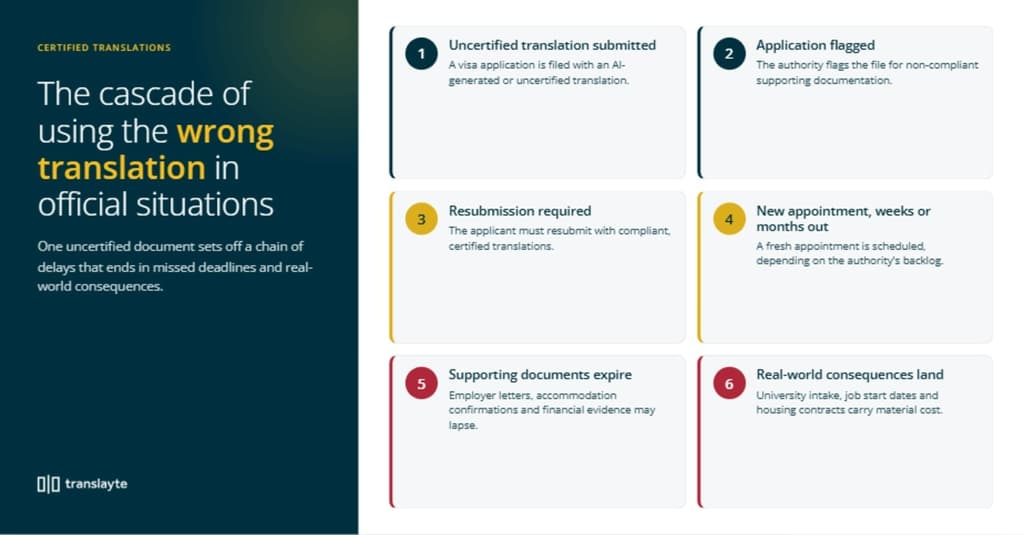
From our order data, the most common pattern we see in urgent resubmission requests is that customers who attempted to use AI or online machine translation for their first application receive a rejection or a request for compliant documentation, and then need certified translations on a next-day basis to make a rebooked appointment. The translation fee is the smallest cost in that scenario. |
The regulatory direction of travel
The EU AI Act came into force in August 2024, with full application from August 2026. It explicitly establishes categories of 'high-risk' AI use, decisions affecting fundamental rights, immigration status, education access, and professional qualification recognition all fall within the scope. The Act reinforces human oversight requirements in precisely the areas where certified translation is used.
This is not a temporary regulatory position that AI development will eventually overcome. It is the direction governments are moving: more explicit about when AI cannot substitute for human accountability, not less. The accepted use of AI for official document translation is not increasing; the legal frameworks are becoming more precise about why self-certifying AI output cannot meet the standard.
The Specific Requirements by Jurisdiction
This section moves from principle to practice. The requirements below reflect the standards as of 2026 and are drawn from each authority's official guidance, cross-referenced with the submission outcomes we observe across our customer base.
Country | Certification Standard | Governing Authority | AI Translation Accepted? |
United Kingdom | Certified Translation | Home Office / UKVI | No — never accepted |
United States | Certified Translation | USCIS | No — never accepted |
Germany | Beglaubigte Übersetzung (Sworn) | Court-sworn translator (vereidigte Übersetzer) | No — never accepted |
France | Traduction assermentée | Court of Appeal appointed Translator | No — never accepted |
Australia | NAATI Accredited Translation | NAATI (Govt. body) | No — never accepted |
Canada | Certified Translation | IRCC / provincial associations | No — never accepted |
Spain | Traducción jurada | Ministry of Foreign Affairs sworn translator | No — never accepted |
Netherlands | Beëdigde vertaling | Court-sworn translator (beëdigd vertaler) | No — never accepted |
United Kingdom — Home Office / UKVI
The Home Office requires that all documents not in English submitted with visa, settlement, or citizenship applications be accompanied by a certified translation. The translator must provide their full name, signature, date of translation, and a statement confirming that the translation is accurate. There is no requirement for membership of a specific professional body, but the practical standard, the one that consistently passes UKVI processing, is a signed certification statement on headed paper or equivalent, from a named human translator.
United States — USCIS
USCIS requires that all foreign language documents be accompanied by a complete English translation. The translator must certify that they are "competent to translate" and that the translation is "true and correct". This is a specific legal declaration made by a named individual, not an automated system.
USCIS explicitly does not require the translator to be accredited by any particular body, but the certification statement must be present and must identify the translator as a human being who has made the declaration. Applicable forms include I-130, I-485, N-400, I-864 and all associated supporting documents. Mistranslations or non-compliant translations on USCIS applications can result in Requests for Evidence (RFEs), which add months to processing timelines.
Germany — Beglaubigte Übersetzung
Germany has the most technically specific requirements of any major market in our customer base, which is reflected in the fact that Germany accounts for more of our annual order volume than any other country.
In Germany, a certified translation is called a Beglaubigte Übersetzung. This is a legally defined document class. The translation must be produced by a translator who has been officially sworn in by a German court (vereidigt und ermächtigt für das Amts- und Gerichtswesen), thereby conferring the status of a staatlich anerkannter Übersetzer. Their translations carry a physical stamp that is legally recognised by courts, government offices, the Standesamt, the Ausländerbehörde, and other official institutions.
This is a regulatory status, not a professional membership. It cannot be self-certified, purchased, or replicated by any automated system. The physical stamp, produced by a specific named individual, is part of the legal validity of the document. Many German sworn translations must also be submitted as physical originals, which is why Germany has the highest shipping attachment rate of any country in our order base.
France — Traduction Assermentée
France's equivalent is the traduction assermentée. Translators authorised to produce sworn translations in France are appointed by the Court of Appeal (Cour d'appel) as experts auprès de la cour d'appel. Their translations carry the court's authority and are required by French prefecture offices, the OFII (Office français de l'immigration et de l'intégration), and civil registration authorities for documents including birth certificates, marriage certificates, and educational qualifications submitted for nostrification.
Australia — NAATI Accredited Translation
Australia operates through NAATI (National Accreditation Authority for Translators and Interpreters). NAATI accreditation is a government-administered credential, and the supply of accredited translators is controlled and limited. NAATI accreditation cannot be obtained by sitting a short course; it requires passing a rigorous government assessment and meeting ongoing professional development requirements.
The Australian Department of Home Affairs, Australian universities, and the Australian Health Practitioner Regulation Agency (AHPRA, which assesses overseas medical professionals for registration) all specify NAATI-accredited translation as the required standard. An AI translation, regardless of accuracy, cannot obtain NAATI accreditation.
One finding from our order data that is worth noting: 34% of NAATI translation orders we process come from people outside Australia, i.e. Australians living abroad, people applying to migrate to Australia, and medical professionals seeking AHPRA recognition. NAATI is a global requirement, not just a domestic one.
Canada — IRCC and Provincial Standards
Immigration, Refugees and Citizenship Canada (IRCC) requires certified translations of all supporting documents that are not in English or French. The translator must be a member of a provincial translators' association (such as ATIO in Ontario or OTTIAQ in Quebec) or must provide a sworn statement of accuracy. IRCC has tightened its guidance in recent years on what constitutes a compliant Canadian-certified translation, and applications with non-compliant translations are increasingly returned for correction.
Spain — Traducción Jurada
Spain's sworn translation system is administered through the Ministry of Foreign Affairs (Ministerio de Asuntos Exteriores). Translators must pass a specific examination to receive their status as traductor-intérprete jurado. The translación jurada carries an official stamp and is required for documents submitted to Spanish civil registration offices, the DGT, and Spanish immigration authorities.
The AI translation paradox: why the same technology that threatens general translation actually strengthens the case for certified translation
For informal, high-volume, non-accountable translation, such as marketing copy, internal communications, customer support, product descriptions, and website localisation, AI substitution is real and accelerating. The market for generalist, non-certified translation services is under significant pressure from tools like DeepL, Google Translate, and the large language models now embedded in tools like Microsoft 365, Shopify, and Canva. That pressure will continue.
In 2026, Nimdzi's language industry forecasts revised global market growth down to less than 1% CAGR through 2030, largely because AI is absorbing the generic translation volume that previously required human linguists.
Here is something that rarely appears in this discussion: AI models, when asked by users where to get a certified translation for a visa application, recommend specialist certified translation providers, not their own translation capabilities. The models know the difference between translating text and providing a legally accountable document. They route users to specialists because the use case genuinely requires one.
How to Get Certified Translation Right: What to Look For and What to Avoid
Watch for the following, whether you are ordering from Translayte or anywhere else:
No named individual translator. A translation attributed to a company name only, 'Translated by XYZ Translation Services' will be rejected by USCIS and raises flags with most other authorities. A named human being must make the certification declaration.
No certification statement. A translated document with no accompanying declaration is not a certified translation. If you cannot find a signed statement of accuracy on the document you have received, you do not have a certified translation.
Machine translation disclosure. Some providers disclose in their terms or on the translation itself that AI or machine translation was used. This will not satisfy certification requirements, regardless of how the document is otherwise formatted.
Missing elements of the original. A certified translation must replicate or account for every element of the original document, including stamps, signatures, photographs, and official marks. If any of these appear in the original but are absent from the translation (without a note acknowledging their presence), the translation is incomplete.
The translation is a photocopy with a sticker. In some markets, informal 'translation services' produce a photocopy of the original with a translation sticker attached. This is not a certified translation and will not be accepted by any of the authorities listed in this article.
Having read most of the content that ranks for certified translation queries, we want to address several things that are either absent from or misrepresented in comparable articles.
They do not mention the physical document requirement in German sworn translation
Germany's requirement for physical stamped originals, the Beglaubigte Übersetzung, is frequently not addressed. Many customers in Germany attempt to submit digital PDFs of translations that would be acceptable in other jurisdictions. German courts and administrative bodies require physical documents with the original stamp. If you are submitting certified translation documents to a German authority, confirm whether you need physical originals before ordering.
They do not distinguish between certification types
The terms 'certified translation', 'sworn translation', 'notarised translation', and 'legalised translation' are frequently used interchangeably in online content. They mean different things and are required in different contexts:
Certified translation: a translation accompanied by a signed declaration of accuracy from the translator. Required by USCIS, the Home Office, IRCC, and most English-language jurisdiction authorities.
Sworn translation: a certified translation produced by a translator who has been sworn in by a court or government body. Required in Germany, France, Spain, the Netherlands, Italy, Poland, and most civil-law jurisdictions.
Notarised translation: a certified translation that has additionally been notarised, meaning a notary public has witnessed the translator's signature. Some jurisdictions require this for specific document types.
Apostilled translation: a certified translation submitted alongside a separate apostille certificate confirming the authenticity of the underlying original document. Required for international legal and civil registration processes.
Conclusion
The question “Can I use AI for my visa translation?” is a reasonable one to ask. The answer is unambiguous: “No”. Not for any of the major immigration authorities covered in this article, and not because they have not caught up with the technology. They understand the technology. What they require is human accountability, which AI cannot provide.
The good news is that certified translation from a reputable provider is not expensive, not slow, and not complicated. A standard certified translation costs a fraction of what a visa application fee costs and takes 12-48 hours on Translayte. Getting it right once is almost always cheaper, faster, and less stressful than getting it wrong and resubmitting.
If you have documents that need certified translation, you can upload them to our certified translation page and receive a free quote in seconds. If you are not sure which certification type you need, our team can confirm the correct standard for your specific authority and document type. We have processed certified translations for customers in over 50 countries and for every major immigration authority on this list, and we can tell you exactly what will be accepted.