Do I need an International Driving Permit in Thailand?
If you plan to drive in Thailand, you must have an International Driving Permit (IDP) and a valid driver's licence from your home country. The IDP is an official translation of your licence into multiple languages, making it easier for local authorities to verify its validity.
An IDP works alongside your home licence, you must carry both at all times to avoid getting in trouble with the local Thai police.
Driving without a valid IDP in Thailand is a traffic offence that can result in fines of up to THB 1,000 and, in some cases, vehicle impoundment.
Note: If your licence was issued in another ASEAN country, such as Malaysia, Singapore, or Vietnam, Thailand recognises it under the ASEAN agreement on domestic driving licences, so you don’t need an IDP to drive as a visitor.
Types of IDPs used in Thailand
Thailand is a party to the 1949 Geneva Convention on Road Traffic, so the 1949 IDP is the permit to rely on. Before you travel on a 1968-format IDP, confirm with the Thai authorities or your rental company that it will be accepted. The two IDP types correspond to different international road traffic agreements:
The 1949 IDP: This permit is based on the 1949 Geneva Convention on Road Traffic and is valid for one year. It is suitable for short-visit travellers and tourists who plan to drive in Thailand.
The 1968 IDP: This permit is based on the 1968 Vienna Convention on Road Traffic and is valid for three years from the date of issue or until your national driving licence expires, whichever comes first.
IDP Type | Convention | Validity | Best For |
1949 IDP | Geneva | 1 year | Tourists / short stays (Thailand is a party to this convention) |
1968 IDP | Vienna | 3 years or until licence expires | Long-term residents / expats (confirm acceptance in Thailand first) |
How can I get an IDP?
Follow these easy steps to get an international driver's permit
1. Check if you’re eligible: To obtain an IDP, you must be at least 18 years old and hold a valid driver's licence from your home country.
2. Gather the necessary documents: Prepare the following essential documents:
3. Submit your application: Visit the office of the recognised issuing authority in your country, such as the American Automobile Association (AAA) in the U.S. or a participating PayPoint store in the U.K. Submit your documents and pay the application fee. You should get the IDP immediately or within a few days.
Note: You must get your IDP in your home country. Thailand does not issue IDPs to foreigners who only have their home country's driver’s licence.
Where to get your IDP by country
United States - American Automobile Association (AAA) or AATA
United Kingdom - participating PayPoint stores
Australia - NRMA, RACV, or your state's motoring club
Canada - CAA (Canadian Automobile Association)
India - your local Regional Transport Office (RTO), and you can start the application through the Parivahan Sewa portal
Note: Allow at least 2–3 weeks before travel in case of postal delays.
Tips for a smooth IDP application process
Applying for an IDP for use in Thailand can be straightforward if you are well prepared. Here are some tips to help you:
Start early: Begin the application process well before your planned travel date. This gives you plenty of time to gather the necessary documents and address potential issues.
Use official websites for information: Always verify information about the IDP application process on the official website or through the authority's contact channels. This ensures you follow the correct procedures and get the most current application forms.
Double-check everything before submission: Before submitting your application, review all forms and documents to ensure you provided the correct information and included all required documentation. Doing so prevents delays due to incomplete applications.
Ask for assistance if needed: Don’t hesitate to contact the issuing authority directly if you have doubts or need more clarification. They can provide valuable guidance and ensure you have all the information you need for a successful application.
Always check for updates: Travel and licence regulations can change, so it’s important to verify the latest IDP requirements before your trip to avoid surprises or last-minute issues.
Check whether your supporting documents need certified translation: Some issuing authorities require that documents not in their national language, such as a foreign birth certificate or medical record, be accompanied by a certified translation. If in doubt, use a professional certified translation service to avoid delays.
How to get a Thai driving licence for foreigners
If you plan to stay in Thailand for a longer time or you intend to apply for residency, it’s better to convert your foreign driver’s licence to a Thai driving licence. This makes it easier for you to interact with local road safety authorities and removes the need to renew your IDP. Here are the steps to get a Thai driving licence. You can’t apply on a tourist visa. You need a non-immigrant visa or another long-stay visa.
Step 1: Gather the required documents
Before you apply for a Thai driving licence, you must gather all the required documents. This includes a valid passport with a non-tourist visa, a certificate of residence from the Immigration Bureau or your embassy (or a work permit showing your address), and a medical certificate from a Thai clinic or hospital confirming you are fit to drive, issued within the past month. If you are converting a foreign licence, also bring the original licence and your IDP.
Step 2: Visit the Department of Land Transport (DLT) office
Once your documents are complete, visit the Department of Land Transport to apply for a Thai driver’s license. You typically complete applications in person at a DLT office near you. Arrive early to avoid queues. Alternatively, you can book an appointment in advance with the DLT Smart Queue website or app. DLT offices are usually open from Monday to Friday, 8:30 AM to 4:30 PM.
Step 3: Submit your documents
At the DLT office, you’ll need to submit all required documents. You will also receive a registration form, which you must complete in Thai or English. Ensure you have photocopies of all your documents along with the originals.
If your home country driver’s licence is not in English, you must provide an IDP or a translation of the licence into English or Thai that has been attested by your embassy.
The Department of Land Transport (DLT) does not accept machine-translated or unverified translations. In some cases, you may also need a notarised translation.
Note: Thailand acceded to the Apostille Convention on 30 June 2026, and the Convention enters into force for Thailand on 28 February 2027. Once it is in force, public documents issued in other member countries can carry an apostille for use in Thailand, which can replace consular legalisation. Until then, the current legalisation requirements still apply, so confirm with the DLT what it will accept for your documents.
Step 4: Take the required tests
At the DLT office, you’ll first take a short physical test to check your eyesight, including colour vision, reaction time, and depth perception.
If you are converting a valid foreign licence, you skip the practical driving test, though some DLT offices also ask conversion applicants to watch a training video or sit the written test, so check with your local office. If you don’t have a foreign licence to convert, you must take the full set of tests: the written test, which is made up of 50 multiple-choice questions covering Thai traffic laws and road signs.
The test is available in English and other languages, and you’ll need to score at least 45 out of 50 to pass. If you pass the written test, you’ll be required to attend a training session.
This session teaches safe driving habits and basic maneuvers to prepare you for the final step: the practical driving test. The practical test takes place on a closed driving course and assesses your ability to perform basic tasks like parking, turning, and making emergency stops.
Step 5: Pay the licence fee
After you pass the required test, the next step is to pay the licence fee. The cost depends on the type of licence you're applying for. A two-year temporary licence costs about THB 205 (~$6), while a five-year licence is around THB 505 (~$15). If you're applying for a motorcycle licence, the fee is cheaper, roughly THB 105(~$3).
Step 6: Receive your Thai driving licence
Once you’ve paid the fee, you’ll be issued your Thai driving licence. First-time applicants will receive a temporary licence valid for two years. After this period, you can renew it for a five-year licence. To renew, you’ll need to provide your current licence, passport, visa, work permit or residence certificate, and a medical certificate. If you have a digital work permit, you must also get a certificate of residence from the Immigration Bureau or your embassy.
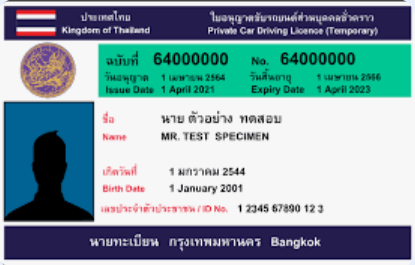
Sample of a Thai driving licence
Need a certified translation for your Thai licence application?
If your driving licence or other supporting documents are not in English, the DLT needs a translation into English or Thai. This translation must be attested by your embassy. A machine or informal translation won’t be accepted. Many embassies certify translations prepared by a professional translator, so check your embassy’s process first.
Services like Translayte provide certified document translations that meet DLT and official submission standards, with fast turnaround and online ordering.
Get a free certified translation quote today.
What is the process for renting a car in Thailand?
Choose a reputable rental agency: You can book a car online from a reputable car rental agency before you arrive in Thailand or use a rental service at the airport or in the city you intend to live in upon arrival.
Present your documents: To rent a car in Thailand, you must present your valid driver's licence from your home country along with your IDP. The 1949 IDP is the safest choice because Thailand is a party to the 1949 Convention. If you have a 1968 IDP, check with the rental company in advance to confirm they will accept it. Remember, you cannot use your foreign driver’s licence or IDP as a standalone legal document – one authenticates the other.
Review and understand the rental agreement: Read the rental agreement carefully before signing. Pay attention to details about the rental period, cost, insurance coverage, and any mileage limits or penalties. Understanding these details will help you avoid unexpected charges.
Check the vehicle’s condition: Inspect the vehicle thoroughly for any damage before taking possession. If you find any damage, ensure the rental agency documents it properly. This will protect you from being held responsible for pre-existing conditions when you return the car.
Inquire about insurance: While many rental agencies offer insurance coverage options, it’s crucial to understand what is covered. Sometimes, you may need additional insurance for comprehensive coverage, especially for collision damage and theft.
Understand local driving laws and conditions: Familiarise yourself with Thai traffic laws and driving conditions. Knowing the rules of the road and common driving practices can help you navigate safely and confidently.
Return the car as agreed: Return the car on time and in the condition stated in your rental agreement to avoid extra charges.
Final tips before you drive in Thailand
Before your trip, confirm which IDP type applies to your licence jurisdiction, apply through your home country's authorised issuing authority, and ensure any supporting documents are accompanied by certified translations if required. Always carry your IDP and original driver's licence together. Thai traffic authorities may ask to see both at any time.