If you are applying for a spousal green card, adjusting your status in the U.S., or filing for citizenship through marriage, you’ll need your Mexican marriage certificate (Acta de Matrimonio). This document is one of the requirements of the U.S. Citizenship and Immigration Services (USCIS) for proof of your relationship.
However, Mexican marriage certificates (Acta de Matrimonio) are issued in Spanish and are not valid for use in the US without a certified translation. This means you must have an authorised translator translate the marriage certificate from Spanish to English to meet USCIS translation requirements.
In this article, you will learn about the USCIS marriage certificate requirements, translation steps, cost, and tips to ensure your documents are accepted.
Do I need to translate a Mexican marriage certificate for USCIS?
Yes, you absolutely need to translate your marriage certificate from Spanish to English for U.S. immigration purposes. Some scenarios where you will need a certified translation of a Mexican marriage certificate online are:
Family-based immigration petitions (Form I-130, I-129F)
Adjustment of Status (Form I-485)
Consular processing (Immigrant visa abroad)
Naturalisation based on marriage (Form N-400)
Waivers and humanitarian petitions (Form I-601, VAWA)
Removal of conditions on residency (Form I-751)
Derivative benefits for spouses in other applications
The certified translation must be done by a competent translator in your country, the US, or elsewhere. They must also attach a statement that the translation is accurate and that they are qualified to translate. This helps USCIS officials understand and verify the information provided.
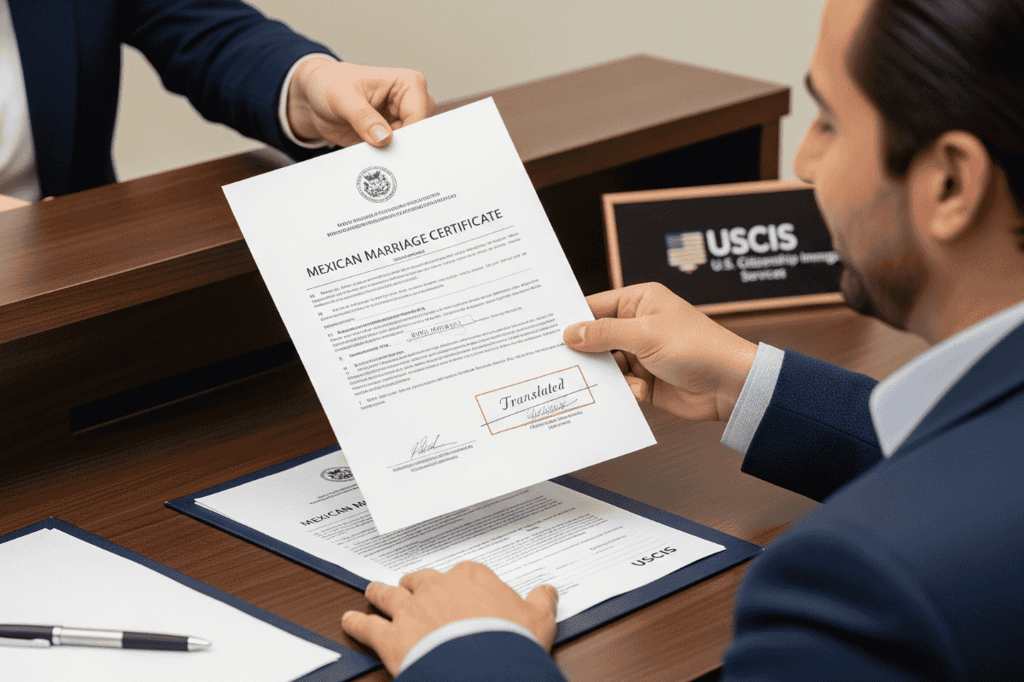
What USCIS requires in a certified translation
For USCIS purposes, a certified translation of a marriage certificate must be complete, accurate, and follow specific guidelines. Here’s what your certified translation for USCIS should include:
Certification of translation accuracy from the translator that clearly lists their name, signature, date, and contact information.
A statement from the translator that the translation is complete and accurate.
A declaration that the translator is competent in both English and Spanish (or the relevant language).
A full translation of the Mexican marriage certificate, including front and back, stamps, seals, and any marginal notes, with no omissions.
Note: Notarisation (i.e., having a notary public affix a notary public stamp to the translation) is not required by USCIS, although some consulates or other agencies may request it. USCIS also does not certify translators; the translator’s own certification counts.
For step-by-step details and examples, you can read our comprehensive guide on USCIS translation requirements to avoid mistakes and delays.
Understanding the Mexican marriage certificate (Acta de Matrimonio)
A Mexican (Acta de Matrimonio) is the official civil marriage certificate in Mexico. It serves as official proof of your marriage in Mexico and must be registered with the Mexican Civil Registry. The elements in a Mexican marriage certificate are:
Names of the spouses: Full legal names, often including both paternal and maternal surnames.
CURP (Clave Única de Registro de Población): A unique identification code similar to a Social Security Number in the U.S.
RFC (Registro Federal de Contribuyentes): The federal taxpayer registry code, sometimes included.
Dates: The marriage date and the date the certificate was issued or registered.
Place and registry office: The state, municipality, and specific Civil Registry office where the marriage was recorded.
Witness information: Names of witnesses present at the marriage ceremony (often included in official records).
Marginal notes (Anotaciones Marginales): Handwritten or stamped notes that may record later events such as divorce, annulment, adoption, or legal name changes.
Official stamps and seals: Government seals, embossed stamps, and signature blocks from registry officials.
Note: Foreigners getting married in Mexico must submit specific documents, such as birth certificates, passports, and prenuptial agreements, to the Registry Office as part of the marriage process. This ensures you get a marriage certificate and your union is recognised in Mexico and internationally.
Step-by-step: How to get a USCIS‑ready translation (Spanish to English)
Getting a Mexican marriage certificate translated for US immigration can be straightforward if you follow the right steps. Here are the typical steps to follow:
Step 1: Obtain the original, clear scan, or photo of the marriage certificate
Obtain a high-resolution scan or photo of your complete Mexican marriage certificate. Your scan should include both the front and back, along with all stamps, seals, and marginal notes, to ensure you don’t miss anything. If your certificate is damaged or invalid, you must get a new one from the Mexican civil registry.
Step 2: Translate a Mexican marriage certificate online
Find a translator or professional translation company, such as Translayte, that offers USCIS translation services and has experience in translating civil documents for USCIS. Select certified translation for USCIS, upload your certificate directly, pay fees, and submit your order.
Step 3: Translation & certification
A professional translator will prepare a complete, accurate English marriage certificate translation with every seal and annotation. The translation includes a signed Certificate of Accuracy with the translator’s name, signature, date, and contact information.
Step 4: Receive your certified translation
You’ll typically receive a PDF copy of the certified translation by email within a stipulated timeline. At Translayte, delivery typically takes 12 to 24 hours, but it may take longer depending on volume. If required, you can also print it for mailing or request a paper copy if a consulate, court, or other agency specifically asks for it.
Request a quote to get Mexican marriage certificate translation services for USCIS from Translayte.
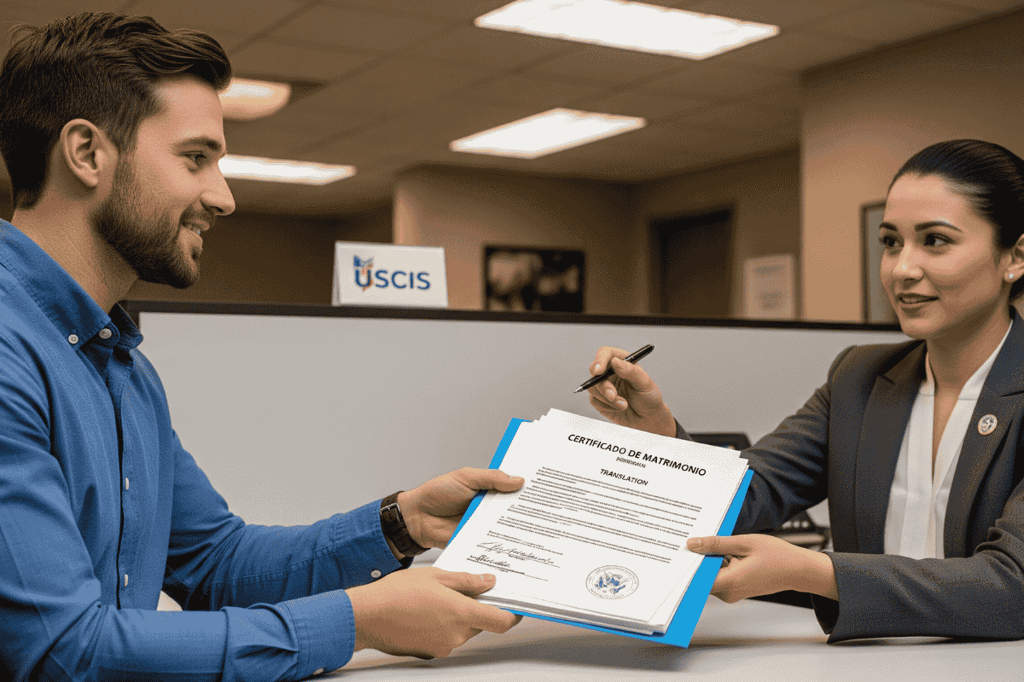
Do I need an apostille or notarisation for USCIS?
For USCIS filings, you do not need an apostille or notarisation for your translated documents. A certified translation that includes the translator’s signed certification of accuracy is enough to meet USCIS requirements.
However, if you are presenting your Mexican marriage certificate outside the U.S., for example, at a U.S. consulate abroad, the National Visa Center (NVC), or a foreign government office, you may be asked to provide an apostille or legalisation of the original certificate to confirm its authenticity.
Costs & timelines: Mexican marriage certificate translation
The cost of Mexican marriage certificate translation services typically ranges from $20 - $40 per page, depending on the provider and turnaround time.
Standard delivery: Most professional translation companies deliver within 24–48 hours. However, Translayte offers a 12-24-hour delivery timeline.
Urgent requests: Same-day or 12-hour delivery is often available for an additional fee.
Additional services: You will incur an extra fee if you request a paper copy to be delivered by post. The cost varies by courier and location.
Common errors that cause RFEs or delays and how to avoid them
Submitting a translation that doesn’t meet USCIS standards can result in a Request for Evidence (RFE) or delay in your application. Here are the most frequent mistakes:
Partial scans or photos: Missing corners, cut-off text, or blurry sections can make the certificate incomplete. Always scan the entire certificate in colour and save it as a clear PDF.
Missing marginal notes: Failing to include annotations about divorce, adoption, or name changes leads to rejection. Ensure the translator translates every annotation, including divorce records, name changes, or handwritten notes.
Untranslated seals and stamps: Translate every official mark, even if it is repetitive. Ensure that all seals, stamps, and signatures are translated, even if they are repetitive and appear in multiple places.
Template or “summary” translations: USCIS requires a full, line-by-line translation, not a shortened template. Request a line-by-line translation that mirrors the structure of the original document.
Missing translator certification statement: Without the signed certification of Accuracy, the translation is invalid. Check that the translation includes a signed Certificate of Accuracy with the translator’s details.
Name or date mismatches: If names, spellings, or dates don’t align with passports or other documents, USCIS may flag inconsistencies. Cross-check spellings and dates against your passport and other documents.