What is an Apostille in Australia
An Apostille in Australia is a specific type of certification issued by the Department of Foreign Affairs and Trade (DFAT) that confirms the authenticity of a document's signature, seal, or stamp for countries that are members of the Hague Apostille Convention.
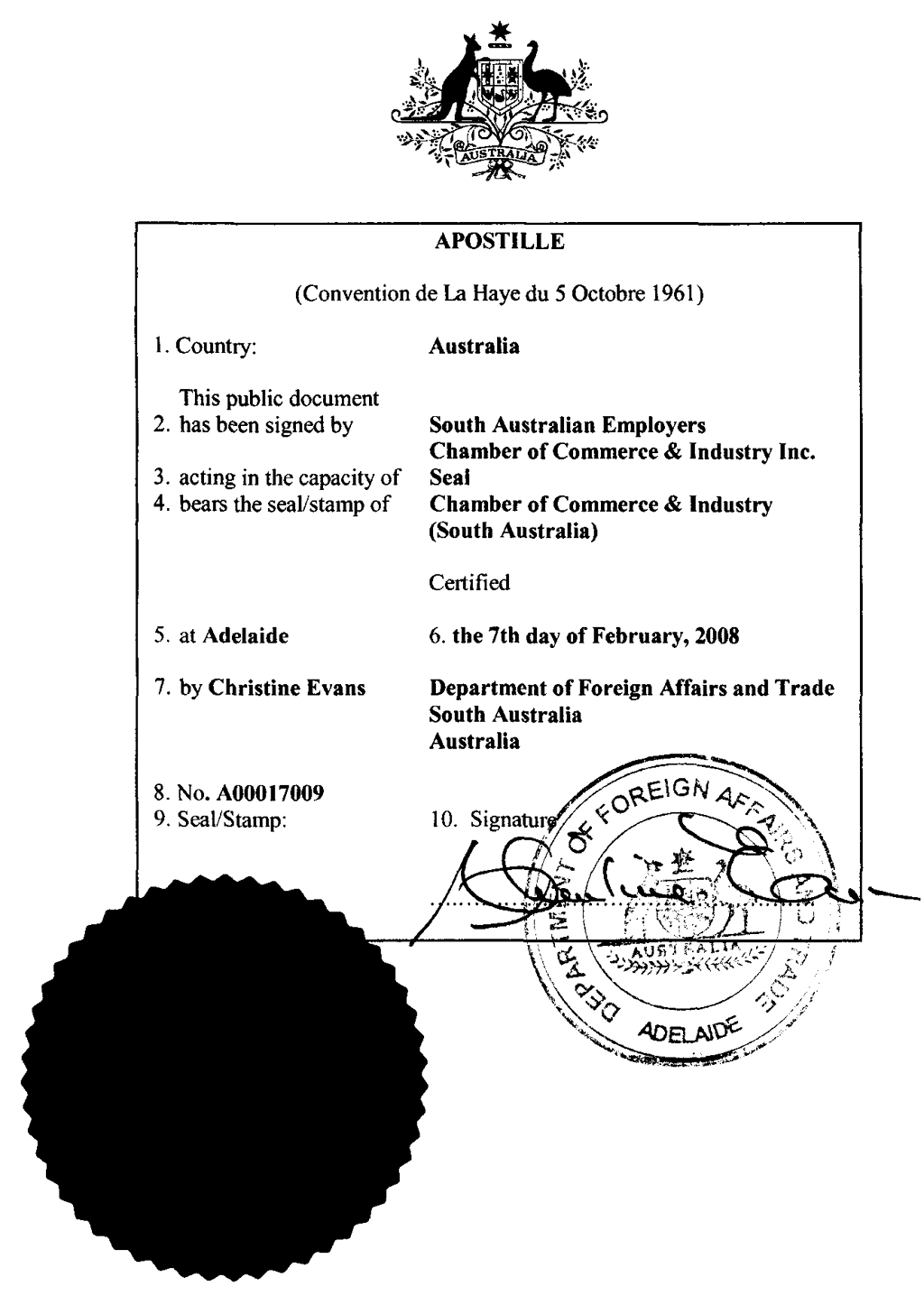
It is a 9x9 cm square certificate that includes details such as the country where the document was issued, the authority of the person or organisation that issued the document, the date of the Apostille, the name of the officer, the seal and stamp of DFAT, and the Apostille number.
An Apostille simplifies the process of authenticating documents for international use. Countries that are signatories to the Hague Convention agree to recognise an Apostille as a valid certification for documents issued by authorities within the same country.
Important distinction: Apostille vs. Authentication:
• Apostille is required for documents going to countries that are members of the Hague Apostille Convention (120+ countries as of 2026, including the UK, USA, most of Europe, India, Japan, New Zealand, and Brazil).
• Authentication Certificate is used for countries NOT in the Hague Convention, such as the UAE, Vietnam, Thailand, Jordan, Kuwait, Egypt, and Malaysia. Authentication goes through DFAT but requires an additional step of embassy or consulate legalisation in the destination country.
Both certificates are issued by DFAT at the same cost ($102). The only difference is whether the destination country is a Hague Convention member.
Note: Documents that are not in English must first be translated and notarised by an Australian Notary Public before they can be submitted to DFAT for an Apostille.
When do you need an Apostille in Australia?
This is typically necessary for documents such as Australian birth certificates, marriage certificates, academic transcripts, and other official documents that require legal recognition abroad. Specific scenarios include:
When using documents issued by the Australian government overseas
To prove the authenticity of public documents such as birth, marriage (excluding ceremonial certificates), or death certificates
For visa or residency applications abroad, where the intended destination country requires legalised Australian documents.
To register your Australian marriage overseas, especially in a country that requires foreign documents to be apostilled.
For employment or study abroad, you will need to submit Australian qualifications or undergo a police check.
To establish business or financial relationships in another country that is a party to the Apostille Convention. Use cases include setting up a company, opening a bank account, and submitting legal documents to authorities abroad.
For international adoption, Australian documents must be recognised in another country.
To prove single status or divorce when marrying abroad, especially where proof of capacity to marry is needed.
For transferring inheritance or property overseas, when Australian probate or legal documents are involved.
If your child is travelling without both parents, the overseas authorities may request documents to prove that your child is authorised to travel.
Documents for Chinese authorities now require an apostille rather than the previous full embassy legalisation, a significant time and cost saving for anyone using Australian documents in China.
Canada joined the Hague Convention in January 2024. Australian documents for Canadian authorities now require a DFAT apostille.
Note: If the receiving country is not a party to the Hague Apostille Convention, you will require authentication. This is typically done at the embassy or consulate of the destination country in Australia. Not all overseas authorities require an apostille. Many immigration offices, universities, and employers accept original documents or simple certified copies without legalisation. Always confirm with the receiving authority (not just a third-party service provider) before spending money on notarisation and apostille fees. You can confirm this information with the country's embassy or consulate in Australia.
Recommended Reading
Australia Awaits - Navigating the Sea of Visa Types
Who can Apostille a document in Australia?
The Department of Foreign Affairs and Trade (DFAT) is the only Australian government body that can issue an Apostille. It issues Apostilles through the passport office in each Australian state and capital city. In the case of private documents, an Australian Notary Public must first notarise them, before they can be submitted to DFAT for an Apostille.
What documents can be apostilled?
The DFAT issues apostilles for various types of documents. This includes public government-issued documents, university documents, original private documents, and other relevant materials. Here’s a breakdown of the different categories:
Original documents issued by the Australian government
These are public documents issued by Australian authorities, including registries, courts, police, and other government departments. They must be original documents, or copies of documents notarised by an Australian Notary Public, to be eligible for an apostille. Documents under this category include:
University documents
This includes academic documents issued by an Australian university recognised in the country. If you are submitting original academic documents, they must be certified as “true and accurate record” by the issuing institution or copies notarised by an Australian Notary Public. Here are some documents:
Note: You can submit copies of your Australian academic documents; however, they must be notarised by a Notary Public and verified by the university. The notarised documents must also include the statement, “the original record has been verified with the issuing institution.”
Australian TAFE documents
You can obtain an apostille for original and notarised copies of documents from the Australian Public Colleges of Technical and Further Education (TAFE). Certified true copies from justices of the peace or other authorised witnesses won’t be accepted for the apostille stamp.
Australian private school and college documents
You can submit documents from Australian private schools, colleges, registered training organisations (RTOs), and Australian Skills Quality Authority (ASQA) to be apostilled. However, they must first be notarised by a Notary Public. In some cases, the Department of Education in the Australian state or territory can also verify and apply its departmental seal to original education documents issued by private schools and colleges. If that’s the case, you can also submit such documents for an apostille in Australia.
Australian primary and secondary school documents
In Australia, certain documents issued by primary and secondary schools can be authenticated through the apostille process. However, these documents must be original, verified, and signed by an authorised officer from the relevant state or territory government education body. If the first option isn’t available, you can submit documents notarised by an Australian Notary Public.
Other documents notarised in Australia
You can get an apostille certificate for a document notarised in Australia, like
Private documents (e.g. Power of Attorney, wills, bank statements, company documents)
Documents issued by an authorised Australian chamber of commerce and industry
Documents in a foreign language, if prepared by a Notary Public in Australia
Certificate of incorporation of an Australian company
Notarised copy of passport, driver's licence, and other identity documents
Document translated by NAATI translators
Consent letters for children to travel or visit overseas
Note: If you need an apostille for other documents without submitting the original, they must first be notarised by a Notary Public in Australia. You should also confirm with the issuing and receiving authorities if it needs to be apostilled.
Recommended Reading
Australian Work Visas: Types, Costs and Requirements

How to apostille a document in Australia: Step-by-Step
To obtain an apostille for documents in Australia, they must be issued by an Australian government department or notarised by a Notary Public, and then submitted to the Department of Foreign Affairs and Trade (DFAT) for Apostille certification. Here are the steps:
Confirm requirements
Before submitting your documents to DFAT for an Apostille, you must confirm if they meet the requirements. This involves contacting the receiving authority in the overseas country to verify if the document needs an apostille stamp. Also, verify if the document is eligible for an apostille by DFAT, or if you'd need consular legalisation.
Gather your documents
If you meet the eligibility requirements, gather the necessary documents. Confirm whether you have original copies, and if they are legible and undamaged. If you are using foreign academic documents, request the required authentication and original copies from your institution if they aren't already available. Additionally, if the document is not an Australian public document, you should take it to the Notary Public for notarisation first before proceeding.
Note: You must translate any documents not issued in English before notarisation. Use NAATI-certified translators to ensure DFAT accepts them.
Request apostille services from DFAT
In Australia, you can request notarial services via mail or in person. To request the service, you must complete the document legalisation request form. Ensure you fill out all sections accurately and completely; DFAT doesn't accept incomplete requests.
Submit your documents
There are two options when submitting documents for an apostille in Australia.
Option 1: Submit in person
You can submit your documents and forms at any Australian Passport Office. However, you must book an appointment before attending. If you aren't available, someone can attend on your behalf. There are different locations where you can submit your documents in person. You can book online instantly for your DFAT apostille appointment through the links below for the office in the Australian state where you reside or you'd like to submit:
Here are a few things to do:
Make sure you've prepared everything you need.
Bring a credit or debit card with you for payment.
Bring a self-addressed registered post envelope, if you want your legalised documents returned to you by mail.
Ensure you follow all requirements. Failure to submit all necessary documents will result in the application being rejected. To continue the process, you'll have to book another DFAT apostille appointment for a later date.
Option 2: Submit by mail
You can send your forms and original documents via registered post. This is useful if you don't have the time to visit a passport office for in-person legalisation services. When submitting via mail, include the following:
Also, ensure you keep a copy of both tracking numbers. You can send your application to any of the addresses below:
GPO Box 2239
MELBOURNE VIC 3001
GPO Box 2239
SYDNEY NSW 2001
Pay DFAT Apostille fees
Pay the DFAT apostille fees to complete the process. Currently, the cost of an apostille in Australia is $102. However, it increases on January 1st each year, in line with the Consumer Price Index (CPI). Always confirm before making payments.
Wait for processing
Once you've applied, the officers will check the signature and seal on your documents against the DFAT database. They will verify the signature or seal by issuing an apostille certificate directly on the document.
In some cases, DFAT might have to contact the issuing authority, which can delay the process. However, you’ll be notified if that happens.
Note: If your application is incomplete, DFAT will return the documents via post with a letter outlining the next steps.
by post, along
Receive your apostilled documents
If the application is complete and meets all requirements, your documents will be apostilled. You can collect them from the Australian Passport Office, or they will be delivered to you in the self-addressed envelope you provided with your application.
If you need more information, you can contact DFAT via email at [email protected]
Note: You can also verify an Australian-issued apostille online when you've received it.
Recommended Reading
Guide to Wills and Estate Planning in Australia
Full cost of getting an apostille in Australia (2026 Guide):
DFAT Apostille fee: $102 (increases 1 January each year with CPI — confirm at smartraveller.gov.au before submitting)
Notary Public fee (if document requires notarisation): typically $150–$400+ depending on provider and document complexity
Certified translation (if document is not in English): approximately $35–$150 per document with a NAATI-certified translator
Third-party apostille service (optional, if you prefer not to attend DFAT yourself): varies by provider, typically $100–$250 on top of the DFAT fee
Registered post (mail submission): standard registered post rates apply; retain both tracking numbers
Total typical cost: $102 (apostille only, no notarisation) to $650+ (apostille + notarisation + translation + service fee)
How long does it take to get an Apostille in Australia?
The processing time for an Australian apostille is typically 3 business days. However, the general process can take up to 6 weeks.
Part 1:Getting a DFAT appointment (if submitting in person):
This is currently the biggest delay. Appointment wait times as of July 2025:
Sydney: approximately 6 weeks
Melbourne: approximately 3 weeks
Brisbane: approximately 3 weeks
Other cities: Vary
Tip: Book your appointment as early as possible and check back regularly; cancellations open up same-day and next-day slots.
Part 2: DFAT processing time after lodgement:
Once DFAT receives your documents (in person or by post), the processing time is typically 2–3 business days.
Submitting by mail: Avoids the appointment wait but adds time for postage in each direction (allow 2–5 business days each way). Total timeline by mail: typically 1–2 weeks from posting.
Using a specialist apostille service: Providers who attend DFAT daily can lodge same-day or next-day and turn documents around in 2–4 business days from receipt, bypassing appointment wait times entirely.
Important: Allow extra time around public holidays, especially Easter (March/April) and Christmas/New Year (December/January), when DFAT appointment availability drops significantly.
Electronic Australian public documents
DFAT also accepts a limited range of official Australian public documents electronically. But you must provide it in its original electronic form for DFAT to issue the Apostille. When you lodge a document via mail or in person, it will be assessed first. The officers need to review it before they can confirm whether it can be processed. This cannot be done over the phone. The verification process involves forwarding the email sent by the issuing authority with the electronic document attached or linked in the email. Alternatively, if the original electronic document is accessible via a web portal, you can provide the portal login details.
My eQuals
If you have Australian university academic documents (degrees, transcripts, awards) issued digitally through the My eQuals platform, they can be apostilled entirely online through DFAT, with no appointment required and no original hard-copy document needed.
How it works:
Log in to My eQuals and download your digital academic credential.
Use the share function within My eQuals to send the document directly to a notary public or apostille service provider registered on the platform.
The provider completes the DFAT authentication process fully online.
DFAT processing time via My eQuals: 2–4 business days.
This is faster than the standard postal or in-person process and avoids having to locate the original hard-copy document. If you graduated from an Australian university that uses My eQuals, this is the recommended pathway.
Note: Not all Australian universities use My eQuals. Check with your institution before attempting this pathway.
When are certified translations required?
If you are submitting documents that are not issued in English, you will need a certified translation. This translation ensures that the relevant authorities accurately understand the information in the document and that it meets the requirements.
DFAT translation compliance checklist
The DFAT authorities can legalise some translated documents. However, the translation you submit for legalisation must include:
The translator's name and signature
The translator’s official National Accreditation Authority for Translators and Interpreters (NAATI) seal (stamp), including their practitioner ID
The date of translation
You must also submit a copy of the original document, with a signature and/or seal from the translator. The above must be contained on every page.
How Translayte can help
The DFAT only accepts translations completed by a NAATI-certified or recognised translator. That's where Translayte comes in. We provide professional translations by NAATI-certified translators that meet your DFAT apostille services requirements. With Translayte, you can enjoy:
Certified translations with 100% acceptance by the Australian government, courts, DFAT, and other authorities globally
Transparent, competitive translation rates starting at AUD 59 ($38.42) per page.
Fast delivery with a 12-to 24-hour window, depending on the document type and volume. You also have options for expedited delivery
Secure online ordering process with multiple payment options
24/7 multilingual customer support via email, phone, and WhatsApp.
Multi-step quality assurance checks to ensure you receive accurate translations
Additionally, we provide notarised translation services for documents issued by entities other than the Australian government that require notarisation by a Notary Public.
Ready to start your apostille process in Australia? Request a free quote for certified translation services and notarisation from Translayte.
Common apostille mistakes to avoid (that cause DFAT rejections)
Submitting photocopies or scans instead of originals: DFAT requires original documents or notarised copies; scans and unofficial photocopies are rejected immediately. Always confirm whether you need the original or a notarised copy before submitting.
Forgetting to book an appointment before attending: Walk-ins are not accepted at DFAT offices. You must book in advance via Smartraveller. In Sydney, wait times are currently up to 6 weeks.
Not confirming whether the destination country requires an apostille: Many overseas authorities don't require legalised documents. Paying $102+ for an apostille you don't need is a costly mistake. Always check with the receiving organisation first.
Sending documents to the wrong country type: Using an apostille for a non-Hague country (like the UAE or Vietnam) will result in rejection. For non-Hague countries, you need an Authentication Certificate from DFAT plus embassy legalisation.
Submitting an incomplete legalisation request form: DFAT will reject incomplete forms and return your documents by post, restarting the timeline. Fill out all sections of the Document Legalisation Request Form before submitting.
Not paying with an accepted payment method: For in-person submissions, bring a credit or debit card. For mail submissions, use the credit card authorisation in Section 7 of the form. DFAT does not accept cash.
Missing the NAATI seal or practitioner ID on translated documents: Even a single missing element in a translation will cause DFAT to reject the document. Every page must carry the translator's name, signature, NAATI seal, practitioner ID, and the date of translation.
Underestimating the total timeline: Many applicants plan around the 3-business-day processing time without accounting for the 3–6 week appointment wait in major cities. Build in at least 8 weeks if submitting in person in Sydney.

.png)
.png)