





What is a Notarized Translation
A notarized translation is a translated document that has been signed and sworn before a notary public.
The notary’s role is not to assess the quality of the translation but to confirm the identity of the translator and verify that they have sworn the translation is accurate to the best of their knowledge.
In other words, the notary certifies the identity of the translator, not the translation itself.
Depending on the country where your document is to be used, a notarized translation may not be sufficient. You may need Foreign Office legalisation or consular legalisation to make your document valid for cross-border use.
At Translayte, your translations are completed by qualified, vetted translators, and then notarized by authorized notaries. This gives your document both the accuracy required by official bodies and the legal formality that notarization provides.
We also offer digital notarization, which carries the same legal validity as physical notarization. You can notarize documents such as birth certificates, marriage certificates, academic records, affidavits, and more, from anywhere in the world.
Over 100,000 happy clients trust us for notarized translations that are clear, compliant, and accepted worldwide.
Need a notarized translation you can rely on? Order online in minutes, fast, secure, and officially recognised.
Digital vs. Physical Notarization
When getting a notarized translation, you can choose between digital notarization and physical (paper) notarization. Translayte offers both options, so you can select the option that best meets the requirements of the authority receiving your document.
Digital Notarization: This involves the use of secure electronic signatures and digital seals. It’s fast and convenient when you need a notarized translation quickly. You’ll receive your notarized file as a PDF, ready to download, print, or submit electronically. However, acceptance varies. Some courts, embassies, or organizations only accept a physical notarized document, so it’s always best to confirm what the receiving party requires.
Physical Notarization: Physical notarization involves a notary public signing, stamping, and sealing the printed translation. This version is widely recognised and accepted globally. Once completed, Translayte can ship the notarized hard copy to your address, wherever you are.
Before placing your order, we recommend checking with the institution requesting your document to confirm whether they accept digital notarization or require a physical original. This ensures you select the right format and avoid delays in your application.
The Difference Between a Certified and Notarized Translation
Many people confuse certified and notarized translations, but they serve different purposes and are required in different situations. The key difference is simple:
A certified translation confirms the accuracy of the translation made by the translator, while a notarized translation confirms the identity of the translator who swears the translation is accurate. Here’s a breakdown;
Certified Translation
A certified translation is one in which the translator or translation agency provides a signed statement, known as a Certificate of Translation Accuracy, attesting that the document translation is complete and accurate to the best of their knowledge. This certification does not require notarization, but it must include the translator’s credentials, signature, and contact information.
This certificate typically includes:
Statement of accuracy
Translator’s name, signature, and qualifications
Date of certification
Agency details, if prepared by a translation company
Certified translations are commonly required for immigration, education, employment, and many government processes.
Notarized Translation
A notarized translation involves the translator swearing an oath before a notary public to affirm that the translation is accurate and complete. The notary then certifies the translator’s statement by stamping and signing it. The notarization process does not verify the quality of the translation itself; it authenticates the translator’s identity and their attestation of accuracy.
Quick Comparison Table
Certified Translation | Notarized Translation |
|---|---|
Confirms the accuracy of the translation | Confirms the identity of the translator |
Signed by translator/agency | Signed before a Notary Public |
Primarily used for immigration, government, education, and employment purposes | Primarily used for courts, affidavits, legal filings, and international documents |
Focuses on accuracy & completeness | Focuses on authenticating the signer, not the content |
If you're unsure which type you need, our team can help you choose the correct option based on your destination country or receiving institution.
When do You Need a Notarized Translation?
You typically need a notarized translation when a document must be formally accepted in another country for legal, educational, corporate, or personal processes.
Here are the most common situations where notarized translations are required;
1. Educational Documents
Schools, colleges, and universities often ask for notarized translations of diplomas, transcripts, certificates, and academic records. This helps admissions teams verify that your qualifications meet their standards and that the documents are accurately reflected.
2. Legal Documents
Courts may require notarized translations of affidavits, powers of attorney, court orders, evidence, witness statements, and statutory declarations. Notarization adds an extra layer of authenticity that legal proceedings rely on.
3. Immigration Documents
For some USCIS cases, notarized translations may be requested for birth certificates, marriage certificates, personal records, and civil documents. This ensures the documents are legally valid and verified adequately for immigration purposes.
4. Business & Corporate Documents
Companies dealing with cross-border operations may need notarized translations of contracts, incorporation documents, patents, trademarks, tax returns, financial statements, and licensing applications. These help ensure compliance with regulatory and international business requirements.
5. Personal & Civil Records
Processes such as name changes, adoptions, divorces, property purchases, or estate matters often require notarized translations of IDs, passports, driver’s licences, written statements, and financial or property documents.
Translayte provides notarized translations that are accurate, secure, and accepted worldwide, all delivered in as little as 12-48 hours. Need a notarized translation for any of the scenarios above? Order online in minutes and get your notarized document fast.
Are Notarized Translations Always Necessary?
Not always, and this is where many people get confused. Whether you need a notarized translation depends entirely on the country, the authority, and the type of document. Some countries only require a certified translation, while others insist on notarization or even additional legalization steps.
For example, in the United States, notarized translations are generally not required for immigration purposes. Instead, the United States Citizenship and Immigration Services (USCIS) requires certified translations.
In Canada, requirements may vary by immigration program and document type. While certified translations are commonly accepted, some documents, particularly those used in legal contexts, may still need to be notarized.
In Europe, the rules can be even tighter. For example, in Germany, notarized translations are often mandatory, especially for documents like birth certificates, marriage licenses, and academic credentials.
It’s always best to check the specific guidelines of the immigration office or government agency you are dealing with to avoid mistakes.
Immigration Translation Requirements by Country
To help you understand what applies to your situation, here’s a clear breakdown of immigration and official translation requirements by region.
United States
The United States Citizenship and Immigration Services (USCIS) does not require notarized translations. They only require a certified translation, which includes a signed statement confirming that the translation is complete and accurate.
Canada
The Immigration, Refugees and Citizenship Canada (IRCC) has different requirements depending on the immigration type and province. Certified translations are generally accepted for most IRCC applications. Some legal documents, especially those used in court or provincial matters, may require notarized translations.
If the translator is not certified by a provincial body (e.g., ATIO, STIBC, OTTIAQ), IRCC may request an affidavit before a notary to confirm accuracy.
It’s important to check the exact program requirements, as rules can differ between Express Entry, study permit, and provincial nominee programs.
United Kingdom
In the UK, notarized translations are not commonly required for immigration applications. Most Home Office applications simply require a certified translation. However, you may need a notarized translation for Court submissions, Overseas marriage/divorce documents, or Commercial/legal documents used in countries like Mexico, Portugal, and Turkey.
European Union Countries
Rules vary widely across the EU and can be stricter than in the US or UK. In Germany, notarized or sworn translations are often mandatory for most documents. In Spain, Spanish notaries handle deeds, contracts, and powers of attorney. For foreign documents, notarized or sworn translations may be required to prove authenticity before registration or legal use. In France, French notaries have a broad role and are deeply involved in real estate, inheritance, and marriage contracts. Translations used in these processes often need notarization or sworn certification. Some EU countries also require an apostille after notarization if the document is being used across borders.
How Our Notarized Translation Service Works
Upload your document securely: Start by uploading a clear photo or scan. Our platform is encrypted to keep your information safe at all times.
Get an instant quote: See your price upfront with no hidden fees. You can also view our Transparent Pricing page for more details.
Your translation is assigned: A qualified, vetted translator is assigned your document and accurately translates it to meet the requirements of the institution/country where it is to be used.
Notary public verifies the signature and attaches the notarial certificate: The translator signs a declaration, and an authorized notary public confirms their identity and notarizes the document.
Receive your notarized translation: You’ll receive a digitally notarized PDF via email. If you need a physical stamped copy, we can ship it to you.
Why Choose Professional Notarized Translation
A notarized translation adds a level of official recognition that many institutions require. It confirms that the translator's identity has been verified by a licensed notary public.
Translayte ensures every notarized translation meets international standards, so your documents are accepted confidently across borders.
Our notarized translation includes official proof elements such as:
Digital signature
Notarial seal or stamp
Statement of authenticity
Notary’s details and verification date
When you work with professional agencies like Translayte, you receive a clear, compliant, and legally recognized notarized translation.
Notarized Translations in 150+ Languages
We provide notarized translations in over 150 languages, including English, French, German, Spanish, Italian, Hungarian, Norwegian, and more. Each translation is completed by a professional translator fluent in both languages and reviewed through our multi-step quality assurance process.
Explore our complete list of languages we offer.
We Translate and Notarize Any Document
We provide notarized document translation services for all major document types, covering both personal and corporate needs.
These include;
Personal Documents: Birth certificates, marriage certificates, divorce decrees, passports, national ID cards, driver's licenses, police clearance certificates, diplomas and degree certificates, academic transcripts, medical records, and adoption or name change documents.
Corporate & Legal Documents: Contracts and agreements, court rulings, financial statements, mortgage papers, property deeds and titles, power of attorney, articles of incorporation, tax documents, patents and trademarks.
Notarized Translation Pricing
At Translayte, we believe notarized translations should be transparent, affordable, and accessible to everyone. Our cost for notarized translation starts at $24.50 per document, with the final price depending on the language pair, document type, and turnaround time. For urgent cases, we also provide express translation and same-day delivery for many document types.
Turnaround Time & Service Options
We understand that notarized translations are often time sensitive. That’s why we offer fast, reliable turnaround times designed to meet urgent deadlines without compromising accuracy.
Standard Delivery: 12-48 hours for most documents
Express Same-Day Service is available for short or simple documents
Digital notarized copies delivered directly to your email
Physical notarized copies shipped via secure courier upon request
What Will You See on the Notarized Document?
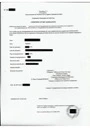
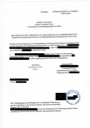
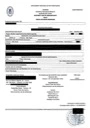
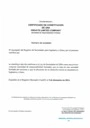
Our notarized translation includes clear, official elements that prove the translator’s identity has been verified and the document has been legally notarized. Here’s exactly what you’ll receive:
The notary’s signature
An official notary seal
The notary’s name and commission details
A certificate of translation accuracy stating the translation is complete and accurate. This will also include the translator’s name, signature, and the date the translation was certified and notarized.
The digital PDF format includes;
The translated document
The Certificate of Accuracy
The notary’s stamped and signed page
If a hard copy is required, we can send:
A printed, stamped, and signed notarized document
Delivered via secure courier on request
Notarized Translation & Legalized Translation
When submitting foreign documents abroad, you may need more than just a notarized translation. Some countries require legalization or an apostille to confirm the document’s authenticity for international use. Understanding the difference helps you choose the correct process.
What is Legalization?
Legalization is an additional step that may follow notarization. It is the process of verifying the authenticity of a document so it can be used in another country. It confirms that the signatures, seals, and stamps on the document are genuine and issued by the appropriate authority.
It is usually verified by:
The Foreign Ministry in your country, such as the Foreign, Commonwealth & Development Office (FCDO) in the UK.
The embassy or consulate of the destination country
Legalization confirms that the notary’s signature and seal are genuine, making the document valid for use abroad.
What is an Apostille?
An apostille is a specific type of legalization used between countries that are members of the Hague Apostille Convention. It is a government-issued certificate or stamp attached to your notarized document to confirm its authenticity internationally.
Many countries form part of what is called the Apostille Convention, and this includes all the European countries and the US; notable exceptions are North Korea and China.
The standard rule is that if the document is intended for use in a country that is a signatory to the Hague Convention of 1961, then it will require an Apostille, and if it is not part of the convention, it will require another form of legalization.
How to Notarize a Translation?
Notarizing a translation involves ensuring that the translated document is officially recognized and authenticated for legal purposes. Here's everything you need to know about it:
Who Issues Notarized Translations?
First, the professional translators or translation agencies prepare the certified translations of the document. After the translator completes the translation, a Notary Public is involved in notarizing the translation. The Notary Public does not verify the accuracy of the translation, but authenticates the identity of the person who signs the document, usually the translator or a representative of the translation agency.
When is the Translation Certificate Signed?
After translation is done, the translator or an authorized signatory of the translation agency signs a statement (usually referred to as a "Certificate of Accuracy") asserting that the translation is accurate and complete. This statement is then presented to a Notary Public.
The certificate is typically signed in the presence of the Notary Public. This ensures the signature is genuine and the signer is who they claim to be.
Do Notaries Keep a Record of the Translations?
Notaries Public do not keep a copy of the translations. However, they maintain a record or a journal of the notarial acts they have performed. This record includes details of the notarization process, such as the date of notarization, the type of document notarized, and the identity of the person who presented the document for notarization.
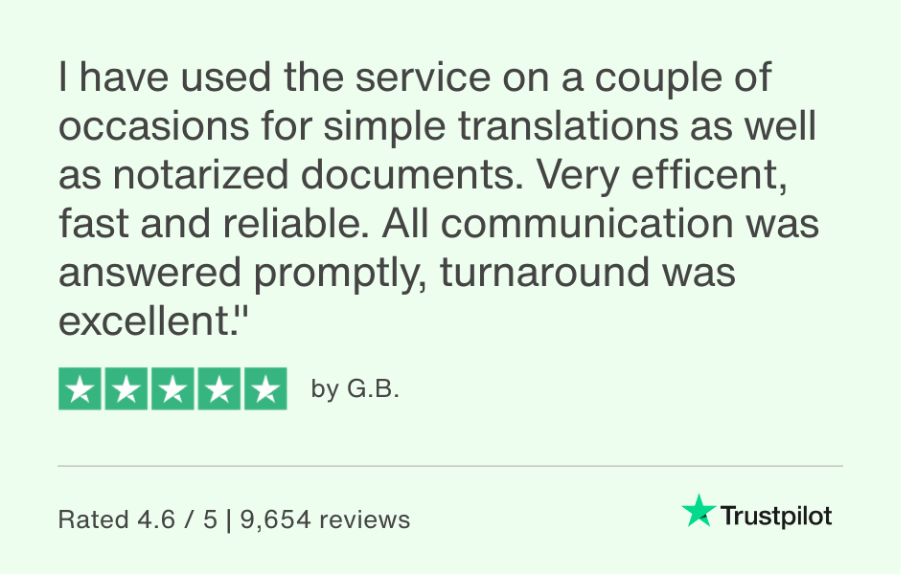
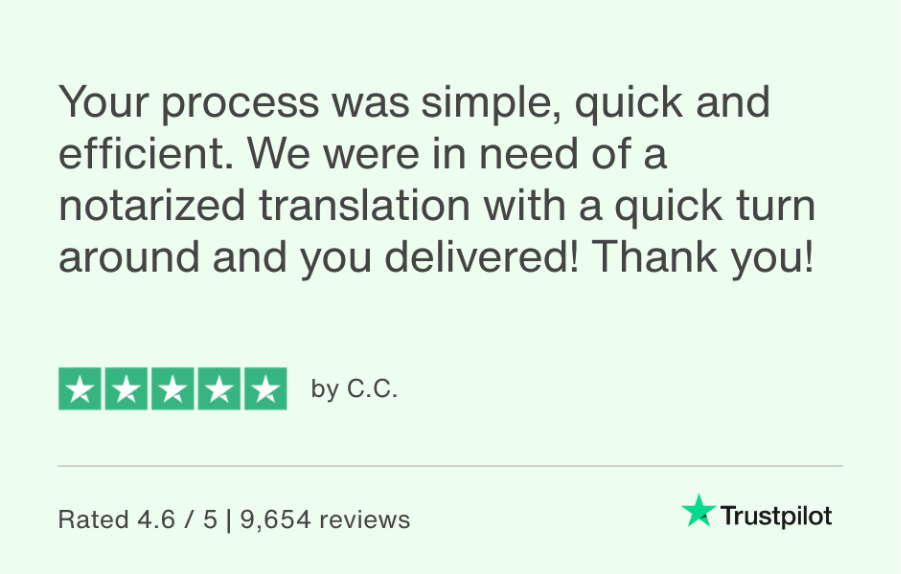
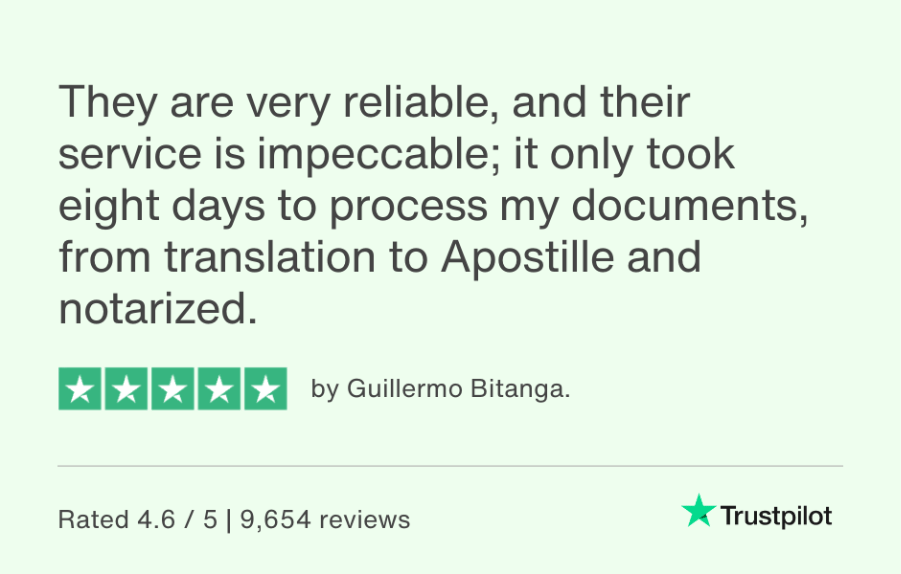
What Our Clients Say About Our Notarized Translation Service
Here's what some of our clients have to say regarding our notarized translation service;