Driving in the United States with a foreign driver's license is allowed in most states for visitors and temporary residents. How long you can drive and whether you need an International Driving Permit (IDP) depends on your residency status and state laws. These rules apply to tourists, students, temporary visitors, and new residents driving in the United States.
In this article, you will learn about driving in the US with a foreign license, IDP requirements, state rules, application steps and when you need a certified driver’s license translation.
Can you drive in the U.S. with a foreign license?
If you're visiting the United States, you can drive with a valid foreign driver’s license for 90 days to one year. The exact time depends on the specific state and your residency status. Here are some quick rules:
Tourist or short-term visitor: You can drive on your foreign licence until you become a resident of the state. In Texas, this is limited to one year from the date of entry. You will need a certified English translation if your licence is not in English and the state requests one.
Temporary residency (student or worker on a visa): You can drive on your foreign license until you become a permanent resident in the state. In California, if you have a job or you’re paying resident tuition, it counts as intent to reside, which means you will have to convert your foreign license within 10 days. Whether you need a certified English translation depends on if your license is not in English and the state requests one.
New resident: You can drive on your foreign license until the deadline set by your state. In California, you have only 10 days. In Florida and Georgia, you only have 30 days to drive on your foreign licence, while in Texas, you have 90 days.
How long can you drive in the U.S. with a foreign license?
You can legally drive in the U.S. with a driver’s license issued in another country for 3 to 12 months for short stays, depending on the state you’re visiting or residing in. In Texas, you can only drive for up to one year from your date of entry.
Your foreign license must be valid whenever you drive. In Massachusetts, for example, you must carry a valid license that has not been suspended or revoked.
Do you need an International Driving Permit?
An International Driving Permit (IDP) is a translation of your license, not a license on its own. Michigan’s Secretary of State describes it as a written English translation of a foreign license. So carry it with your original license.
You must get an IDP in your home country before you travel. This is because the U.S. does not issue IDPs to foreign visitors. IDPs issued for use in the U.S. are valid for one year according to USA.gov.
Not every state requires an IDP. Several states accept an IDP or an English translation when your license is not in English. We’ll highlight these states below.
State-by-state rules
Each U.S. state has its own rules and validity period for foreign drivers using their domestic licenses. Some states require that foreign drivers have an IDP in addition to a valid driver’s license. Others do not. Let’s look at the rules for driving with a foreign license in states that are popular destinations for international visitors:
State | Visitors | New resident deadline | IDP or translation rule | Source |
|---|
California | Drivers 18 and above may drive on a valid license from the country where they live. | Residents must hold a California license. New residents must get one within 10 days. | The DMV does not specify. But it is recommended. | CA DMV · Vehicle Code 12502 |
Florida | Visitors must carry a valid license issued in their name by their country of residence. | 30 days after becoming a resident. | The DMV does not specify. But it is recommended. | FLHSMV |
Georgia | Non-U.S. citizens may drive on a valid foreign license for tourism or business. Officers may ask for your passport or visa. | 30 days after becoming a resident. | The DDS does not specify. But it is recommended. | Georgia DDS |
Massachusetts | Drivers 16 and over may drive on a valid foreign license, for the vehicle type it covers. | Convert when you become a resident. The RMV states no grace period. | If not in English: an IDP, the RMV translation form, or a photo translation document. | Mass.gov |
Michigan | Visitors do not need a Michigan license. | The Secretary of State does not specify a deadline. | License must be in English or carried with a written English translation. Drivers from non-treaty countries also need proof of legal presence. | Michigan SOS |
New York | Visitors may drive on a valid foreign license. | Apply once you become a resident. The DMV does not specify a deadline. | For the road test, a non-English license needs an IDP or a certified translation. | NY DMV |
Texas | Up to one year from entry, or until you become a resident, whichever is sooner. | 90 days after moving to Texas. | The license must be translated into English. | Texas DPS |
California drivers aged 16 or 17: you may drive on a foreign license for up to 10 days. To drive longer, you need a nonresident minor’s certificate from the DMV and proof of insurance on file.
How to get a U.S. driving license
The process of getting a U.S. driver’s license may vary by state, but these main steps are typically the same:
Determine your eligibility: You must be at least 16 (some states have higher age requirements) and a legal resident of the state where you are applying for the license.
Gather required documents: You will need the following documents to apply for a U.S. driver's license:
Proof of identity and age (such as your birth certificate or passport).
Your Social Security Number (SSN). If you do not have an SSN, some states will require a letter from the Social Security Administration stating you are ineligible for a number.
Proof of residency (such as utility bills, lease agreements, or bank statements).
Non-U.S. citizens must provide documents such as a visa, Permanent Resident Card, or employment authorisation.
Pass a vision test: You must undergo a vision test at your state’s Department of Motor Vehicles (DMV) to ensure your eyesight meets driving standards.
Take the written knowledge test: This test covers road signs, traffic laws, and safe driving practices. To prepare, get the driver’s handbook from your state's DMV website or a local office and study it thoroughly.
Complete a driver’s education course (if applicable): Some states require new drivers, especially teenagers, to complete a driver’s education course. The written/knowledge tests are often waived for older applicants.
Pass the driving skills test: This test measures your ability to drive and follow traffic laws. You may need to bring your car, which must be in good condition and insured.
Pay the fees: The cost of getting a U.S. driver’s license may range from $10 to $89, depending on the state. You may also need to pay additional fees for your driving test and educational courses (if required).
States that allow direct exchanges
If your license is issued by any of these countries, you can exchange your license without taking the full driving test, provided you are in any of these states;
State | Licenses exchanged without full testing |
|---|
Texas | Canada, France, Germany, South Korea and Taiwan. The DPS new-resident guide also lists the United Arab Emirates. |
Massachusetts | Canada, Mexico, U.S. territories, South Korea, Germany, France and Taiwan. Each has its own document rules. |
Georgia | Countries with a reciprocal agreement with the DDS. Others take the written, road and vision tests. |
California | None. Foreign license holders must pass the knowledge and drive tests. |
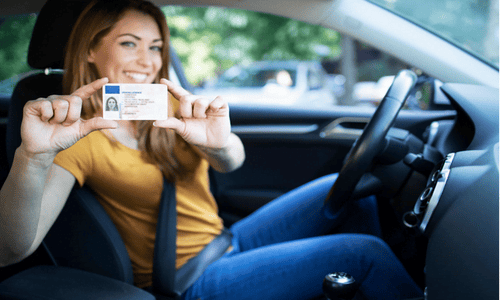
Penalties for driving with an expired foreign license in the U.S.
Fines: The main penalty for driving with an expired license is a fine. It can range from $100 to over $250, depending on the state and whether it’s your first offense. Repeat violations may bring heavier penalties, such as vehicle impoundment or jail time.
Difficulty obtaining a U.S. license: A record of driving with an expired license can hurt your application. DMV officials might add steps or restrictions during your licensing process.
Increased insurance premiums: If you get a U.S. driver's license after driving with an expired one, you might face higher insurance premiums. Insurers view violations as risks that can raise your costs. Some may also charge more if you lack a U.S. driving history.
Impact on legal status: Driving with an expired license could affect the legal status of non-U.S. citizens, such as tourists or temporary workers. In serious cases, repeated violations may lead to legal problems that affect future immigration processes.
Practical driving tips for foreigners in the U.S.
Your driver’s license must be valid. If it’s not in English, carry an IDP as well. You also need adequate car insurance, which is mandatory in most states and protects you financially in the event of an accident.
Keep an emergency kit in your vehicle, including a first aid kit and a flashlight.
Pay attention to the weather and adjust your driving to match conditions, such as snow or rain.
Always check local parking regulations to avoid fines; these can vary widely, especially in urban areas. When parking at a meter, ensure you have the correct payment method, which could be via coins or a digital payment.
Even if a state doesn’t require an IDP, major rental companies (like Hertz) often do. Make sure you have one if the state you are visiting requires it.
Do I need certified translations for a foreign driving license exchange in the US?
Certified translations are commonly required when converting a foreign driver's license to a U.S. license.
For the translation it usually needs to be done by a professional translator or translation company and come with a signed statement of accuracy. Rules differ by state: California, for example, accepts a certified translation or an affidavit of translation. Additionally, some states might require the translation to be notarised.
Translayte provides certified driver’s license translations for states that accept a translation service, such as Texas and Massachusetts. New York requires a government body or consulate to certify, so check your state first.