Understanding translation pricing in 2026
Today, translation is a vital element in almost all industries and processes. This is mostly due to immigration, study, business expansion into new markets, and the need to simplify communication globally.
However, with the growing global demand for translation, so is the pricing. In 2026, the cost of translation is affected by many factors beyond the demand. These factors include the complexity, volume, and requirements of each project.
Additionally, certified translations are typically priced per page, but standard documents like business contracts are priced per word. Other factors, such as translation for specialised industries with unique terminology, will also contribute to how much you pay for translation.
Alternatively, if you aren't sure, you can request an instant quote from the translation company to get accurate pricing before placing your order.
In general, the cost of translation services is no longer a secondary consideration. It has become a strategic requirement for organisations that need to compete internationally, meet regulatory and compliance standards, and ensure accurate communication across borders.
How are translation rates calculated?
When you want to know how much it costs to translate something, you should understand that translation costs are calculated differently. Professional translation providers use different pricing models depending on the document type, language pair, and project requirements.
Here's a simple breakdown of methods:
1. Per word or page
Translators usually charge based on the number of words they need to translate. Sometimes, they might charge per page. This is a straightforward way to figure out the cost; the more words or pages you have, the more it will cost. Per word translations range between $0.05 and $0.50; per page translations range from $20 to $130.
2. Hourly rates
Some translators charge by the hour. This method is often used for tasks that are not just about translating words. For example, if the job has to be done quickly or needs special attention, like legal translations. Hourly rates from translation range between $15 and $150.
3. Per character or per-million characters
This applies to certain languages such as Chinese, Japanese, and Korean with character-based letters. For such languages, the pricing may be calculated per character or per million characters rather than per word for a more accurate pricing. Typical pricing per character ranges from $0.03 to $0.08 per character.
To save money on translation, here are a few tips:
Compare prices: Just like shopping for anything else, compare prices from different translators or translation companies.
Bulk orders: Sometimes, if you have a lot of translation work, you might get a discount, like the 20% volume discount off translations and transcriptions on a Translayte Business account.
Use what's needed: If you don't need a specialised translator, don't pay for one. A regular translator might do the job just fine for less money.
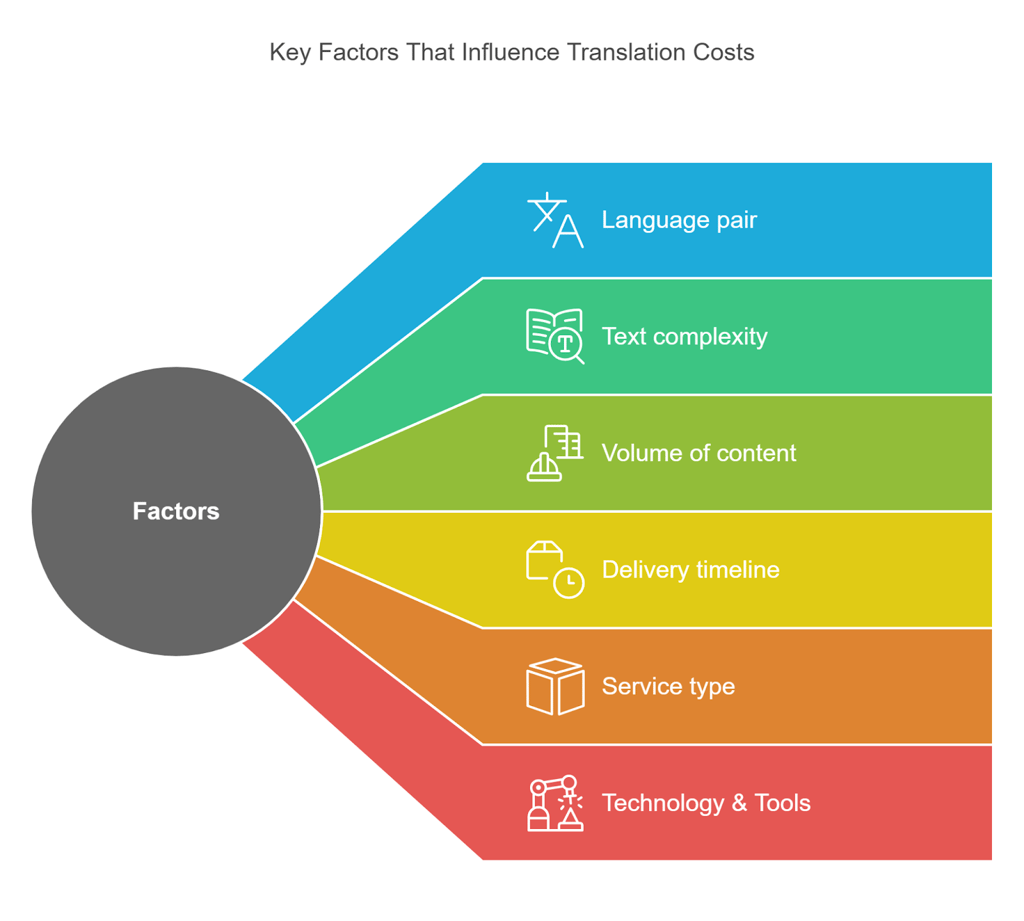
Key factors that influence translation costs
Besides the general per-word and page pricing structure, other factors determine your translation's cost. Here's a quick overview of some key factors
The Language pair: Some languages are more expensive to translate than others. Some instances that can change the pricing for language pairs include their similarities and popularity. For example, if the language translation you need is rare, it might cost more, e.g., Mandarin to French. In contrast, English-to-Spanish translation might be cheaper because they are very popular.
Text complexity and subject matter: Technical or specialised content (e.g., legal, medical, or financial translations) often incurs higher fees. This is because, unlike regular translation, they require a translator with subject matter expertise and specialised knowledge. For example, you will need a translator with medical experience if you are transiting a medical document. This experience helps them translate industry-specific terminology without losing its meaning. In contrast, simple text or general documents like ad copy or website content are generally cheaper to translate.
Volume of content: A 30 - 40 page project will mostly be more expensive. But they can benefit from discounts depending on the translation agency and their rules. This might reduce the cost of translation.
Delivery timeline: If you need expedited document translations, you should be willing to pay a premium. Urgent or expedited translations typically increase costs by 25%–50% and may require faster processing and multiple translators. These factors will increase the cost beyond what you will pay for a standard delivery timeline.
Service type: While certified translation services are priced per page, standard translation has a per-word pricing structure. Also, extra services like notarisation, apostille, physical delivery, localisation, transcription, or multimedia adaptation may increase the overall cost.
Technology and tools: Some translation agencies might use translation software and tools which can impact pricing. Some projects might be cheaper if they involve pre-existing or machine translation post-editing, manual translation is often priced higher.
Translator's expertise: A translator's experience, qualifications, and reputation can influence rates. For example, certified translators or those with specialised expertise may charge premium rates. That's why translating a website might cost less than translating a technical or medical document that will require a specialist to preserve quality.
So, when you're looking to get a translation service, remember these factors. They will help you understand how the costs are calculated, and you might be able to save some money.

Languages that cost more to translate
Certain languages are inherently more expensive to translate. These typically include less commonly spoken languages or those with complex scripts and grammatical structures. The demand and supply of translators in these languages also play a role in determining the cost.
So, which languages usually cost more to translate?
Rare and low-demand languages such as Icelandic, Basque, and Quechua. Fewer professional translators are also available for these languages, which can increase the rates. The cost ranges from $0.15–$0.50 per word
Asian languages like Mandarin Chinese, Japanese, Korean, and Arabic. The translation cost ranges from $0.18–$0.40 per word
African languages like Zulu, Amharic, and Swahili. Translation can cost $0.10–$0.45 per word
Eastern European languages such as Hungarian, Serbian, and Albanian. The translation can cost $0.10–$0.40 per word
Scandinavian languages like Norwegian, Swedish, and Danish can cost $0.10–$0.35 per word
Specialised technical languages, for example, translating technical, medical, or scientific content from German or French to English, will often cost more. Ideally from $0.25–$0.55 per word
Another reason some languages are pricier to translate is the demand and supply of translators. If many people need translations into a specific language, but there aren't many translators who can do it, the cost will go up.
Recommended Reading
How Much Does Document Translation Cost in Norway?
Typical translation rates per word, per page & per hour in 2026
In 2026, professional translation services rates typically start from $0.10 per word, $20-$100 per page and $20- $150 per hour depending on language, subject matter, and quality level. However, the final cost will vary based on several factors, including the
type of translation (human vs. machine)
translator's native language proficiency
content format (e.g., text, video).
Additionally, Translation Memory (TM) technology can reduce costs for repetitive content. The industry also uses the Multidimensional Quality Metrics (MQM) framework to assure translation quality, which can influence pricing.
Translation rates per word
The per word translation pricing model is often used for standard document translation. This includes translation for business documents, website content, and letters that don't require certification. The cost per word rates can vary by language pair, specialisation, and complexity. Here's a breakdown
Common language pairs (e.g., English-Spanish) range from $0.10 to $0.25 per word.
Less common or complex languages (e.g., English-Japanese) can be $0.15 to $0.40 per word.
Standard human translation averages $0.05 to $0.15 per word.
Translations that require subject-matter expertise, such as legal, medical, or technical documents, are priced higher, up to 50% to 100% more than standard translation, due to the specialised knowledge involved.
Translation cost per page
The cost per page translation pricing is used for certified translations (e.g., legal or government use). These documents require additional certification, such as a certificate of accuracy, which shows that the translation conveys the original message. Also, a page for this type of translation is usually defined as 250 words, including numbers. The translation cost per page varies based on the document type:
Legal documents: $20–$125 per page
Medical translations: $35–$150 per page
Business documents: $25–$75 per page
Immigration document: $25-$150
Translation rates per hour
Hourly rates apply mainly to interpretation services and some complex translation projects. They are also often the standard model for freelancers.
Pro Tip: Translation costs vary, but you can always request an instant quote. This will help you understand the cost and eliminate unnecessary items for the specific translation.

How does the cost of machine translation (MT) compare to human translation?
Machine Translation, like services offered by Amazon and Microsoft, is a cost-effective solution for certain types of content. However, it's not always the best choice, especially for complex or nuanced texts. While MT is advantageous for its speed and lower cost, it lacks a professional human translator's precision and cultural sensitivity. Most machine translation platforms offer you a free version, but you may need to upgrade to a paid plan for better offers. For Amazon and Microsoft, their paid plans cost between $8.74 - $60 per month.
We have now taken you through the numerous factors that should be taken into consideration when faced with the question, "How much does a translation cost?" you may also be wondering how you can tell a good translator who is worth their salt from an inexperienced one, the simple answer is to look to their reviews and request for their certifications, for proof of their qualifications.
Recommended Reading
How AI Supports Translations in Business
Machine Translation vs. Human Translation: Pros & Cons
Both machine translation (MT) and human translation (HT) have advantages and limitations. Here's a side-by-side comparison of factors like quality, cost, accuracy, and efficiency.
Criteria | Machine Translation (MT) | Human Translation |
Quality | Inconsistent quality. Might struggle with idioms, tone, and cultural nuances | High quality. It maintains context, accuracy, and cultural sensitivity. |
Cost | Low or free for basic use. Using a professional MT with post-editing is more affordable than human translation. | Higher cost, especially for specialised fields like legal and medical translation. |
Accuracy | Errors are common in complex or technical texts. | Ensures grammatical correctness and precise meaning. |
Speed | Instant delivery makes it suitable for large-scale, quick translations. | Depends on content complexity and translator workload. Some translations can take up to 24 hours, while others are longer. However, Translayte guarantees a 12- hour delivery turnaround which is helpful when you have a tight deadline, especially for certified translation. |
Creativity & Adaptation | It often cannot localise humour, tone, or cultural references effectively. | Human translators can adjust tone, idioms, and style for the target audience |
Data privacy | Some tools store data, posing security risks. | More secure. Professional translators follow confidentiality agreements. |
Scalability | You can translate massive volumes quickly. | Limited by translator workload which means large projects require multiple translators. |
Use case | Best for casual communication, internal reports, and preliminary drafts. | Ideal for legal, medical, technical, creative content, and certified translation where precision matters. |
As post-editing becomes more common, translators are now moving from per-word pricing to an hourly based pricing model. This reflects a broader shift in the industry, where translators do more than simply translate texts from one language to another.
Recommended reading
The Importance of Accurate Translation in Business
How much does it cost to hire a professional translator in 2026?
The cost of hiring a professional translator in 2026 varies based on experience, specialisation, and service model (freelancer, agency, or in-house). Here's a breakdown of pricing
Service model | Rates per Word | Rates per Hour | Rates per Page | Additional Notes |
Freelance translator | $0.06 – $0.25 | $25 – $100+ | $20 – $100 | More affordable, direct communication, but quality varies. |
Translation Agency | $0.05 – $0.40 | $20 – $150+ | $20 – $200 | Higher quality assurance, faster delivery, but more expensive. |
In-house translator | Fixed Salary | | | Salaries range from $50,000 to $80,000+ annually, and they are best for companies with ongoing translation needs. |
What is the difference between hiring an in-house translator vs a freelance translator / translation company?
In-House Translator | Freelance translator/translation company |
An in-house translator becomes familiar with the company's products, style, and audience, leading to consistent translation quality | They offer more flexibility. They can be hired for specific projects, which is ideal for companies with irregular translation needs. |
They are readily available during business hours, which can be helpful for quick tasks or urgent projects. | They often specialise in specific fields or languages, providing expertise that might not be available in-house. |
Companies can invest in their in-house translators' skills, ensuring they stay up-to-date with the latest industry standards. | Hiring them typically costs less in terms of overhead. There's no need for a full-time salary or benefits. |
It can be cost-effective for companies with ongoing, large-scale translation needs. | There are also companies like Translayte that offer discounts and special features that allow for uniformity of translations. |
Fixed salary and benefits | Lower (pay per project) to high cost depending on project needs. |
Their expertise is limited to one or few languages | Offers flexible, but slower delivery for large projects. However, it's best for multi-language, large-scale projects |
Faster turnaround time, especially for internal documents | Turnaround time is often moderate within 24–48 hours. Expedited delivery costs more. |
Might have limited access to translation tools | Often has access to translation tools, especially for agencies. |
In-house translators are best for companies with regular translation needs and sensitive materials. | Best for small to large businesses and individuals who need a wide range of translation services for complex content. |
Pro Tip: The quality and availability of freelancers can vary. It's important to choose freelancers or translation agencies with good track records to ensure high-quality work.
Recommended Reading
Top 5 Common Mistakes in Certified Translation and How to Avoid Them
Cost breakdown for different translation industries
Translation costs vary significantly based on industry, document type, language pair, and level of expertise required. Below is a cost breakdown for different sectors:
Legal document translation costs
Legal translation is highly specialised due to the need for accuracy, legal terminology, and certification. Prices depend on factors like sworn translation, notarisation, and urgency.
Standard legal translation: $0.15 - $0.30 per word
Certified translation: $20 - $50 per page
Notarised translation: $60+ per order
Medical translation costs
Medical translation requires industry expertise and often involves sensitive or highly technical content. Therefore, it is more expensive than standard translations.
Specialised medical reports, clinical trial documents, or pharmaceutical content typically fall on the higher end of the pricing scale. Legalised translations may incur additional fees for apostille or notarisation services.
Standard medical translation: $0.20 – $0.30
Certified medical translation: $24 – $45 per page
Notarised medical translation: $60+ per order
Website & Software localisation pricing
Website and software localisation involves more than just translation—it requires adapting content for cultural nuances, SEO optimisation, and sometimes UX/UI adjustments.
Basic website translation: $0.05 – $0.30 per word
Website localisation: $0.10 – $0.50 per word
Software localisation: $0.18 – $0.60 per word
Recommended Reading
Top 5 Industries That Benefit From Professional Translation Services
What impacts the cost of certified translations?
Certified translations, often required for legal, immigration, and official purposes, typically cost more than standard translations due to several key factors.
For example, legal documents, medical records, and technical files require specialised expertise. This helps to ensure accuracy and compliance with legal standards, which can raise costs.
Additionally, common language pairs like English tend to be more affordable. In contrast, rare languages such as English-Icelandic are typically more expensive due to a smaller pool of qualified translators.
Other factors that impact the cost of certified translations include
Document length and formatting
Certification and notarisation fee
Urgency and turnaround time
Pro Tip: For the most accurate pricing, it's best to compare translation providers and request an instant quote.
Common mistakes to avoid when choosing a translation service
Selecting the right translation service is crucial for accuracy, cost-efficiency, and overall quality. Here are some of the most common mistakes businesses and individuals make when hiring a translation provider, along with ways to avoid them:
Overlooking hidden costs
Some translation companies charge additional fees for project management, rush services, engineering (such as extracting text from images or PDFs), and in-country reviews. These fees can add 10-15% to the total cost. To avoid surprises, always confirm whether additional fees apply for revisions, formatting, project management, or rush delivery, and request an instant quote with a full breakdown of costs before committing to a service.
Choosing based on price alone
While budget is a key consideration, opting for the cheapest provider often results in poor-quality translations. Some agencies use automated translation tools without human review, leading to inaccuracies. Instead of just comparing prices, request samples and check references. You can also check their reviews to learn more about the service delivery. For example, Translayte has a 4.7-star rating on Trustpilot from over 8000 customers. This should help you learn more about the delivery and quality from other people.
Providing an incomplete or vague brief
Unclear instructions can lead to incorrect translations, requiring costly revisions. To get accurate results from the start, ensure your brief includes specific terminology, industry-specific language, and formatting preferences.
Ignoring quality assurance and certification
Certified translators are often required for most legal, immigration, and medical translations. Some companies may not offer certified translation services, leading to rejected documents in legal or immigration processes. Always confirm if certification is included in the service. For example, Translayte attaches a certificate of accuracy to all certified translations. We can also help you with notarisation and apostille services when needed.
Overlooking communication
Some agencies have limited communication options, making it difficult to clarify issues. Look for a provider with flexible, real-time communication and scalability. Translayte offers 24/7 customer support on WhatsApp, live chat, email, and phone which ensures optimal communication. We also provide multilingual language support to help seamless communication for multiple locations.
Why choose Translayte for your translation needs?
Translayte is a trusted translation service provider offering tailored solutions for businesses and individuals. Our competitive pricing, fast turnaround, and quality assurance set us apart in the industry. We also have a 4.7-star rating on Trustpilot from over 8000 customers which showcases our dedication to quality delivery. Here’s why you should choose us
Competitive pricing for professional translations
We offer flexible pricing options to suit different needs and budgets. Whether you need
quick and cost-effective translation
professional translation with expert review,
specialist translation for highly technical content
We provide transparent pricing starting at just $0.10 per word. Our tiered approach ensures you get the right balance of affordability and quality.
Recommended Reading
Expertise for Every Need: Our Updated Professional Translation Services
Faster turnaround for urgent translations
Translayte understands that some projects require quick delivery. We offer fast translation services with turnaround times as short as 12-hours for standard documents. Expedited services are available for urgent legal, medical, and business translations, ensuring you meet tight deadlines without sacrificing accuracy.
Guaranteed quality & accuracy
Every translation undergoes a rigorous quality assurance process. This starts with using an expert native translator to translate your documents. We also ensure every document is reviewed and refined for precision. This multi-step process allows us to deliver accurate and high-quality translation to customers
Need a Translation service? Get a quote now
How to get an accurate translation quote
Getting an accurate translation quote depends on the information you provide upfront. Here’s how to ensure the pricing you receive reflects the quality of work you’ll get;
1. Upload the exact document
Whether it's a birth certificate, passport, marriage certificate, academic transcript, or more, upload the exact file you want to translate. This enables the system to assess your document and give you an accurate quote.
2. Select the type of translation
Most platforms, like Translayte, offer multiple translation services. For an accurate quote, you need to select which translation service you want, whether professional or certified or sworn translations.
3. Confirm the language pair
Language pair is one of the major factors that affect translation cost. A translation from English to French may cost less than a translation from Arabic to Greek. So it’s important to specify the source and target language.
4. Set your delivery timeline
Urgent translations typically cost 25%-50% higher than standard translation due to prioritized workflows or the need for extra translators.
5. Explain the purpose of the translation
While this does not directly affect the cost of translation service, it’s still helpful to leave a note for the translator on the purpose of the translation. It could be for immigration, court submissions, academic admissions, or regulatory filings. Also inform them if the content you’re translating includes any specialized terms, like legal, medical, technical, or financial. This ensures the translation provider has all the information to provide an accurate quote.


.png)