Understanding Marriage in Indonesia
“Marriage is valid if it is carried out according to the religious laws of each party concerned.”, according to Law Number 1 of 1974 on Marriage in Indonesia Article 2 (1).
In Indonesia, religion is deeply integrated into law and daily life. Unlike many other nations, Indonesian Marriage Law dictates that you and your partner must practice the same religion to marry legally. This shared faith must be one of the six officially recognised by the government: Islam, Protestantism, Catholicism, Hinduism, Buddhism, or Confucianism.
Neither partner may declare atheism or agnosticism, and following Supreme Court Circular No. 2 of 2023, courts and registration offices are strictly prohibited from registering interfaith marriages. If you practice different faiths, one partner must convert to the other's religion by signing an official declaration of change of religion before the marriage can take place. Your shared religion determines both the type of wedding ceremony and the specific legal registration process that follows.
For a Muslim wedding, the ceremony is officiated directly by a state religious official (Penghulu) from the Kantor Urusan Agama (KUA), who acts as both the officiant and the legal registrar. For non-Muslim weddings, the ceremony must first be officiated and blessed by an authorised Minister of Religion (such as a priest, pastor, or monk) at their respective house of worship.
Following the religious ceremony, the marriage must be recorded by officers at the Kantor Catatan Sipil (Civil Registry Office) to be recognised under secular civil law.
Legal requirements for marriage in Indonesia
In Indonesia, marriage is considered legal only if it has been solemnised and then registered at the relevant institution. Marriage ceremonies are conducted according to the religions of the spouses; for instance, Muslims will be married according to Sharia law. To become legally married, you and your spouse must meet the following Indonesian marriage requirements:
You and your spouse must be at least 19 years old to be legally married in Indonesia.
You must have proof or a Certificate of Singlehood from the Civil Registry Office if you have never been married before. If you have been previously married, you must have a divorce certificate.
If you are a foreigner, you need to have a Certificate of No Impediment to Marriage from your home country. It is a legal document that certifies a person's freedom to marry or enter into a civil partnership.
Your foreign spouse must have the right visa to enter Indonesia.
You and your spouse may decide to sign a prenuptial agreement before the wedding, as it has become quite common among Indonesian couples. This agreement is meant to protect the interests, rights and assets of both you and your spouse in the event of a divorce.
You and your partner must be heterosexual.
If you are getting married under the Islamic process, you must have a Wali (marriage guardian). This is usually the bride’s father, grandfather or brother.
You must have two marriage witnesses who are adults of sound mind and hold a valid identity card (KTP or passport). For Muslim marriages, women are not allowed to be witnesses.
Note that every foreign document you or your spouse provides needs to be accurately translated into Bahasa Indonesia by a certified translator. This is so that it can be considered a legal document in Indonesia. Translayte is a trustworthy certified translation service that understands the requirements of Indonesian Authorities. Our professional translators can provide certified, sworn, notarised and legalised translations that are acceptable all over Indonesia. In just a few easy steps, you can have the most accurate and affordable translations for your documents in your hands. Request a quote to get started.
The Indonesian marriage process
Islamic marriages
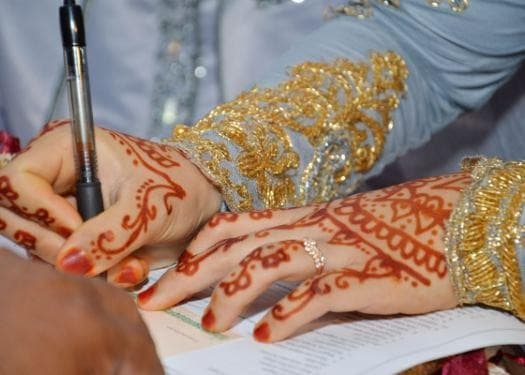
Muslim weddings are officiated by the Kantor Urusan Agama. After the ceremony, the couple is issued the Buku Nikah (Marriage Books) as proof of the marriage. You are usually not required to register a muslim marriage with the Kantor Catatan Sipil, although it is a good idea if you intend to move to another country.
Some Muslims get married through the Nikah Siri, which is the Muslim traditional marriage. Although it is acceptable within Indonesia, it is not accepted as a legal marriage by foreign governments. This means that if you intend to get a spouse visa to visit your spouse in another country, you will not be considered married and will not be granted the spouse visa.
For Christians, Hindus and Buddhists
For Christian, Hindu and Buddhist couples, you have to have two kinds of marriage ceremonies. You will have your religious ceremony first at either your church or temple. This will be officiated by your religious leader; then you will have a civil ceremony. You will receive two marriage certificates presented at the end of the ceremony, and you will submit one at the Kantor Catatan Sipil. Many countries outside Indonesia don't recognise the church-issued marriage certificate as legal.
You may need to submit a Notice of Intention to Marry to the Kantor Catatan Sipil before your wedding. This is so that the registry can publish a notice of intention to marry to the public to see if anyone objects to your marriage. The required notice period can depend on the authority handling the marriage. Civil registration requirements may refer to working days, while religious institutions may have their own notice periods. Confirm the exact deadline with the local Civil Registry Office and, where applicable, your religious institution before setting your wedding date.
After your wedding ceremonies, you must register the marriage at the Kantor Catatan Sipil for it to be considered legal. To do this, you and your spouse will need to submit the originals and photocopies of some documentation. This documentation varies from province to province, and it is advised that you confirm with the civil registry office in that province while making your marriage preparations.
General documentation for marriage registration in Indonesia
For all marriage registrations in Indonesia, such as the Notice of Intention to Marry or the post-marriage registration at the Civil Registry Office, you need to submit the following documents. You must submit photocopies only, but you must also bring the originals to show. The documents include:
Your Certificate of No Impediment from the Embassy or Consulate (for your foreign spouse).
Your Kartu Keluarga (family card) and Kartu Tanda Penduduk (Indonesian ID).
Your International Passports.
Your certified, legalised, and translated birth certificates (including for all your legal children, if any).
Your church or temple-issued marriage certificate.
Divorce Certificate or death certificate of former partner (if applicable).
Tax receipt or proof of settled tax (for foreigners who work in Indonesia).
Four coloured passport photographs (4x6), against a red background.
A copy of your temporary residence permit or visa (if applicable).
Citizenship letter and endorsement letter from the police (if you live in Indonesia).
Police Reports from the home country of your foreign spouse.
Your Certificates of Religion.
Declaration of Change of Religion, if your spouse has converted to your religion.
The marriage process
Step One: Make sure you are eligible
Go through all the legal requirements and make sure you both meet them.
Step Two: Get a Certificate of No Impediment (CNI)
If you are a foreigner, get a Certificate of No Impediment, or your country's equivalent, from your country's embassy or consulate in Indonesia. For example, the British Embassy Jakarta and British Consulate Bali issue a Marriage Affirmation or Affidavit to serve as legal proof of freedom to marry, replacing the traditional Certificate of No Impediment (CNI).
Step Three: Apostille for Certificate of No Impediment
If a Certificate of No Impediment (CNI) is issued in your home country (e.g., via the UK Legalisation Office), it must receive a single Apostille stamp in that originating country. It does not get stamped by MoFA or the Indonesian Embassy. For an Affirmation/Affidavit of Marriage obtained directly from your foreign embassy inside Jakarta or Bali, local authorities accept the embassy's stamp directly without any MoFA legalisation.
Step Four: Declare your religion
Declare your religion at the local Civil Registry Office. This declaration will help you determine the type of ceremony and applicable legal procedures.
Step Five: Translate and submit your documents
Translate all necessary foreign documents, such as your CNI and other relevant certificates, into Bahasa Indonesia when required by the local authorities. Before submitting your documents, check that your name and other personal details are consistent across your passport, marriage documents, certificates, and translations. Pay particular attention to the spelling and order of your first name, middle name, and surname.
Step Six: Submit your documents to the civil registry
Submit all required documents to the local Civil Registry Office where you plan to get married and give the Notice of Intention to Marry.
Step Seven: Observe the required notice period
After submitting your documents and giving the required notice of marriage, you may need to wait for the applicable notice period before the marriage can take place. The length of this period depends on the authority handling your marriage and the type of ceremony.
Step Eight: Attend your wedding ceremony
Attend your marriage ceremony at the Civil Registry or religious office. The ceremony may include the exchange of vows and the signing of the marriage certificate.
Step Nine: Collect your marriage certificate
After the ceremony, collect your official marriage certificate from the Civil Registry or the religious office where the marriage was conducted.
Step Ten: Register your marriage
After you have collected your marriage certificate, make sure that your marriage is officially registered with the local Civil Registry. This step is needed for the legal recognition of your marriage.
Note: You should request several official copies of your marriage certificate when your marriage is registered. Indonesia does not have a central repository for civil records, so obtaining another official copy of your marriage record later may not always be easy. Extra copies can be useful if you later need to apply for a visa, immigration benefit, name change, or marriage registration in another country.
What can you use your Indonesian marriage certificate for?
Your Indonesian marriage certificate may be needed for more than proving that you are married. You may need it when applying for an immigration benefit or spouse visa, registering your marriage in your home country, changing your marital status on official records, or completing other legal and administrative procedures abroad.
For example, if you are a U.S. citizen or permanent resident sponsoring your foreign spouse for immigration, your marriage certificate may be required as supporting evidence for an immigrant petition such as Form I-130.
Before submitting your certificate to a foreign government, check whether it needs to be translated, legalised, authenticated, or accompanied by additional documents.
Will your home country recognise your Indonesian marriage?
Getting legally married in Indonesia does not automatically tell you what you need to do in your home country. Each country has its own rules for recognising marriages performed abroad.
Before or after your wedding, check whether your home country requires you to register your Indonesian marriage with its civil authorities. You should also find out whether there are additional requirements if you live outside your home country.
You may need to submit your Indonesian marriage certificate, a certified translation, proof of identity, and other supporting documents. Some countries may also require the certificate to be legalised or authenticated before they will accept it. Check with the relevant authority in your home country to confirm whether your marriage must be registered and which documents you need.

 in the UK.png)