How valuable is an Italian passport?
The Italian passport is one of the most powerful passports in the world. In the January 2026 edition of the Henley Passport Index, it ranked fourth worldwide, down from third in 2025.
With an Italian passport, you can access about 185 destinations visa-free or with a visa on arrival, making international travel easier and less stressful.
As part of the European Union, Italian passport holders can also live, work, or study in any EU country without a visa. The benefits of having an Italian passport are tempting. However, as a foreigner, you can obtain an Italian passport only by becoming an Italian citizen.
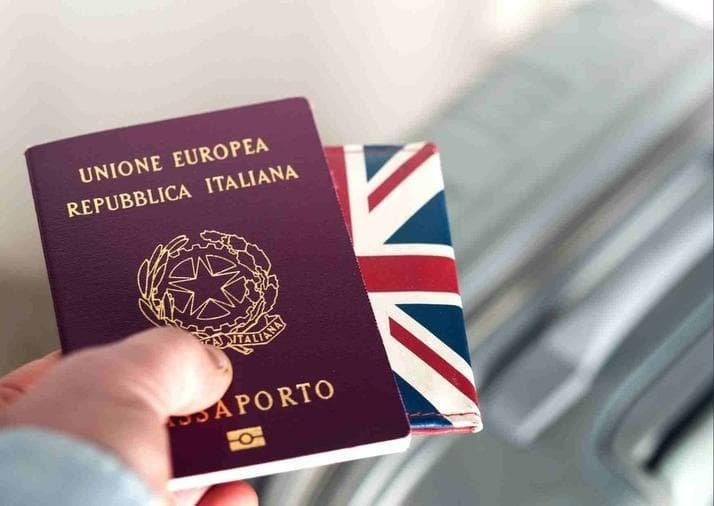
A man holding an Italian passport
Benefits of an Italian passport
Holding an Italian passport comes with a range of benefits, given that Italy is a member of the European Union (EU) and the Schengen Area. Here are some of the key advantages:
Freedom of movement within the EU and Schengen Area: Italian passport holders can live, work, and travel freely within the 27 EU member states and the 29 countries of the Schengen Area without visas or work permits.
Education and healthcare in the EU: As an Italian passport holder, one has access to education, healthcare, and other social services in any EU country, often under the same conditions and at the same cost as nationals of that country.
Visa-Free or visa-on-arrival access: Italian passport holders enjoy visa-free or visa-on-arrival access to many countries around the world, making international travel more convenient.
Dual citizenship: Italy allows dual or multiple citizenship, meaning you can retain your original nationality while also enjoying the benefits of Italian citizenship.
Consular assistance abroad: In emergencies or while traveling, Italian citizens can seek assistance from Italian embassies and consulates worldwide. Additionally, if there's no Italian representation in a particular country, any EU embassy or consulate can assist Italian citizens.
Right to vote: Italian passport holders can vote in Italian national elections as well as European Parliament elections.
Cultural and language ties: An Italian passport can also connect you to Italy's rich culture, history, and language.
Investment opportunities: Being an Italian and, by extension, an EU citizen can provide more straightforward access to investment opportunities within the European Economic Area.
Protection under Italian and EU law: Italian passport holders are protected by the laws and regulations of both Italy and the European Union, ensuring their rights and freedoms are safeguarded.
Ease of acquisition for descendants: Italy has laws that permit individuals of Italian descent to acquire citizenship through their ancestors in certain circumstances, making it easier for future generations to benefit.
Recommended Reading
How to Translate Documents for Use in Italy
How to get Italian citizenship - Passport application
To apply for Italian citizenship, you must meet certain criteria. Here are some of the criteria that make you eligible for citizenship in Italy:
By descent: This is the fastest route to obtaining Italian citizenship. Under decreto legge n. 36, 28/03/2025, later converted into Law No. 74 of 2025, if you were born abroad and hold another citizenship, you are recognised as Italian through the "jure sanguinis" (right of blood) principle only if: you, or a consulate, had registered your application or appointment by 27 March 2025; a parent or grandparent holds, or held at the time of death, only Italian citizenship; or an Italian parent lived in Italy for at least two continuous years after becoming Italian and before you were born or adopted. This replaces the previous rule that allowed claims based on any Italian ancestor alive after 1861. Italy’s Constitutional Court upheld the new rules in judgment No. 63 of 30 April 2026.
By marriage: Marrying an Italian citizen can make you eligible after 2 years of marriage or civil union if you live in Italy, or 3 years if you live abroad. These periods are halved if you have children who were born to or adopted by the couple. You must also prove Italian language skills at B1 level or higher. Marrying in Italy won't automatically grant you a passport, but it will speed up the naturalization process.
By birthright: If a person is born in Italy and has no other citizenship by birth, they can claim Italian citizenship. Additionally, children born to at least one Italian parent, irrespective of their birthplace, are usually considered Italian citizens by birth. However, under the 2025 reform, a child born abroad who also holds another citizenship only receives Italian citizenship automatically if they meet one of the conditions listed under “By Descent” above.
By residency: Living in Italy for an extended period (typically 10 years) makes you eligible for citizenship. In addition, you must be a tax-paying, income-earning resident in Italy to be eligible. Note: The standard residency requirement remains 10 years. A proposal to reduce it to 5 years was put to a referendum in June 2025, but it failed because turnout was only about 30.6%, below the quorum needed for the vote to count, so the law did not change. Foreign descendants of Italian citizens who no longer qualify by descent, for example through a great-grandparent, can apply after 2 years of legal residence in Italy.
By working for the Italian government: Individuals who work for the Italian government for at least 5 years, regardless of where they work (in Italy or abroad), can apply for Italian citizenship.
By adoption: Foreigners who are legally adopted by Italian citizens can acquire Italian citizenship from the moment of adoption.
Recommended Reading
How to Obtain Permanent Residency in Italy
Italian passport requirements for eligible foreigners
Once you've established eligibility and want to apply for Italian citizenship, there are specific requirements to meet:
1. Proof of residency
If applying based on residency, you must demonstrate continuous legal residence in Italy for the required number of years (10 years for non-EU citizens and 4 years for EU citizens). You can show this through rental agreements, utility bills, or official documentation from local authorities.
2. Criminal record
An applicant should have a clean criminal record in both Italy and their home country. Serious crimes or multiple minor offenses can lead to disqualification from obtaining citizenship. The nature of the crime, the penalty imposed, and how long ago the crime occurred are all considered during the application process.
3. Integration
Demonstrating integration into Italian society can significantly bolster your application. You can show this through continuous employment in Italy, involvement in community or local activities, or proficiency in Italian. For citizenship by marriage or residency, a certificate proving Italian at B1 level or higher from a recognised institution is a requirement, not just a benefit.
4. Marriage certificate
Those applying through marriage need to provide a valid marriage certificate. You may also need proof of a continuous, valid marital relationship, such as shared property, children's birth certificates, or other joint documents.
5. Employment with the Italian government (if applicable)
If you're claiming citizenship through employment with the Italian government, you must provide official documentation of your employment status, role, and length of service.
6. Adoption documentation (if applying by adoption)
Legal adoption papers are crucial for those pursuing citizenship through this route. The adoption process needs to be recognised and validated by the Italian legal system.
7. Birthright (if applying based on birth in Italy)
You need a valid birth certificate issued by an Italian municipality (comune). If one parent is an Italian citizen, you also need documentation proving their Italian citizenship.
8. Other Italian passport requirements
An income tax return, such as the CU, 730, or Unico form, to show you have sufficient income in recent years. A certificate of housing eligibility, which is mandatory in some cases, proving you live in housing that meets Italian standards.
What documents are required for an Italian passport application?
To apply for an Italian passport, you need to provide the following documents:
Certified copy of your birth certificate (translated into Italian).
A previous passport, if you have one.
Certified copy of your marriage certificate (translated into Italian).
Evidence of Italian lineage (if applying by descent).
Proof of residence or legal stay in Italy
A valid travel document (visa) or other identification document (National ID card).
Criminal background checks from Italy and any other country you have lived in since age 14.
An Italian passport application form from your local police headquarters or the nearest Italian embassy in your home country.
2 passport-size photographs that were taken against a white background.
A letter of consent (if you are applying for a minor).
An Italian language proficiency certificate showing B1 level proficiency or higher (for citizenship by marriage or residency).
Passport application fee receipt.
Certificate of Italian citizenship (or any other proof of your Italian citizenship).
How to get a certified translation for an Italian citizenship/passport application
When submitting non-Italian documents for an Italian passport application, you must have them translated and certified. Documents typically requiring certified translation in Italy include birth certificates, marriage certificates, and criminal records.
Choose a certified translator: Ensure that the translator/translation agency is certified to translate official documents in Italy.
Submit original documents: Provide the translator with clear, original versions of your documents.
Get an apostille: Some documents may need an apostille in Italy; a certification that verifies the document's authenticity for international use. This is required if the originating country is a member of the Hague Apostille Convention. Translayte can also arrange apostille services alongside your certified translations.
How to apply for an Italian passport
You can apply for an Italian passport at the embassy or consulate in your country of residence. If you live in Italy, you can apply at the “Questura” (local police headquarters). The process of applying for an Italian passport can take up to two or three years, during which you may have six months to decide on your right to Italian citizenship.
Once approved, you can apply for an Italian passport and receive your passport within 1-6 weeks.
Book an appointment: Book an appointment with the Italian consulate or “Questura”
Application form: Fill out the passport application form, available at local municipalities or online.
Document submission: Submit all necessary documents based on your eligibility category.
Payment: Once your documents are in order, you'll need to pay the application fee. The standard fee for an adult passport application is €116, and €42 for minors under 18. The fast track fee is €50. You can pay by bank transfer, cash, or debit/credit card. Always ask for and keep the payment receipt, as you might need it during the collection process. Note: As of January 1, 2025, the consular fee for applying for Italian citizenship by descent (iure sanguinis) has increased to €600 per adult applicant. Article 1, paragraph 639 of the 2025 Budget Law outlines the change. This fee applies to all Italian consulates worldwide, including those in the US.
Interview: Attend an interview at the local municipality or consulate, if required.
Wait: The processing time can range from 1-6 weeks, depending on the application's nature.
Collection: Once your passport is ready, you will be notified, usually by phone, SMS, or email. You must collect your passport in person. Remember to bring the payment receipt and identification, like a national ID or driver's license, when going to collect your passport.
Where to apply for Italian citizenship & passport
Depending on your eligibility:
By descent: Apply at the Italian consulate of your country of residence.
By marriage: Apply at the local municipality where you reside in Italy or on the Italian Ministry of Interior portal.
By residency: Apply at the City Hall in your local province.
Recommended Reading
How to get Married in Italy as a Foreigner
What to do if you are denied Italian citizenship?
Receiving a denial for your Italian citizenship application can be disheartening. However, remember that a rejection is not necessarily the end of the road.
If your Italian citizenship application is denied, you can appeal within 60 days. You can appeal on your own or through a third party. An Italian citizenship lawyer can review your denial letter to determine whether appealing to the Italian courts is your best option.
Some common reasons for a citizenship application to be denied include:
1. Understand the reason for denial
Before you can address the issue, you need to understand why your application was denied. The denial letter will typically provide a reason. Common reasons for denial include:
Incomplete or inaccurate documentation.
Lack of sufficient proof of eligibility (e.g., lineage, residency, marriage).
Criminal record or security concerns.
2. Seek legal advice
Consult an immigration attorney or a specialist in Italian citizenship applications. They can explain the denial reason and guide you on the best course of action. They may spot errors or omissions you overlooked or suggest legal strategies to counter the denial.
3. Gather additional documentation or evidence
Based on the reason for denial, you might need to collect additional documents or evidence. For instance:
If your lineage was questioned, gather more extensive family records or documents proving your Italian ancestry.
If a criminal record was the issue, obtain certificates of rehabilitation or proof of good conduct since the incident.
4. Consider an appeal
If you believe your application was unjustly denied, you have the right to appeal the decision. The appeal process can be complex, and it's essential to have all required documentation in order.
Submit your appeal to the competent Regional Administrative Court (TAR) within 60 days of receiving the denial.
Ensure you have a clear, robust case and provide all necessary documentation and legal arguments.
5. Reapply for citizenship
If you believe that addressing the concerns raised in the denial will significantly strengthen your application, consider reapplying. Ultimately, you should only go before the Administrative Courts of Italy if you feel your application was unfairly denied.
Recommended Reading
Digital Nomad Visa in Italy for Remote Workers
Alternatives to Italian citizenship
While obtaining Italian citizenship offers numerous benefits, it might not be the ideal or feasible route for everyone. Depending on your circumstances or preferences, you might consider alternatives that offer many of the same benefits without full citizenship. Here's a closer look at some of these alternatives:
1. Long-Term residency permits
If you're more interested in living and working in Italy than obtaining a passport, a long-term residency permit, also known as "Permesso di Soggiorno," might be a more accessible solution. This permit allows non-EU nationals to live, work, and study in Italy. After living in Italy for five years on this permit, you're eligible to apply for long-term EU residence, which makes it easier to move to and live in other EU countries, although they may set their own conditions.
2. Elective residency visa
The Elective Residency Visa is ideal for individuals with a steady income from outside Italy (like retirees or remote workers) who want to live in Italy without working there. Applicants need to show they have sufficient financial resources to support themselves without needing employment in Italy.
3. Investor visa
Italy introduced an investor visa program to attract foreign investments. This is a residency-by-investment program, not a direct path to citizenship. However, as a resident, you may eventually become eligible for citizenship by residency after the required period. To qualify:
Invest €2 million in Italian government bonds, held for two years.
Invest €500,000 in an Italian company or €250,000 in an innovative start-up.
Donate €1 million to a philanthropic initiative in Italy in sectors like culture, education, immigration management, research, or heritage restoration.
The investor visa grants residency, not citizenship. Still, it's a step closer to citizenship if that's your ultimate goal. The visa is initially valid for two years and can be renewed for an additional three years.
4. Work visa
If you have a job offer from an Italian employer, you can apply for a work visa. This visa allows you to live and work in Italy and might lead to long-term residency and eventually citizenship.
5. Student visa
For those looking to study in Italy, a student visa provides a pathway. While studying, you can also work for a limited number of hours. After completing your studies, you might find employment and switch to a work visa, leading to long-term residency.
Note: While these alternatives provide a legal way to stay in Italy for extended periods, they come with their own requirements and don't offer the full advantages of citizenship. However, if that's your long-term goal, they can serve as stepping stones to obtaining Italian citizenship.
Need a certified translation in Italy for Italian passport application documents? Request a free quote to get accurate translation fast at competitive market rates.
 22.png)