What is translation?
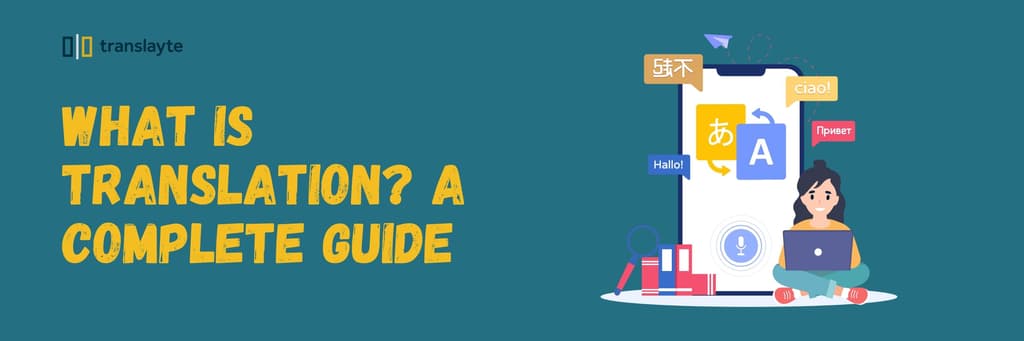
Translation is the process of converting written or spoken content from one language into another, while preserving its original meaning, tone, and context. It enables communication between people who speak different languages, making ideas, information, and stories accessible across cultures and borders.
The word “translation” comes from the Latin “translatio”, meaning “to carry across”, and that’s exactly what translation does. It carries meaning, not just words, from one language (called the source language) to another (the target language).
A good translation captures the intent, tone, and style of the original content, allowing the new audience to experience it in the same way as the original. This may involve rephrasing sentences, adjusting idioms, or even modifying cultural references to ensure the message still resonates.
Why translations are important
Global communication: From a speech at the United Nations or a WhatsApp message between friends in different countries, translation makes global conversations possible.
Access to knowledge and education: Many of the world’s books, academic papers, scientific research, and historical texts exist in just one language. Translation enables it to spread, helping students, professionals, and researchers learn from work produced worldwide.
Business and trade: Companies use translation to reach international markets, localise their products, and connect with customers around the world.
Preservation of culture and literature: Without translation, we wouldn’t be able to enjoy Korean dramas or Japanese anime. It allows stories to travel and cultures to be shared.
Support for migration and travel: Immigrants and travellers rely on translation for visas, official documents, health services, and more. It helps people feel safe and informed when living abroad or moving.
Types of translation
Below are the most common types of translation used today:
1. Business translation
This includes internal and external communication, reports, presentations, proposals, and company policies. Business translation is important for multinational teams and global partnerships where clarity and tone are key.
Recommended Reading
The Importance of Accurate Translation in Business
2. Document translation
A broad category covering the translation of general documents such as resumes, letters, CVs, certificates, application forms, and more. It’s one of the most frequently requested translation types for everyday use.
3. Legal translation
This involves translating legal documents, such as contracts, agreements, court rulings, terms and conditions, privacy policies, and legal correspondence. It requires a strong understanding of legal terminology and the legal systems of both source and target countries.
4. Literary translation
The translation of books, poetry, short stories, and plays. Literary translators must preserve the author’s voice, tone, emotion, and stylistic choices while adapting the text for a different cultural audience.
5. Technical translation
It is focused on instruction manuals, engineering specs, safety data sheets, user guides, and machinery documentation. Technical translators must be detail-oriented and familiar with industry-specific terms.
6. Financial translation
Includes the translation of financial reports, balance sheets, investment portfolios, tax documents, insurance contracts, and banking materials. Accuracy and confidentiality are vital in this field.
7. Marketing translation
Goes beyond word-for-word conversion. It adapts brand messaging, slogans, ads, and content to resonate with local audiences while maintaining the core brand identity, often through transcreation.
8. Medical translation
Used for translating medical records, prescriptions, clinical trial documentation, patient consent forms, and pharmaceutical information. Accuracy is important to ensure patient safety and regulatory compliance.
9. Website translation
The process of translating an entire website's content, from landing pages to blog posts and metadata. It is often paired with localisation to make sure cultural references, design, and calls-to-action work in every target market.
10. Life science translation
This involves translating documents for the pharmaceutical, biotechnology, medical device, and healthcare industries, such as clinical trial documents, regulatory submissions, patient information leaflets, medical research, and technical documentation. The translator must have specialist knowledge of scientific and medical terminology, regulatory requirements, and life sciences industry conventions.
11. NGO translation
This involves translating documents used by non-governmental organisations (NGOs), such as project proposals, grant applications, donor reports, training materials, policy documents, websites, and communications. It requires an understanding of development, humanitarian, social impact, and international development terminology.
12. Software translation
This is used when you need to translate ing software-related content, such as user interfaces, technical documentation, help guides, error messages, software manuals, and support content. It requires an understanding of software terminology, technical language, and how translated text needs to fit within digital interfaces without affecting functionality or usability.
13. App translation
This involves translating the content and user interface of mobile and web applications. What’s translated includes menus, buttons, notifications, onboarding screens, in-app messages, and help content. Translation is more in-depth because text must fit within the app's interface and adapt to the language, culture, and expectations of target users.
Recommended Reading
Can Translating Your Website Boost Your SEO?
Translation methods
There are two main translation methods: human translation and machine translation. Each method has its strengths and ideal use cases. Let’s look at both in detail.
1. Human translation
Skilled professionals fluent in both the source and target languages perform human translation. More importantly, they understand the cultural, emotional, and contextual layers behind the words.
Human translation is the right choice when nuance, tone, style, or cultural sensitivity plays a key role in communication. A professional translator can identify and adapt sarcasm, idioms, wordplay, and culturally specific references that could confuse or mislead readers if translated literally. It is particularly valuable for legal, medical, marketing, financial, technical, and other specialised content where accuracy and context matter.
Although human translation can take more time and cost more than machine translation, it provides the linguistic judgement and quality control needed when getting the meaning right matters. Translayte provides professional human translation services, matching documents with experienced translators based on the language pair, subject matter, and project requirements.
2. Machine translation
Machine translation (MT) is the automated translation of text by software without direct human input. Popular tools like Google Translate, DeepL, and Microsoft Translator use algorithms to scan and convert languages in seconds.
Modern MT systems are trained on massive multilingual databases and are increasingly accurate for general-purpose content. However, they often struggle with idiomatic language, specialised vocabulary, and cultural nuance.
To solve this, many professionals use machine translation combined with human editing (also known as MTPE – Machine Translation Post-Editing) to balance speed and quality.
Machine translation works best when the goal is speed, not perfection. It’s commonly used for informal communication, internal business documents, or when you need a rough idea of what something means.
Recommended Reading
Advancements in Machine Translation That Your Company Will Benefit From
Translation techniques
Professional translators use a range of techniques to convey meaning, tone, and context across languages. These techniques can be grouped by purpose: staying close to the original, adapting content culturally, or improving flow and clarity.
1. Direct translation techniques
These methods stick closely to the original text's structure and wording. They're useful when the source and target languages share similar grammar and sentence structure.
Literal translation
A word-for-word conversion that preserves sentence structure.
Borrowing
Using the original word in the translation, often for names, brands, or untranslatable concepts.
Calque (Loan translation)
A literal, word-for-word translation of a phrase that creates a new expression in the target language.
2. Structural and semantic adjustment techniques
These techniques help ensure that grammar, tone, and meaning are preserved even when the target language requires structural changes.
Transposition
Changing the grammatical category (e.g. noun to verb) to make the translation sound natural.
Modulation
This involves altering the viewpoint or phrasing while keeping the original meaning.
Reduction and Expansion
Reduction removes unnecessary words to improve flow, while expansion adds words for clarity where needed.
3. Cultural adaptation techniques
These techniques localise the content by replacing or reshaping cultural references to better fit the target audience.
Adaptation (Cultural substitution)
This means replacing cultural elements with equivalents more familiar to the target audience.
Equivalence
Using an entirely different expression that achieves the same meaning or emotional impact.
Recommended Reading
How AI Supports Translations in Business
Transcription vs Translation vs Interpretation
Transcription, translation, and interpretation are important language services used to make spoken or written content accessible across different formats and languages. Although they are often used together, they serve different functions.
What is transcription?
Transcription is the process of converting spoken words into written text. This involves listening to an audio or video recording and typing out everything that’s said. Transcriptions can be verbatim (including filler words and pauses) or edited for clarity and readability. It’s commonly used in interviews, podcasts, lectures, meetings, and legal proceedings.
What is translation?
Translation is the process of converting written text from one language into another. In transcription and translation services, this often means taking transcribed text (in the original language) and translating it into a new language while preserving its tone, meaning, and intent.
What is interpretation?
Interpretation refers to the conversion of spoken words in real time. Interpreters listen to someone speaking in one language and immediately convey the message in another. This can happen face-to-face, over the phone, or through video conferencing.
Difference between transcription, translation, and interpretation
Transcription converts the same language from one form to another, spoken to written (e.g., English audio to English text).
Translation works across two languages, written to written (e.g., English text to French text).
Interpretation is used when you need to communicate in real-time in multilingual settings such as court hearings.
Tools and technologies in translation
Translators rely on a mix of traditional skills and modern tools to improve speed and accuracy. Here are some of the most widely used tools and technologies:
1. Computer-assisted translation (CAT) tools
CAT tools help human translators work more efficiently by breaking content into manageable segments and storing previous translations for reuse. They are software programs that help translators maintain translation quality by automating repetitive tasks. Most CAT tools offer features that support consistency, productivity, and quality assurance.
A translation memory is a database that stores previously translated text segments (like phrases or sentences). When the same or similar text appears again, the TM suggests the previous translation, saving time and ensuring consistency. For example, if the “Terms and Conditions” page has already been translated once, it doesn’t need to be retranslated in future documents.
These tools help maintain accuracy in specialised fields (like legal, medical, or technical translation) by managing approved terms and definitions in translated text. Also known as termbases or termbase systems, they are often used by organisations working with multiple languages to ensure that all translations adhere to a specific brand style.
Concordance search allows translators to search a translation memory for specific words or phrases and see how they were translated in previous projects. This is useful when a translator needs to check how a particular term was previously translated and maintain consistency across different documents or projects.
Collaboration features allow translators, editors, proofreaders, and project managers to work on the same translation project and share resources such as translation memories and terminology databases. This makes it easier for teams to maintain consistency and manage large or multilingual translation projects.
CAT tools support a wide range of file formats, allowing translators to work directly with documents without manually copying and pasting text. Depending on the tool, supported formats can include Word documents, Excel spreadsheets, PowerPoint presentations, HTML, XML, and other structured or localisation file formats. This helps preserve the original formatting and reduces the risk of translation errors.
2. Translation management systems (TMS)
A translation management system (TMS) is a software solution that helps businesses streamline the entire translation process from project set-up and task assignment to final delivery and review. These combine CAT tool features with workflow management, task automation, progress tracking, and reporting.
TMS platforms provide tools to plan and manage translation projects from start to finish. Project managers can assign tasks, set deadlines, monitor progress, manage priorities, and coordinate translators, editors, and reviewers from a central platform. This is particularly useful for large or ongoing multilingual projects.
CMS integration connects a TMS with a website or other content management system (CMS), allowing content to be sent for translation and returned to the CMS without manual copy-and-paste. This can make it easier for businesses to manage multilingual websites and keep translated content up to date.
Vendor management features help businesses manage external translators, language service providers, and other translation vendors from a central system. These tools can support vendor selection, assignment, availability, performance tracking, rates, and invoicing, making it easier to manage large networks of language professionals.
3. Quality assurance (QA) tools
QA tools automatically scan translations for common errors like inconsistent terms, missing numbers, spacing issues, or punctuation mistakes. They help catch small issues before the final delivery.

Translation quality assessment
Translation quality assessment (TQA) is the process of reviewing a translated text to determine whether it accurately communicates the meaning of the source text and meets the required linguistic, technical, and formatting standards. It can involve checks by translators, editors, proofreaders, or automated quality assurance tools.
Why is translation quality assessment important?
A translation can be grammatically correct but still fail to communicate the intended meaning. Quality assessment helps identify errors such as mistranslations, omissions, inconsistent terminology, incorrect numbers or names, grammatical mistakes, and formatting problems before you deliver or publish the translated content.
The level of quality assessment required can also depend on the type of content. A minor error in marketing copy may affect how a brand is perceived, while an error in a legal, medical, financial, or immigration document could have more serious consequences.
How does Translayte ensure translations are properly done?
Translayte uses a combination of professional translators, review processes, and technology-assisted quality checks to maintain translation quality. Translayte matches projects with translators based on factors such as language pair, subject matter, and project requirements. The translations also undergo additional review or proofreading to identify and correct errors before delivery.
Common aspects of a translation quality assessment process
Accuracy: The reviewer checks whether the translation correctly communicates the meaning of the source text without adding, omitting, or changing important information.
Fluency and grammar: The reviewer checks the translated text for grammar, spelling, punctuation, sentence structure, and natural language usage in the target language.
Terminology consistency: The reviewer checks specialised terms, names, product names, and approved terminology to ensure they are translated consistently throughout the document.
Completeness: The reviewer checks that all relevant content has been translated and that no words, sentences, sections, numbers, or other important information have been accidentally omitted.
Style and tone: The reviewer assesses the translation to ensure its tone and writing style suit the intended audience and purpose. For example, legal, academic, marketing, and technical content may each require a different style.
Cultural and contextual accuracy: The reviewer checks whether idioms, references, measurements, dates, and other culturally specific elements have been appropriately adapted for the target audience rather than translated literally.
Formatting and layout: The reviewer checks the final document to ensure formatting, headings, tables, numbers, images, and other visual elements are correctly presented and that the translation has not affected the document's usability.
Quality assurance checks: Translation technology and CAT tools can also perform automated checks for issues such as inconsistent terminology, missing translations, numbers, punctuation, tags, and formatting. These automated checks complement, rather than replace, human linguistic review.
Becoming a translator
Translators play a vital role in the translation process. They are language experts who convey meaning from one language to another while considering cultural nuances.
Primarily, a translator's job is to provide accurate translation that reads as though it were originally written in the target language. However, becoming one isn’t as straightforward as the job sounds.
Here’s an overview of what you’ll need to become a professional translator.
Become fluent in at least two languages
To succeed as a translator, you must have native-level proficiency in at least one language (usually your target language) and advanced fluency in another (usually your source language).
Your target language is the language you translate into; ideally, this is your mother tongue. Your source language is the language you will translate from. Most translators prefer to focus on one or two language pairs to avoid confusion (e.g, French to English, German to English)
Choose a specialisation
To stand out as a translator, you need to have a specialisation, i.e., an industry you are well-versed in. This ensures you are familiar with the tone and terminology used in that field and can deliver the type of translation required.
You can choose from legal, medical, marketing, financial, or even technical. It’s totally up to you! If you’re unsure which area to start with, think about your background and/or experience and connect the dots to the industry where you feel the most comfortable, or maybe pays the most, whichever comes first for you.
Build strong writing skills in your target language
Translation is as much about writing as it is about language knowledge. You need to write clearly and accurately, match the original tone, and adapt grammar and sentence structure for natural flow when translating. So, while making efforts to be fluent in your target language, make equal effort to write accurately.
Get certified (If required or recommended)
Depending on your country or career goals, getting certified can help you prove your skills. While it's not mandatory everywhere, certification adds credibility and can help you get high-paying jobs. Some common certifications include;
American Translators Association (ATA) – USA
Chartered Institute of Linguists (CIOL) – UK
National Accreditation Authority for Translators and Interpreters (NAATI) – Australia
Institute of Translation and Interpreting (ITI) – UK
Gain translation experience
Start small and build a portfolio. You can gain experience by volunteering with non-profits or open-source projects, or by translating blog posts or articles for practice. As you grow, you can then take on freelance jobs through platforms like ProZ.com, TranslatorsCafe, Upwork, or Fiverr, or intern at translation agencies or with international companies.
Earn a relevant degree
While not always required, a degree can give you an edge. You might pursue a degree in languages, linguistics, or translation studies or a specialised degree in your field of interest (e.g. law, medicine, engineering) if you want to translate technical content. Some universities offer dedicated translation and interpretation programmes that cover both theory and real-world practice.