


Certified Translations Accepted by IRCC and Canadian Authorities
A certified translation in Canada is a translation signed and sealed by a translator who is a member of a provincial or territorial translators association.
If a certified translator in Canada doesn't produce your translation or you don't have a sworn affidavit, it won’t meet IRCC’s requirements. This can delay your PR or citizenship application, cause you to miss an Express Entry deadline, and cost you another translation.
Translayte's certified translations are accepted by IRCC, WES, ServiceOntario, and other Canadian authorities. Our translators are members of provincial associations such as ATIO, ATIS, STIBC, and more, which are under the Canadian Translators, Terminologists and Interpreters Council (CTTIC), and of OTTIAQ, Quebec’s separate professional order of translators.
Translayte works with hundreds of certified translators in Canada who can translate from 150+ languages into French or English and are accepted by Canadian authorities.
Applying From Outside Canada?
A translator does not need to be in Canada to produce translations accepted by IRCC. If the translation is done outside Canada, IRCC requires that the translator is accredited (officially recognised or authorised) in the country where the translation is completed.
Wherever it is done, the translation must include the translator’s certification statement, signature, seal, or stamp, showing their membership number and date. You must also translate any stamps or seals on your original documents that are not in English or French.
Which Certified Translation Do You Need?
Below are the different types of official document translation, and which ones you will require in Canada;
Certified translation: This is commonly required in Canada by IRCC, WES, Provincial Licensing bodies, and courts. It is signed and sealed by a provincially certified translator.
Translation with affidavit: When a certified translator can’t do the translation, IRCC accepts a non-certified translator if an affidavit is sworn before a commissioner of oaths or notary.
Notarized translation: A foreign embassy or authority asks for a notary’s seal on the translation.
Apostille/Authentication: Canada is a member of the Hague Apostille Convention. If a Canadian document will be used abroad, it must bear an apostille stamp issued by Global Affairs Canada. Documents issued in Alberta, British Columbia, Ontario, Quebec, or Saskatchewan must bear an apostille stamp issued by that province’s competent authority.
Translation With an Affidavit
The translator must swear the affidavit before a person authorised to administer oaths. In Canada, this is a notary public, commissioner of oaths, or commissioner for taking affidavits. Outside Canada, it can be a notary public or an equivalent authority proficient in English or French.
The affidavit must swear to the translation's accuracy and the translator's language proficiency. You, any family member, or anyone who is not a lawyer, notary, or translator cannot swear an affidavit. Submit it with the translation and the original document, or a certified copy.
What You Get With Every Certified Translation
A complete word-for-word translation that mirrors the layout and formatting of your original document.
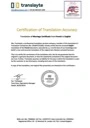
A certification statement confirming that the translation is true and accurate
The translator’s full name, signature, and contact details
The translator’s official seal with provincial membership number
Date of translation
A certified PDF by email, plus optional hard-copy delivery by Canada Post or courier.
Who Accepts Our Certified Translations in Canada
Translayte’s certified translations meet the requirements of the following Canadian bodies.
IRCC: Typically required for Express Entry, permanent residence, citizenship, study and work permits, sponsorship, and PR cards.
Passport Program (IRCC): You’ll need one for Canadian passport applications that include foreign documents, such as a foreign birth or marriage certificate.
Quebec MIFI: Quebec immigration programs, including the CSQ, PEQ, and Quebec Skilled Worker Program. These files are often submitted with French translations.
WES, ICAS, ICES, IQAS, and CES: Educational Credential Assessments for Express Entry and for employers, based on translated diplomas and transcripts.
Universities and Colleges: Admissions transcripts and degree recognition for international students.
ServiceOntario, ServiceBC and Provincial Vital Statistics Offices: For name changes, marriage licenses, and birth and death registration.
DriveTest (Ontario), ICBC (BC), Alberta Registries, and SAAQ (Quebec): For exchanging a foreign driver's license for a provincial license.
Provincial and Federal Courts: Divorce, custody, family law, and civil evidence.
Canada Revenue Agency (CRA): Foreign income, tax, and benefits documents
Employment and Social Development Canada (ESDC): Social Insurance Number, Employment Insurance, Canada Pension Plan, and Old Age Security files that require foreign documents.
Provincial Ministries of Health: Health card registration and foreign medical records
Canadian Human Rights Commission: For evidence in a foreign language supporting a complaint.
Professional Regulators: Licensing for regulated professions, for example, nursing colleges, medical councils, and engineering regulators.
Banks and Mortgage Lenders: Proof of funds, ID, and mortgage checks.
Canada Mortgage and Housing Corporation (CMHC): Foreign income and identity documents for CMHC-insured mortgages arranged through your lender.
Translations for Educational Credential Assessment (ECA)
If you studied outside Canada and are applying through Express Entry, you will need an Educational Credential Assessment from an IRCC-designated organisation.
Evaluators such as WES and IQAS review your original documents alongside their translation. So if your translation is inaccurate or incomplete, it can delay your assessment. We’ve explained what each evaluator expects;
IQAS: Credential evaluation with IQAS, Alberta’s IRCC-designated assessment service
ICES: How to apply for an ICES credential evaluation, British Columbia’s IRCC-designated assessment service
Certified Translation Across Canada
Every province and territory has its own translators’ association and its own local authorities. Seven of these associations are members of CTTIC, while Quebec’s OTTIAQ is a separate professional body. Here is who to look for, and what applies where you live.
Ontario
In Ontario, only translators certified by ATIO can produce legally valid certified translations for use with ServiceOntario, DriveTest/MTO, and Ontario Courts. This is required when submitting certified translations for use in Toronto, Ottawa, Mississauga, Hamilton, and Brampton.
Quebec
In Quebec, translators must be certified by OTTIAQ (Ordre des traducteurs, terminologues et interprètes agréés du Québec) to produce certified translations valid for use with official authorities such as MIFI, SAAQ, and the Directeur de l’état civil.
OTTIAQ is Quebec’s professional body for translators. It withdrew from CTTIC in June 2012, which is why it is listed separately from the other provincial associations.
Many Quebec authorities want documents translated into French, not English. Quebec also runs its own immigration system through MIFI, including the Quebec Silled Worker Program and the PEQ.
Translayte provides French translations by OTTIAQ-accredited translators, valid for use in Quebec. Our certified translations in Quebec are also used in Montréal, Quebec City, Laval, and Gatineau.
British Columbia
Translators certified by STIBC can produce certified translations for use with Service BC, ICBC, and BC Vital Statistics. We provide certified translation services in Vancouver, Surrey, Victoria, and Burnaby.
Alberta
In Alberta, translators must be certified by ATIA to produce certified translations submitted to official authorities such as Alberta Registries and IQAS. Our certified translation services also support Calgary, Edmonton, and Red Deer.
Manitoba
Translators must be certified by the Association of Translators and Interpreters of Manitoba (ATIM) to produce legally valid translations for use in Manitoba. We also serve clients in Winnipeg and Brandon.
Saskatchewan
Translators certified by ATIS can certify translations for use with SGI and eHealth Saskatchewan. We also serve clients in Saskatoon and Regina.
Nova Scotia
Translators certified by ATINS can certify translations for use with Access Nova Scotia and NS Vital Statistics. We also serve clients in Halifax.
New Brunswick
Only translators certified by CTINB can certify translations for use in New Brunswick with official authorities such as Service New Brunswick. Our certified translation services are also used in Moncton, Saint John, and Fredericton.
How Much Does a Certified Translation Cost
Based on 2,680 Canadian certified translation orders, the median cost of a certified translation in Canada is CA$89.00 for 2 pages.
The final cost depends on your document's length and complexity, the language pair, and whether you need urgent turnaround, notarisation, or an apostille. You’ll see the full price breakdown at checkout. No hidden fees or surprise charges.
How Fast Can You Get It?
Translayte offers the fastest turnaround time for certified translation, with delivery in 12-24 hours. If you need it faster, Translayte offers rush delivery options in 12 hours or less. Turnaround time may vary depending on the document’s length and complexity, language pair, and translator availability. We also offer physical delivery to your location via Canada Post Xpresspost.
Documents That Require Certified Translation in Canada
Our Canadian document translation services cover a wide range of documents, including but not limited to:
Birth certificates
Marriage certificates
Diplomas and transcripts
Medical records
Police clearance certificates
Certified Translation in 150+ Languages
Translayte produces certified translations into English, French, and 150+ languages. In the last 12 months, Spanish to English was our most requested language pair for Canadian immigration, followed by French to English. We also regularly translate German, Portuguese, and Italian documents for Canadian applications.
Every translator is a native-speaking professional, thoroughly vetted, and regularly reviewed to maintain the highest quality standards across all projects. Visit our languages page for the full list of languages we translate.
Why 150,000+ Customers Choose Translayte
4.5-star rating on Trustpilot from 10,000 reviews
Translators certified by ATIO / OTTIAQ / STIBC
ATC-accredited professional translators
Over 15,000 certified translations delivered for use in Canada.
We translate into English and French from the most commonly translated languages for Canadian immigration, including Spanish (Latin America), English, Spanish (Mexico), German, Portuguese, and Italian.
24/7 support by phone, email, and WhatsApp